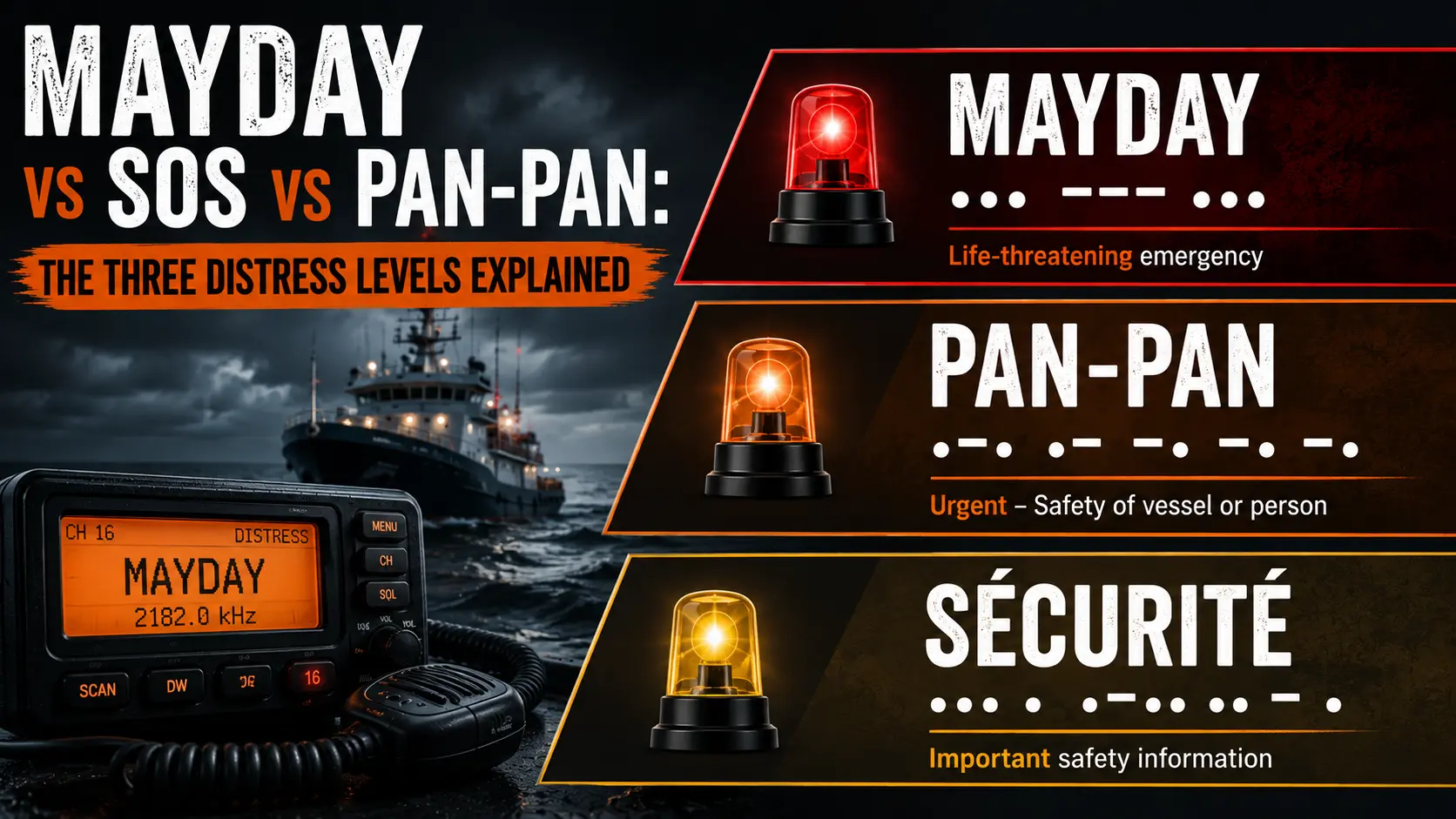
In the movies, Mayday, SOS and Pan-Pan get used interchangeably, usually by someone shouting into a handset. On a real radio they are three different instructions to everyone listening, and picking the wrong one either launches a helicopter you did not need or fails to get you the response you did.
Two of them mean exactly the same thing. One of them has been off the airwaves since 1999 but is still a legally recognized distress signal today. And there is a fourth level almost nobody outside the maritime world has heard of.
Quick Answer: Mayday vs SOS vs Pan-Pan
Mayday is the spoken distress call for grave and imminent danger, the highest priority, said three times. SOS (...---...) is the Morse form of that same distress level, no longer sent on radio but still valid as a visual or sound signal. Pan-Pan is one level down: the urgency call for a serious situation that is not an immediate threat to life. A fourth level, Sécurité, carries navigation and weather warnings. Priority runs distress, urgency, safety, then routine traffic.
The Three Levels of Radio Emergency
International radio rules define three grades of emergency traffic. Each has a spoken form for voice radio and an older Morse form from the radiotelegraph era, and each one is sent three times so a partially heard transmission is still recognizable. Every level takes absolute priority over everything below it.
| Level | Voice signal | Morse signal | What it means | Priority |
|---|---|---|---|---|
| Distress | Mayday | ...---... (SOS) |
Grave and imminent danger to a vessel, aircraft or person; immediate assistance required | Highest — silences all other traffic |
| Urgency | Pan-Pan | -..- -..- -..- (XXX) |
Very urgent message about the safety of a vessel, aircraft or person, with no immediate danger to life | Above everything except distress |
| Safety | Sécurité | - - - (TTT) |
Navigational hazards, meteorological warnings | Above routine traffic |
The wording is not informal convention. In the United States these three signals are defined in FCC rules, Title 47 CFR Part 80, Subpart G. The urgency signal, for example, consists of three repetitions of the group XXX in radiotelegraphy, or three spoken repetitions of PAN PAN in radiotelephony, and it may only be sent on the authority of the master or the person responsible for the station.
Mayday: The Distress Call
Mayday is reserved for grave and imminent danger where immediate assistance is required: a vessel sinking, fire on board, a person overboard in bad conditions, an aircraft losing power over water, a crew abandoning ship. It is spoken three times so that a listener who catches only the tail of the transmission still knows what they are hearing.
At sea, a Mayday goes out on VHF channel 16 (156.800 MHz) or 2182 kHz on MF. In the air it goes on 121.5 MHz, the civil VHF guard frequency. On a modern boat the spoken call is paired with the red distress button on a DSC radio, which sends an automatic digital alert and your GPS position on channel 70 before you ever open your mouth.
The Standard Mayday Call Format
Rescue coordinators need six specific things. Giving them in order is the difference between a fast response and five minutes of clarifying questions:
- “Mayday, Mayday, Mayday”
- “This is [vessel name]”, said three times, plus call sign or MMSI
- Position — latitude and longitude, or a bearing and distance from a known landmark
- Nature of distress — sinking, fire, flooding, medical
- Assistance required
- Number of people on board, and anything else useful: liferaft, EPIRB, injuries
Then say “Over” and release the transmit key. A Mayday can also be sent on behalf of another vessel that cannot call for itself; that is a Mayday Relay, and it begins with “Mayday Relay” spoken three times so no one thinks the relaying station is the one sinking.
Where the Word Mayday Came From
Mayday was proposed in 1923 by Frederick Stanley Mockford, senior radio officer at Croydon Airport in London, who needed a distress word that would be understood by both British and French operators on the busy Croydon–Le Bourget route. It was adopted internationally at the 1927 Washington radiotelegraph convention.
The French root is usually given as venez m’aider, “come and help me.” FCC rule text itself is blunter and simply says Mayday is pronounced as the French expression m’aider. Both point the same direction. What matters is that it has nothing to do with the first of May, and that it was chosen for its sound, not its meaning: two clear syllables that survive a noisy channel.
SOS: The Same Level, Sent in Morse
SOS is not a weaker or older cousin of Mayday. It is the same distress level in a different medium. Mayday is what you say; SOS is what you key.
It was adopted at the 1906 Berlin international radiotelegraph convention and came into force in 1908, chosen for the rhythm rather than the letters. It is not an acronym, so “Save Our Souls” and “Save Our Ship” are later inventions rather than the origin. The full story is on the SOS in Morse code page.
Why SOS Is Written With a Line Over It
This is the detail almost every article gets wrong. SOS is a prosign, not three letters. It is sent as one unbroken run of nine elements with no letter gaps, which is why it is properly written S̅O̅S̅ with an overbar. Written as three separate letters with normal gaps it decodes as S, O, S; run together it is a single symbol that exists nowhere else in the code and cannot be mistaken for anything.
That has a measurable consequence:
| Form | Pattern | Time units | At 20 WPM | At 5 WPM |
|---|---|---|---|---|
| SOS as a prosign (correct) | ...---... |
23 | 1.38 s | 5.52 s |
| S O S as three letters | ... --- ... |
27 | 1.62 s | 6.48 s |
Figures use the standard PARIS model, where one time unit equals 1200 ÷ WPM milliseconds. The prosign saves four units because the two 3-unit letter gaps are replaced by 1-unit element gaps. You can hear the difference by typing SOS into the Morse code translator and dropping the speed to 5 WPM.
Is SOS Still Official?
Yes, but not on the radio. When the Global Maritime Distress and Safety System became fully mandatory on 1 February 1999, the manual Morse watch was replaced by DSC alerts, satellite EPIRBs and voice. No ship anywhere is sitting with headphones on waiting for a Morse SOS.
What survived is the visual and audible version. The international collision regulations, COLREGS Annex IV, list the recognized distress signals, and among them is the Morse group ...---... made by any signaling method. That is why flashing SOS from a lifeboat is still a formally recognized distress signal in 2026, while keying it on a radio is not.
Pan-Pan: The Urgency Call
Pan-Pan sits one level below Mayday. It covers situations that are serious and may deteriorate but do not yet threaten life: a failed engine in open water with nobody hurt, steering failure in calm conditions, a fuel state that is becoming a problem, a passenger who needs medical advice that is not life-threatening.
The word comes from the French panne, a breakdown, and FCC rules specify that each word is pronounced as that French word — closer to “pahn pahn” than “pan pan.” Like Mayday it is spoken three times.
Two things people underestimate about Pan-Pan. First, it still outranks every other transmission on the channel except an actual distress call, so it is not a polite way of not making a fuss. Second, mobile stations that hear an urgency signal are expected to keep listening for at least three minutes in case the message follows. A Pan-Pan can be upgraded to a Mayday at any point, and if you are unsure which applies, the seamanlike answer is that it is easier to downgrade a Mayday than to explain why you waited.
Sécurité: The Level Almost Nobody Knows
The lowest of the emergency levels is Sécurité, pronounced “say-cure-ee-tay,” from the French for safety. It carries navigational and meteorological warnings rather than emergencies: a container adrift in a shipping lane, a light out of service, a gale warning, a naval exercise area going hot. It is normally broadcast by a coast station or coastguard rather than by a vessel in trouble, which is why recreational boaters hear it constantly and never think of it as an emergency signal at all. Its Morse form is TTT.
What Happens After a Mayday: Seelonce, Prudonce, Feenee
This is the part dramatizations always skip, and it is the part that shows the system is a protocol rather than a shout for help. Once a distress call is in progress, the channel is cleared and controlled with four procedure words, all of them phonetic renderings of French:
- Seelonce Mayday — imposed by the station in distress or the station controlling distress traffic. All other transmissions stop. The radiotelegraph equivalent was the abbreviation QRT followed by SOS.
- Seelonce Distress — the same instruction, but issued by any nearby station when it is essential, followed by its own identification.
- Prudonce — from prudence. Distress work is continuing but restricted normal traffic may resume with care.
- Seelonce Feenee — from silence fini. Distress traffic has ended and the channel returns to normal working. Only the coordinating station may say it.
You can hear the pattern: every single one of these came into English from French, because the words had to be agreed between operators who did not share a language.
Why SOS Survived Off the Radio
Here is the puzzle. On a modern radio you send a Mayday, never an SOS. Yet SOS is still what a stranded hiker flashes at a search plane. Why did the obsolete one outlive the current one in everyday life?
Because ...---... is close to the simplest signal that can exist. Three short, three long, three short, one unbroken rhythm, symmetrical, with no start or end to get wrong and no way to garble it into something else. It can be produced by anything that switches on and off: a flashlight, a mirror catching sunlight, a whistle, a car horn, a pan lid struck against a rock, or the letters stamped into snow. It needs no equipment, no power, no shared language and no one tuned to a frequency.
Mayday only works if you have a working radio and somebody is listening. SOS works when you have a flashlight and a line of sight. The two signals quietly divided the job between them.
How to Signal SOS Without a Radio
- Flashlight or headlamp: three quick flashes, three long flashes, three quick flashes, then a pause of several seconds before repeating. Do not chase perfect Morse timing — the pause between repetitions is what makes it read as a signal instead of a person fiddling with a light. The Morse code light translator will flash the pattern for you at a set speed so you can learn the rhythm.
- Signal mirror: the highest-visibility daytime option by a wide margin, effective for miles. Aiming is the whole skill, and it is covered on how to send SOS with a mirror.
- Sound: a whistle carries far further than a voice and costs no energy. Same nine-blast rhythm.
- Ground markings: SOS laid out in rocks, logs or trampled snow, made as large and as high-contrast as you can manage. The ICAO ground-to-air code also recognizes a large V for “require assistance” and X for “require medical assistance,” both easier to make big than three letters.
Before SOS There Was CQD
SOS was not the first radio distress call. Marconi’s company issued CQD in 1904 — the general call “CQ” plus D for distress — and operators trained on Marconi equipment kept using it for years after SOS was adopted. That overlap is why the Titanic, call sign MGY, transmitted both on the night of 14–15 April 1912, and why the myth persists that Titanic sent “the first SOS.” It did not, but it was the moment that made SOS stick in public memory. The traffic that night is reconstructed message by message in Titanic Morse code messages explained.
Mayday and Pan-Pan in the Air
Aviation uses the same two words for the same two levels. What differs is that pilots have a second, silent channel: the transponder. Squawking 7700 declares a general emergency and paints the aircraft red on every controller’s screen within range, which is why a crew dealing with a serious failure will often set the transponder before they touch the radio. 7600 indicates lost communications and 7500 unlawful interference.
Pilots also use the phrase “declaring an emergency,” which controllers treat as equivalent to a Mayday. Pan-Pan is the correct call for the aviation equivalent of a serious-but-stable problem: a single failure with redundancy remaining, a passenger medical issue, or a fuel state that has become a concern but is not yet critical.
Which One Should You Use?
- Life is in grave and imminent danger, and you have a radio — Mayday, three times, plus the DSC distress button if fitted.
- Serious problem, no immediate danger to life — Pan-Pan, three times. Upgrade to Mayday the moment that changes.
- A hazard others need to know about — Sécurité.
- No radio at all — SOS by light, sound, mirror or ground marking, repeated with clear pauses.
- Never send a false distress call. In the US this is a Class D federal felony under 14 U.S.C. §88(c), carrying a civil penalty and liability for the full cost of the search; the Coast Guard cites maximum penalties of up to ten years in prison and a $250,000 criminal fine. Beyond the law, it pulls crews and aircraft away from someone who is actually drowning.
Five Things People Get Wrong
- “SOS stands for Save Our Souls.” It stands for nothing. The letters were chosen because the pattern is unmistakable.
- “SOS is weaker than Mayday.” Identical priority. Different medium.
- “Pan-Pan is for minor problems.” It outranks every transmission on the channel except an actual distress call.
- “SOS is three letters.” It is one prosign, sent with no letter gaps, written with an overbar.
- “There are three emergency levels.” There are three plus routine traffic, and most people have never heard of Sécurité.
Frequently Asked Questions
They mean the same thing and carry the same priority. Mayday is the spoken distress signal used on voice radio; SOS is the Morse pattern ...---.... Mayday is what you transmit on a modern radio, while SOS survives as a light, sound or written signal for situations where you have no radio.
Use Pan-Pan when the situation is urgent and concerns the safety of a vessel, aircraft or person but there is no immediate danger to life, such as a mechanical breakdown or a non-critical medical problem. Upgrade to Mayday the moment life becomes endangered.
Not on the radio. The Global Maritime Distress and Safety System replaced the Morse distress watch on 1 February 1999. SOS remains a formally recognized distress signal under COLREGS Annex IV when made by any signaling method, which is why flashing it with a light is still valid.
It comes from the French panne, meaning a breakdown or failure. It is the international urgency signal, spoken three times, indicating a very urgent message about the safety of a vessel, aircraft or person.
Sécurité, the safety signal, from the French for safety. It carries navigational hazards and weather warnings and is usually broadcast by coast stations. Its Morse equivalent is TTT.
From French. It was proposed in 1923 by Frederick Stanley Mockford, a radio officer at Croydon Airport in London, for traffic between London and Paris. FCC rules describe it as pronounced like the French m’aider, and it is usually traced to venez m’aider, “come and help me.”
Repetition protects against noise and partial reception. A listener who catches only the second or third repetition still recognizes the signal, and three repetitions distinguish a deliberate distress call from a garbled word.
Say “Mayday” three times, identify your vessel three times with call sign or MMSI, give your position, the nature of the distress, the assistance required and the number of people on board, then say “Over” and release the transmit key. On a DSC radio, press the distress button first.
It is the instruction that imposes radio silence during distress traffic, from the French silence. Only the station in distress, the station controlling distress traffic, or a nearby station where essential may impose it. “Seelonce Feenee” (silence fini) ends it.
No. “Save Our Souls” and “Save Our Ship” are backronyms invented after the fact. SOS was chosen in 1906 for the distinctiveness of the pattern, not for the letters.
...---... — three dits, three dahs, three dits, sent as one continuous prosign with no gaps between the letters. As a prosign it occupies 23 time units, about 1.4 seconds at 20 words per minute.
Yes. In the United States, knowingly communicating a false distress message to the Coast Guard is a Class D felony under 14 U.S.C. §88(c), with a civil penalty and liability for the entire cost of the search. Most countries treat it as a serious offense for the same reason: it diverts rescuers from real emergencies.
Mayday. Aviation distress calls go out by voice on 121.5 MHz, usually alongside squawking 7700 on the transponder. Pan-Pan is used for urgent but non-life-threatening situations.
How This Page Was Verified
The signal definitions, priority order and procedure words on this page were checked against FCC rules at 47 CFR §80.325, §80.327, §80.329 and §80.1125, and against the distress signals listed in COLREGS Annex IV. The penalties for false distress calls were checked against 14 U.S.C. §88(c). Morse timings were calculated from the standard 50-unit PARIS model, where one time unit equals 1200 ÷ WPM milliseconds, and verified against the Morse code translator on this site.
Last reviewed: September 2026.
Sources
- 47 CFR Part 80, Subpart G — Distress, Alarm, Urgency and Safety Procedures (FCC). Definitions of the distress, urgency and safety signals, the Seelonce procedure words, and the three-minute listening requirement after an urgency signal.
- COLREGS Annex IV — Distress Signals (IMO). Recognition of the Morse group
...---...made by any signaling method. - 14 U.S.C. §88(c) — penalties for communicating a false distress message to the Coast Guard.
- Aeronautical Information Manual, Chapter 6 (FAA). Mayday and Pan-Pan in aviation, and transponder emergency codes.
- International Radiotelegraph Convention, Washington, 25 November 1927. Adoption of the urgency and safety signals.
