Ask whether the military still uses Morse code and you get two wrong answers online. One says it vanished decades ago. The other says special forces still send secret, encrypted Morse over the radio. Neither is right. Morse does still have a real military job, but a narrow and specific one, and it has nothing to do with secrecy. Here is what militaries actually use it for today, and an important correction to a myth that even shows up on plenty of Morse code websites.
Quick answer: Yes, but only in one narrow role. Militaries dropped Morse as a radio mode decades ago. What survives is visual signaling, flashing a light in Morse between ships, kept by the US Navy, the Commonwealth navies, and NATO for moments when radio has to stay silent or could be jammed. And one correction worth making up front: Morse is not secret or encrypted. It is plaintext. Anyone who can see or hear it and knows the code can read it. Any security comes from how the signal is sent, not from Morse itself.
What the Military Stopped Using
For about a century, Morse over the radio, known as CW, was a backbone of military communication. It carried messages through both world wars and well into the Cold War, because it travelled far on very little power and got through when nothing else could. That era is over. Voice, satellite, and digital data links replaced Morse radio as faster, higher-capacity options. The long maritime watch on the 500 kHz distress frequency ended in the late 1990s, and the famous SOS signal, ...---..., was retired as the maritime distress standard in 1999 when the Global Maritime Distress and Safety System took over. As a routine radio mode, military Morse is gone. You can read more about where it survives at large on the is Morse code still used today page.
What the Military Still Uses: Flashing Light
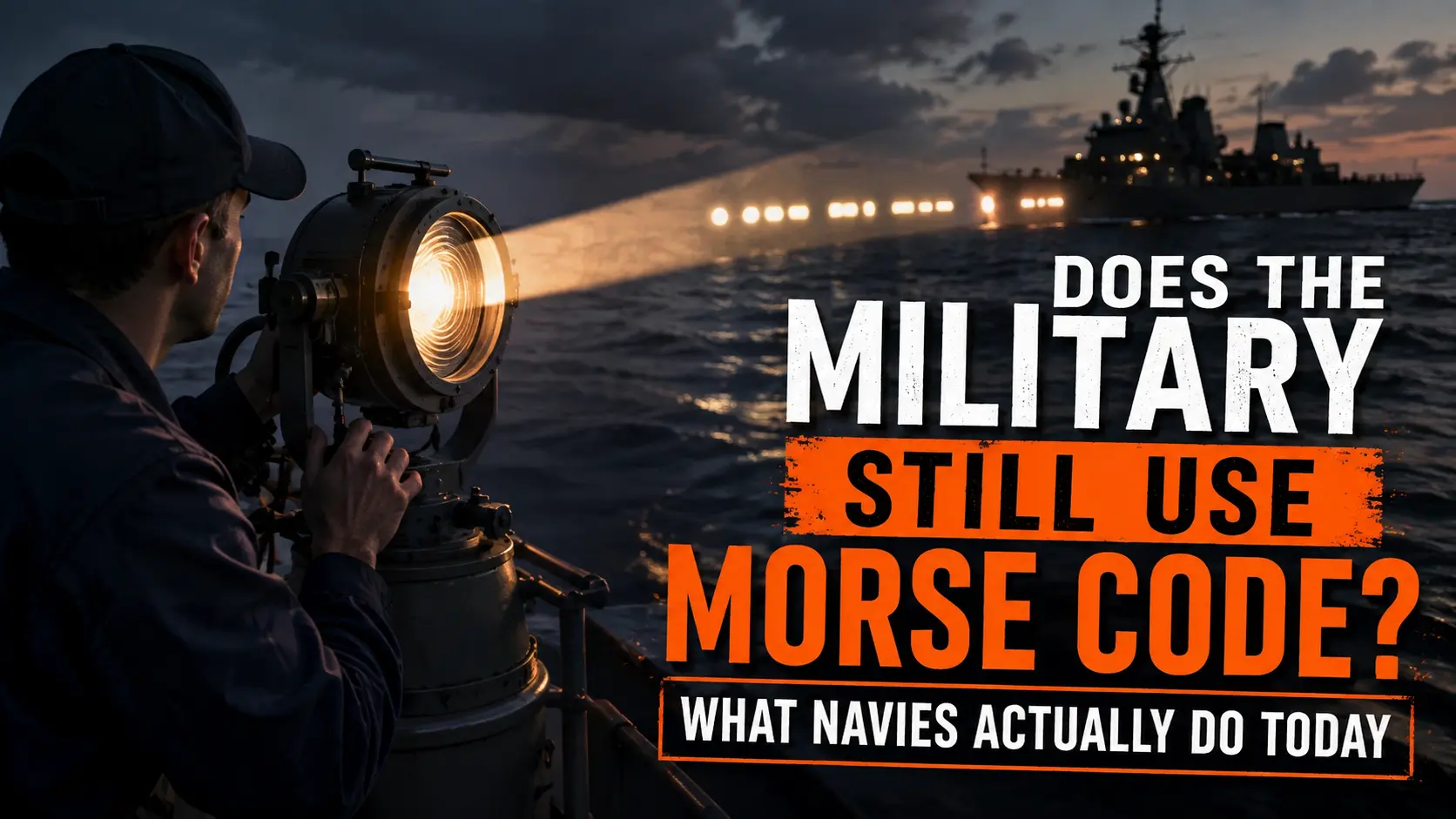
The part that lives on is visual. Navy ships carry signal lamps, often called Aldis lamps, mounted where the crew can aim them at another ship. An operator opens and closes a shutter to flash dots and dashes across the water. The idea goes back to the British Royal Navy in the 1860s, and it is still in service today.
The reason it survives is that it solves a problem radio cannot. A signal lamp throws a tight, directional beam that only reaches a ship in its line of sight, and it puts out no radio signal at all. That matters during emissions control, when a fleet goes silent so the enemy cannot detect or locate it by its transmissions. It also matters when jamming or electronic spoofing is likely, since a light beam cannot be jammed the way a radio channel can. At night, navies often use lamps in the infrared range, which are hard to see without the right equipment. The Commonwealth navies and NATO forces all keep this capability for exactly these situations.
Modern crews do not always have to read the flashes by eye. In 2017 the US Navy and the Office of Naval Research tested the Flashing Light to Text Converter, a system that clips onto an existing signal lamp, flashes typed text as Morse, and uses a camera on the receiving ship to decode the light back into plain words automatically. The sailor never has to know Morse by hand, but the signal on the water is still Morse. Interest has not faded either. At a 2024 NATO security conference, senior officers discussed using blinker-light Morse to help protect tankers and supply ships in a possible Pacific conflict, precisely because it is so hard to detect and jam.
Morse Beyond the Navy
A few other corners of defense and aviation still touch Morse. The cryptologic and information warfare communities train some personnel to copy Morse by ear, not to send their own, but to intercept and understand allies and adversaries who still use it. In aviation, many radio navigation beacons still identify themselves by broadcasting their call letters in Morse, so a pilot can confirm the station. And it lingers as a low-tech fallback skill in some survival and special operations training, where a light, a mirror, or a tapped-out rhythm can carry a message when nothing else is available.
The Myth: Morse Code Is Not Secret or Encrypted
This is the part that many websites, including some Morse code sites, get wrong. Morse code is often described as a secure or encrypted way to send messages. It is not. Morse is simply a public, standardized way of writing letters and numbers as dots and dashes. It is an encoding, not a cipher. There is no secret key. Every military, and every ham radio operator, knows the same code, so anyone who can see or hear a Morse signal can read it straight off.
So why does military Morse sometimes get called secure? Because the security is in the delivery, not in the code:
- A directional signal lamp only reaches whoever sits in its narrow line of sight, so a ship off to the side sees nothing.
- Staying off the radio means there is no transmission for an enemy to detect or trace back to your position.
- Infrared lamps at night are hard to spot without special gear.
- When the message itself must be secret, it is encrypted first with a real cipher, and only then sent in Morse. The secrecy lives in the cipher, not in the dots and dashes.
The takeaway is simple. If you can see or hear a Morse signal and you know the code, you can read it. Treat any Morse you send, whether it is a tattoo, a bracelet, or a note to a friend, as plain public writing, never as a hidden or protected message. If you want to see how readable it is, run any text through the Morse code translator and compare it against the Morse code alphabet.
So, Does the Military Still Use Morse Code?
Yes, in one specific way. Not as a radio mode, which is long gone, but as visual flashing-light signaling between ships when radio has to stay silent or could be jammed, kept alive by the US Navy, the Commonwealth navies, and NATO. And never as a secret code, because Morse has never been secret. For the wider history of how the military relied on it in the world wars, see the history of Morse code, and for its most famous message, the SOS signal.
Frequently Asked Questions
Yes, for visual flashing-light signaling between ships when radio must stay silent or could be jammed. It is no longer a routine radio mode. Some cryptologic sailors also learn to copy Morse in order to intercept others who use it.
No. Morse is plaintext, a public encoding of letters and numbers. Anyone who knows it can read it. Any security in military use comes from the delivery method, such as a directional light or radio silence, or from encrypting the message before it is sent, not from Morse itself.
A directional light beam only reaches a ship in its line of sight and gives off no radio signal to be detected, located, or jammed. That is valuable during radio silence and in situations where an enemy might interfere with radio.
Yes. In certain situations NATO still sends messages in Morse using light flashes and other visual signals, because they are difficult to detect electronically.
Mostly. It is no longer taught to all personnel as it once was, but specialized communities, such as US Navy cryptologic technicians, still learn it for intercept work.
Sources
- NATO phonetic alphabet, codes and signals (NATO). NATO’s continued use of Morse through light flashes and other visual signals that are hard to detect electronically.
- Signal lamp (Wikipedia). The Aldis lamp, its Royal Navy origins, present-day naval use, and infrared signaling at night.
- Morse code (Wikipedia). Morse as a standardized plaintext encoding of characters, and the move to the Global Maritime Distress and Safety System in 1999.
- Could Future Naval Battles Be Fought With Morse Code? (gCaptain, 2024). NATO officers discussing blinker-light Morse for protecting supply ships.
