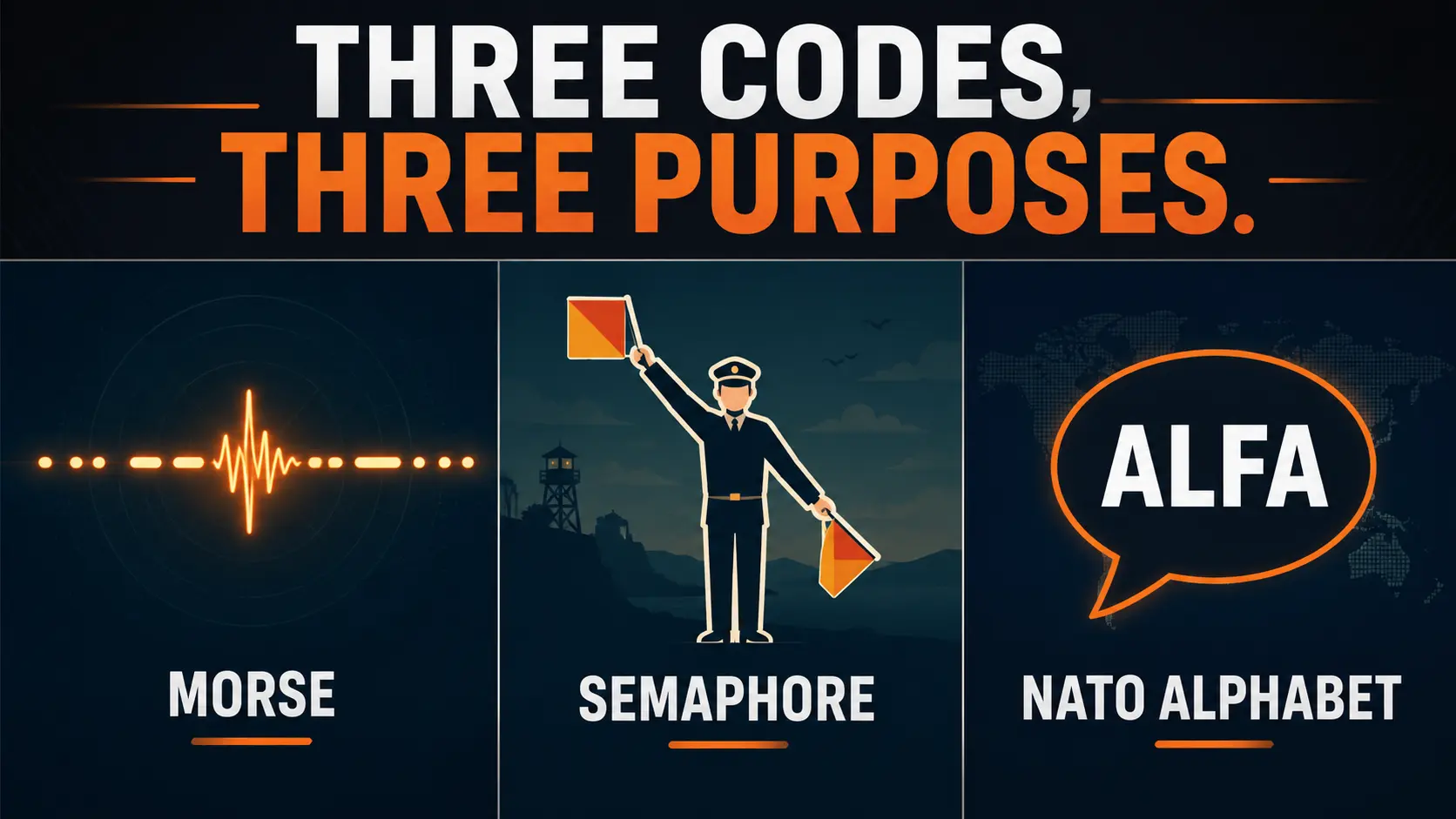
People often use “Morse code,” “semaphore,” and “the NATO alphabet” as if they’re interchangeable — three old-fashioned ways of spelling things out. They’re not. Each one solves a completely different communication problem, uses a different medium, and comes from a different standard-setting body. Here’s exactly what separates them, and when each one is actually used today.
Quick answer: Morse code encodes letters as patterns of short and long signals (dots and dashes) sent by sound, light, or electrical pulses. Flag semaphore encodes letters as physical positions of two handheld flags, read visually at a distance. The NATO phonetic alphabet doesn’t encode letters into symbols at all — it assigns a clear, unmistakable spoken word (Alpha, Bravo, Charlie…) to each letter so spelling can’t be misheard over voice radio. Morse and semaphore are true codes; the NATO alphabet is a spelling convention.
What Each System Actually Is
Morse Code
Morse code represents each letter, number, and punctuation mark as a sequence of short and long signals — dots and dashes — such as ... for S or --- for O. It can be transmitted through virtually any on/off medium: sound (beeps), light (flashes), or electrical pulses down a wire, which is why it became the backbone of telegraph and early radio communication. The modern character set and timing are formally defined by the International Telecommunication Union’s Recommendation ITU-R M.1677. If you’re learning it, our step-by-step guide to learning Morse code fast and the Koch Method training system cover the actual process.
Flag Semaphore
Flag semaphore encodes each letter as a specific position of two handheld flags. The signaler holds one flag in each hand and extends both arms into one of eight possible directions, and each unique combination of the two flag positions maps to a letter or number. It’s a purely visual system — there’s no sound involved — and it was developed and standardized by navies during the 19th century for ship-to-ship and ship-to-shore communication over distances too far for shouting but too close (or too visible to the enemy) for flag hoists spelling out whole words. Semaphore is one of several transmission methods recognized under the International Code of Signals, alongside flag hoist, signal lamp, and radio.
The NATO Phonetic Alphabet
The NATO phonetic alphabet — officially the International Radiotelephony Spelling Alphabet — doesn’t encode letters into a different symbol system at all. It simply replaces each letter’s normal name with a distinct, hard-to-mishear word: Alfa for A, Bravo for B, Charlie for C, and so on through Zulu for Z. It exists because letter names like “B,” “D,” “P,” and “T” sound almost identical over a noisy radio channel, while words like “Bravo” and “Delta” don’t. It was finalized by the International Civil Aviation Organization on March 1, 1956, adopted by NATO the same year, and formally adopted into international radio regulations by the ITU by 1959. (See the full NATO alphabet with the Morse code for every letter for the complete reference table.)
The 1956 version wasn’t the first attempt. According to NATO’s own official history, the ITU produced the first internationally recognized phonetic alphabet as early as 1927, using city names like Amsterdam and Casablanca. During the Second World War, the U.S. and British militaries used a separate “Able Baker” alphabet (Able, Baker, Charlie, Dog…), which stuck around into the Korean War before civilian and military authorities finally agreed on one universal version — the Alfa-to-Zulu alphabet still used today. That’s three full generations of spelling alphabets before the current one, which is part of why it’s stayed unchanged for nearly 70 years: it’s the result of decades of refinement, not a first attempt.
Side-by-Side Comparison
| System | Medium | What It Encodes | Governing Standard | Still Used Today? |
| Morse Code | Sound, light, electrical pulses | Letters as dot/dash patterns | ITU-R M.1677 | Yes — amateur radio, aviation navigation aids, emergency signaling |
| Flag Semaphore | Visual (two handheld flags) | Letters as arm/flag positions | International Code of Signals | Limited — naval replenishment, sea cadets, emergency backup |
| NATO Phonetic Alphabet | Spoken voice | Letters as clear spoken words | ICAO / NATO / ITU Radio Regulations | Yes — aviation, military, maritime, emergency services, call centers |
The Real Difference: Encoding vs. Spelling Clarity
The distinction most explanations miss is this: Morse code and flag semaphore are true encoding systems — they translate a letter into an entirely different physical form (sound/light patterns, or flag positions) that has to be decoded back into letters by the receiver. The NATO phonetic alphabet isn’t encoding anything. “Bravo” is still just the English word for the letter B, spoken aloud — nothing is translated or decoded, it’s just a version of “B” that’s much harder to confuse with “D” or “P” over a bad connection. That’s why Morse code and semaphore both require dedicated training to read, while the NATO alphabet can be understood by anyone who speaks the words, with essentially no learning curve.
Speed and Practicality Compared
Each system also trades off speed differently. Morse code, once learned, can be sent and received quickly — proficient operators regularly work at 15-25+ words per minute — and it works over long distances via radio with minimal equipment. Flag semaphore is limited by line-of-sight and by how fast a person can physically move their arms, making it far slower and only useful at close-to-moderate visual range in good visibility. The NATO phonetic alphabet is the slowest per letter, since it spells out a whole word for every single character, but it requires zero training and works over any voice channel, which is exactly why it’s still standard for spelling names, call signs, and confirmation codes over the phone or radio today.
Can They Be Used Together?
Yes, and historically they often were. On a ship, semaphore might be used for a quick close-range visual message, Morse code (via signal lamp or radio) for longer-range or nighttime communication, and the NATO phonetic alphabet for spelling out a ship’s name or call sign clearly over voice radio. All three are still recognized within the maritime signaling framework precisely because each is suited to a different situation — visibility, distance, available equipment, and noise level all determine which one actually works.
Why Morse Code Isn’t Fully Obsolete
It’s easy to assume Morse code has been replaced by faster, easier systems, but NATO’s own communications documentation confirms it’s still used in specific situations today — including encoding messages via light-flashes precisely because that method is difficult to detect electronically. In other words, Morse code’s biggest “weakness” (it’s slow and old-fashioned compared to digital radio) is also its advantage in one specific scenario: a light-flashed Morse message has no radio signature at all, making it useful when staying undetected matters more than speed. This is a niche, deliberate use case, not evidence that Morse code is broadly relevant to modern communications — but it explains why it hasn’t disappeared entirely from military use the way many people assume.
Two Systems People Confuse With Semaphore
Semaphore often gets lumped together with two other visual signaling methods that are actually distinct:
- Flaghoist communication: Instead of a person’s arms forming letter positions, entire flags and pennants are raised on a ship’s halyard, either individually or in short combinations, to send pre-defined coded messages under the International Code of Signals. It’s a different mechanism from semaphore — no arm positions involved — and it’s generally used for longer, less time-sensitive messages between ships that are farther apart.
- Panel signalling: A ground-to-air method where physical panels are laid out in patterns to send simple, predefined messages to aircraft overhead — for example, a request for medical supplies. It shares semaphore and flaghoist’s reliance on visual positioning, but it’s built for communicating with aircraft rather than between ships or ground units.
Knowing these two exist — and how they differ from semaphore — matters if you’re trying to identify a signaling method described in a historical account, a military manual, or a game/simulation, since all three are visual, flag-or-panel-based, and easy to mix up at a glance.
Facts Most Comparisons Leave Out
- Semaphore inspired the peace sign. The semaphore positions for the letters “N” and “D” (short for “nuclear disarmament”), overlaid, are the origin of the peace symbol designed in 1958.
- “Bravo Zulu” lives on in writing. Originally a naval flag-hoist signal meaning “well done,” Bravo Zulu (often shortened to “BZ”) is still used today in military emails and written communication as an informal commendation, long after the flag-hoist version fell out of everyday use.
- The NATO alphabet has stayed frozen since 1956. Unlike Morse code, which has had minor character additions over time, and semaphore, which varies slightly by organization, the NATO/ICAO phonetic alphabet’s 26 code words haven’t changed in nearly seven decades — a deliberate choice, since altering even one word requires re-testing the entire alphabet for new confusion patterns.
Frequently Asked Questions
Morse code encodes letters as patterns of sound or light signals (dots and dashes), while flag semaphore encodes letters as physical positions of two handheld flags read visually. Morse code works over long distances via radio; semaphore only works within line of sight.
No. The NATO phonetic alphabet assigns a clear spoken word to each letter (Alpha, Bravo, Charlie…) to prevent letters from being misheard over voice radio. Morse code is a completely different system that encodes letters as dot-and-dash signal patterns rather than spoken words.
Morse code is generally faster and more practical, since a trained operator can send it quickly over radio at long range, while flag semaphore is limited by line of sight and how quickly a person can physically move the flags.
The NATO phonetic alphabet solves a different problem — clear spelling over spoken voice radio — while Morse code is used for a completely different transmission method (signal patterns, not speech). They’re used in different situations rather than replacing each other.
Yes, though rarely. It’s mainly used during naval underway replenishment, by sea cadet and scouting organizations for training, and as an emergency backup visual signaling method when radio isn’t available.
The current version was finalized by the International Civil Aviation Organization (ICAO) on March 1, 1956, following years of international testing. NATO adopted it the same year, and the International Telecommunication Union incorporated it into international radio regulations by 1959.
Yes, in limited situations. NATO communications documentation notes that Morse code is still used to encode messages via light-flashes in specific cases, since a light-flashed signal has no radio signature and is difficult to detect electronically, unlike voice or digital radio transmissions.
Semaphore uses a person’s arm and hand-flag positions to represent individual letters, while flaghoist signaling raises entire flags or pennants on a ship’s halyard to send predefined coded messages under the International Code of Signals. They are separate visual signaling methods, not different names for the same system.
Bravo Zulu, often written as “BZ,” is a naval signal meaning “well done.” It originated as a flag-hoist signal and is still used today, including in military written and email communication, as an informal way of commending someone.
Yes. The peace symbol, designed in 1958, is based on the semaphore flag positions for the letters N and D, standing for “nuclear disarmament,” overlaid within a circle.
References
- International Telecommunication Union — Recommendation ITU-R M.1677-1, International Morse Code
- NATO — The NATO Phonetic Alphabet (Official History)
- NATO — NATO Phonetic Alphabet, Codes and Signals
- NATO — Phonetic Alphabet, Codes & Signals (Official Reference Poster, PDF)
- Wikipedia — NATO Phonetic Alphabet
- Wikipedia — Flag Semaphore
- Wikipedia — International Code of Signals
Morse code, flag semaphore, and the NATO phonetic alphabet all exist to solve the same underlying problem — getting a message across accurately when normal speech won’t reach or won’t be understood — but each does it through a completely different medium. Knowing which is which isn’t just trivia: it’s the difference between picking the right tool for an actual signaling situation instead of assuming they’re all the same thing. If Morse code is the one you’re interested in learning properly, our complete guide to learning it fast is the place to start.
