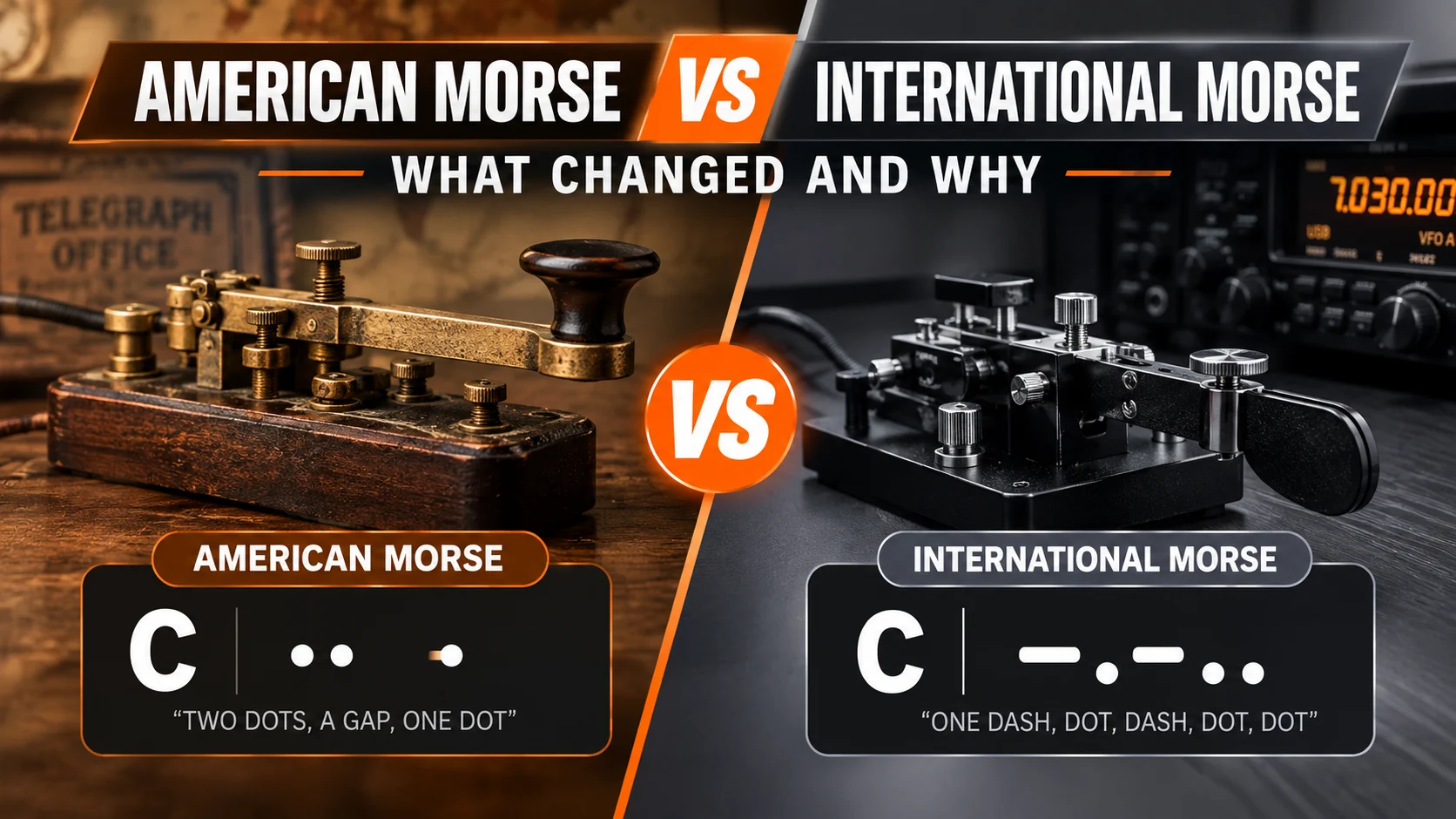
Pull up a scan of a Civil War field telegram or a railroad train order from the 1890s and try to read it with a modern Morse chart. It falls apart within a word. The letter O is two dots. L is one enormous dash. Some characters look like they have a gap punched through the middle. Nothing is broken and nobody made a mistake: you are reading a different code. There were two Morse codes, and the one those operators used is not the one the world uses now.
Quick Answer: American Morse (also called Railroad Morse or landline Morse) is the original code Samuel Morse and Alfred Vail built in the 1840s. International Morse is Friedrich Gerke’s 1848 simplification, adopted as the European standard in 1865. The two codes share 15 letters and differ on 11 letters and 9 of the 10 digits. American Morse also uses three dash lengths and a long gap hidden inside C, O, R, Y, Z and &, features Gerke deleted. Those gaps made it unreliable on undersea cables and on radio, so International Morse won everywhere except US landline and railroad telegraphy, where American Morse survived into the 1970s.
The Numbers, Up Front
- 15 letters are identical: A, B, D, E, G, H, I, K, M, N, S, T, U, V, W.
- 11 letters differ: C, F, J, L, O, P, Q, R, X, Y, Z.
- 9 of 10 digits differ. Only 4 (
....-) is written the same way in both codes. - International uses 2 signal lengths. American uses 3 dash lengths plus 2 gap lengths inside characters.
- Six characters hide a long internal gap: C, O, R, Y, Z and the ampersand.
- American was faster — roughly 5% faster by Western Union’s own reasoning, and up to 20% faster in the hands of a skilled operator.
How to Read the Notation on This Page
American Morse needs symbols that International Morse never required. Everything below uses this key:
| Symbol | Meaning | Length |
|---|---|---|
. |
Dot | 1 unit |
- |
Dash | 2 units in American, 3 in International |
⸺ |
Long dash (letter L only) | About 4 units |
⸻ |
Extra-long dash (numeral 0 only) | About 5 units |
| space inside a code | Long intra-character gap | Longer than the normal 1-unit gap, shorter than a letter gap |
That space is the single most important thing on this page. In .. . (American C), the gap sits inside the letter. Hold it a fraction too long and the receiving operator hears two letters, I and E, instead of one.
Full A–Z Comparison Table
Every letter, both codes, in one place. The Match column tells you whether you can carry your existing knowledge over.
| Letter | International | American | Match? |
|---|---|---|---|
| A | .- |
.- |
Same |
| B | -... |
-... |
Same |
| C | -.-. |
.. . |
Differs (internal gap) |
| D | -.. |
-.. |
Same |
| E | . |
. |
Same |
| F | ..-. |
.-. |
Differs |
| G | --. |
--. |
Same |
| H | .... |
.... |
Same |
| I | .. |
.. |
Same |
| J | .--- |
-.-. |
Differs |
| K | -.- |
-.- |
Same |
| L | .-.. |
⸺ |
Differs (long dash) |
| M | -- |
-- |
Same |
| N | -. |
-. |
Same |
| O | --- |
. . |
Differs (internal gap) |
| P | .--. |
..... |
Differs |
| Q | --.- |
..-. |
Differs |
| R | .-. |
. .. |
Differs (internal gap) |
| S | ... |
... |
Same |
| T | - |
- |
Same pattern, shorter dash |
| U | ..- |
..- |
Same |
| V | ...- |
...- |
Same |
| W | .-- |
.-- |
Same |
| X | -..- |
.-.. |
Differs |
| Y | -.-- |
.. .. |
Differs (internal gap) |
| Z | --.. |
... . |
Differs (internal gap) |
One caveat on the fifteen matches. The pattern of dots and dashes is identical, but the American dash is two units where the International dash is three, so the same letter sounds noticeably clipped. If you want the modern patterns on their own, the full Morse code alphabet page lists all 26 with their spoken dit-dah forms.
The 11 Letters That Changed, and What They Turn Into
This is the table that explains why an old telegram looks like nonsense. Read American Morse with an International chart and the characters do not simply fail — they resolve into the wrong letters, confidently.
| Letter | American | An International reader hears |
|---|---|---|
| C | .. . |
I E |
| F | .-. |
R |
| J | -.-. |
C |
| L | ⸺ |
T, stretched (or nothing recognizable) |
| O | . . |
E E |
| P | ..... |
5 |
| Q | ..-. |
F |
| R | . .. |
E I |
| X | .-.. |
L |
| Y | .. .. |
I I |
| Z | ... . |
S E |
Silent failure is the danger here. A garbled character announces itself; a character that decodes cleanly into the wrong letters does not. Send the American word ROCK to an International operator and it arrives as EI, EE, IE, K.
The Digits: Only One Survives Unchanged
International Morse gives the numbers a tidy structure — a dash marching across five positions. American Morse has no such pattern. It was built for speed on a wire, not for symmetry.
| Digit | International | American | Reads as (International) |
|---|---|---|---|
| 0 | ----- |
⸻ |
no equivalent |
| 1 | .---- |
.--. |
P |
| 2 | ..--- |
..-.. |
no equivalent |
| 3 | ...-- |
...-. |
no equivalent |
| 4 | ....- |
....- |
4 — the only match |
| 5 | ..... |
--- |
O |
| 6 | -.... |
...... |
six dots, no equivalent |
| 7 | --... |
--.. |
Z |
| 8 | ---.. |
-.... |
6 |
| 9 | ----. |
-..- |
X |
Note how brutally efficient the American digits are. American 8 is five elements; International 8 is five elements too, but with three full-length dashes instead of one. Across a page of train orders full of times, car numbers and mileposts, that difference added up to real minutes.
Punctuation Went Its Own Way Too
Punctuation is where the two codes diverge most and where American Morse looks least like anything a modern operator would recognize. A few of the common marks:
| Symbol | International | American |
|---|---|---|
| Period | .-.-.- |
..--.. |
| Comma | --..-- |
.-.- |
| Question mark | ..--.. |
-..-. |
| Ampersand | .-... |
. ... |
The collision in the first two rows is worth a second look. The American period is written exactly like the International question mark. On a wire where those two codes ever met, a statement could arrive as a question.
Timing: Three Dash Lengths and Two Kinds of Gap
The alphabet differences are the visible half of the story. The timing model is the other half, and it is where the two codes really part company.
| Element | International | American |
|---|---|---|
| Dot | 1 unit | 1 unit |
| Dash | 3 units | 2 units |
| Long dash (L) | — | about 4 units |
| Extra-long dash (0) | — | about 5 units |
| Gap between elements | 1 unit | 1 unit |
| Long internal gap (C, O, R, Y, Z, &) | — | roughly 1.5–2 units |
| Gap between letters | 3 units | about 2 units |
| Gap between words | 7 units | about 3 units |
American Morse timings were never standardized the way International timings were; the figures above are the interpretation most commonly used by preservation groups and translators, and period sources vary. International Morse, by contrast, is fixed by standard, which is why every modern trainer and translator agrees on it — the exact ratios are set out on the Morse code timing rules page.
Look at the last two rows. American Morse packs the same message into far less silence: a 2-unit letter gap against 3, a 3-unit word gap against 7. Combine that with a shorter dash and you have a code that is genuinely quicker to send — and that leaves far less margin for a mistimed pause.
Hog-Morse: When the Gap Was Read Wrong
Operators had a name for a message mangled in transit: hog-Morse. American Morse invited it. With three dash lengths and two gap lengths, the difference between a correct message and a wrong one could be a few tens of milliseconds of fist.
The classic trap was L against T. The letter L is a long dash of about four units, and T is a dash of two. Send L a little short, or T a little long, and the word changes. Telegraph lore preserves the example of an order for undressed staves arriving as undressed slaves. The internal gap was the other hazard: C stretched slightly becomes I and E, which is exactly how an experienced operator’s ear would parse it.
There is even a theory, argued by researchers studying the origins of the keyboard, that the QWERTY layout was shaped in part by telegraph operators transcribing American Morse, who needed to move quickly between letters that the code’s ambiguities kept confusing. It remains a contested account rather than settled history, but it shows how deeply the code’s quirks pressed on the people who used it.
Why the Rest of the World Switched
Friedrich Gerke reworked the code in Germany in 1848. His version deleted the two long dashes and the long internal gaps, changed eleven letters and most of the numerals, and left a code with exactly two signal lengths and even spacing. It was not a matter of taste. It was a matter of cable physics.
Long telegraph cables suffer dispersion, a smearing of each pulse that grows worse with distance. Smeared pulses run into each other, which is called intersymbol interference, and it puts a hard ceiling on speed: the first transatlantic cable of 1858 managed under one word per minute. American Morse suffers more from this than Gerke’s code, because it packs closely spaced dots more densely. On a cable, those tight dot runs blur into mush.
So Gerke’s code traveled the way cables did. The Austro-German Telegraph Union adopted it in 1851 so that cables could be connected directly across borders without an operator recoding every message. It became the European standard in 1865 under the name Continental Morse, later International Morse — and only at that point did the original acquire the name American Morse, to tell the two apart. The wider arc of that split is covered on the history of Morse code page.
Radio finished the job. When wireless telegraphy arrived in the late 1890s, operators used whichever code they knew, so American Morse went on the air in the United States while Continental Morse went on the air in Europe. Signals travel further than wires do, and ships needed one code. The 1912 Radiotelegraphic Convention in London settled it: radiograms were to be sent in International Morse.
Why US Railroads Kept the Old Code Anyway
Here is the part most summaries skip. American telegraph companies did not stay with American Morse out of stubbornness. They stayed because on their wires the new code offered them nothing.
- It was faster. With a shorter dash and tighter spacing, the original code could be sent about 5% quicker than International — and one detailed account of the trade puts a skilled operator’s advantage at 20% or more. On a busy commercial wire, that is capacity.
- Overhead wires do not disperse. The problem International Morse was built to solve barely exists on open-air land lines. The main argument for switching simply did not apply to a railroad circuit strung on poles.
- Retraining was expensive. Western Union and its peers employed thousands of operators fluent in American Morse. A US proposal to adopt the international code was put forward as early as 1854 and rejected by the telegraph companies.
- It was a closed system. Railroad dispatching and domestic message traffic never had to interoperate with Europe. Where the two systems did meet, at the transatlantic cable heads, operators simply learned both and recoded messages by hand.
So the split held for decades. American Morse stayed on US land lines and railroad wires, and was even common on domestic radio circuits on the Great Lakes and along both coasts, while International Morse ruled the open ocean. Commercial landline and railroad Morse faded through the 1960s and 1970s as teleprinters and radio dispatch took over; the last working circuits were an anachronism kept alive by a handful of operators rather than a system in service.
A Short Timeline
| Year | What happened |
|---|---|
| 1837–1844 | Morse and Vail develop the original code. By a widely repeated account, Vail weighted the shortest codes toward the commonest English letters after consulting a printer’s type case. |
| 1844 | “What hath God wrought” is sent on the Baltimore–Washington line, in American Morse. |
| 1848 | Friedrich Gerke publishes a simplified code in Germany. |
| 1851 | The Austro-German Telegraph Union adopts Gerke’s code for cross-border cable traffic. |
| 1854 | A proposal to adopt the international code in the US is rejected by the telegraph companies. |
| 1865 | Gerke’s code becomes the European standard as Continental Morse. The original is renamed American Morse. |
| 1912 | The London Radiotelegraphic Convention requires International Morse for radiograms. |
| 1960s–70s | US landline and railroad Morse circuits go quiet. |
| 1999 | Commercial marine Morse ends in North America; the final message is sent on 12 July. |
| Today | American Morse survives in railroad museums, telegraph preservation clubs and Civil War reenactments. |
How to Tell Which Code You Are Looking At
If you have a scanned tape, a transcript, or a photograph of a telegram and you do not know its provenance, four checks settle it in seconds:
- A run of five dots. International Morse uses
.....for the digit 5 and nothing else. If it appears mid-word among letters, you are reading American P. - A dash that is obviously longer than the rest. International Morse has one dash length. Two or three visibly different lengths means American, and the longest one is the numeral 0.
- Gaps inside characters. A pause that is clearly shorter than a letter gap but longer than an element gap is the American long intra-character gap: C, O, R, Y, Z or &.
- Decoded text full of E and I. If a transcript comes out as strings like EE, IE and EI where vowels and common consonants should be, the source is American Morse being read with an International chart.
So Which Should You Learn?
International Morse, without hesitation. It is the standard for amateur radio, aviation navigation beacons and maritime use, including in the United States. Every trainer, every translator and every practice tool you will find is built around it, and even the US operators who once preferred American Morse on the air have moved over.
American Morse is worth knowing if you are reading period documents, restoring a sounder or a Vibroplex key, working a museum wire or taking part in a reenactment. Think of it the way you would think of a regional script: historically vital, still legible, no longer the working standard. It is one of several codes that sit outside the international standard, alongside Japanese Wabun and the Cyrillic and Greek adaptations covered in our guide to non-English Morse code.
Frequently Asked Questions
International Morse uses two signal lengths, a dot and a dash, with fixed even spacing. American Morse uses three dash lengths and places a long gap inside six characters. Eleven letters and nine of the ten digits are different between the two codes.
Eleven letters differ: C, F, J, L, O, P, Q, R, X, Y and Z. The other fifteen — A, B, D, E, G, H, I, K, M, N, S, T, U, V and W — use the same dot-and-dash pattern in both codes, though the American dash is shorter.
No. Morse and Alfred Vail created American Morse in the 1840s. International Morse comes from Friedrich Gerke’s 1848 rework of that code, which was adopted for cross-border cables in 1851 and became the European standard in 1865. The code named after Morse is not the code he built.
Because US railroads used it for train dispatching over land-line telegraph long after the rest of the world had switched. It is also called land-line Morse for the same reason.
C, O, R, Y, Z and the ampersand contain a long intra-character gap, a deliberate pause inside the character. It let Vail build very short codes for common letters. The cost is ambiguity: read slightly long, C becomes I and E, and O becomes E and E.
It is the letter L, a single dash of about four units where a normal American dash is two. The numeral 0 is longer still, about five units. International Morse has no element longer than three units, so neither has any equivalent there.
Yes. Its dash is shorter, its letter and word gaps are tighter, and its commonest letters have very short codes. Estimates of the advantage range from about 5% to more than 20% depending on the operator and the traffic. That speed is a large part of why US companies kept it.
Hog-Morse is telegraph slang for a message garbled by bad sending. It is associated with American Morse because the code’s multiple dash lengths and two gap lengths gave a careless operator many more ways to produce something that decoded cleanly into the wrong words.
American Morse. US military telegraphy in the 1860s ran on land lines using the original code; International Morse was only adopted as the European standard in 1865 and did not displace American Morse domestically for decades afterward.
International Morse. By 1912 the international code was the standard for maritime wireless, and the 1912 London convention formalized it for radiograms that same year.
Partly, and misleadingly. The fifteen shared letters come through, so a good deal of a message appears to decode, but the eleven changed letters resolve silently into wrong characters rather than obvious errors. Reading American Morse by ear takes deliberate practice on exactly those letters.
Barely. It is nearly extinct, kept alive by railroad museums, telegraph preservation societies such as the Morse Telegraph Club, and Civil War reenactors. Even US amateur radio operators now use International Morse almost exclusively.
How This Page Was Verified
Every American Morse character in the tables above was checked against the published American Morse table and against the American Morse reference maintained by Morse Code World, and every International Morse character against the ITU standard set used across this site. The 15 identical letters were confirmed element by element. Timing values are given as ranges because American Morse was never standardized: period practice varied by company, by wire and by operator, and any single set of unit figures is one reasonable interpretation rather than a specification.
Sources
- American Morse code (Wikipedia) — the full American Morse table, the long dashes and internal gaps, the 1851 and 1865 adoptions, the 1854 US rejection, the 1912 London convention, and the speed comparison.
- Hog-Morse (Wikipedia) — the timing errors American Morse invited and the staves-and-slaves example.
- American Morse Code (Morse Code World) — the unit timing model used in the timing table, including the 2-unit dash, 4-unit long dash and 5-unit zero.
- Morse Telegraph Club — the preservation society that keeps landline and railroad telegraphy in working order.
Last updated September 2026. Changelog: rebuilt from the earlier version of this page — full A–Z comparison table added; the numeral 0 corrected from roughly six units to about five; the ampersand added to the list of characters with an internal gap; the “reads as” columns added for letters and digits; punctuation comparison added; the end-of-use date revised from “the early 1980s” to the 1960s–70s, in line with the record for landline and railroad circuits.
