Morse Code Bracelet
Quick Answer: A Morse code bracelet spells a hidden word in beads — small round beads for dots, long tube beads for dashes, and a contrasting spacer between letters. The word LOVE is
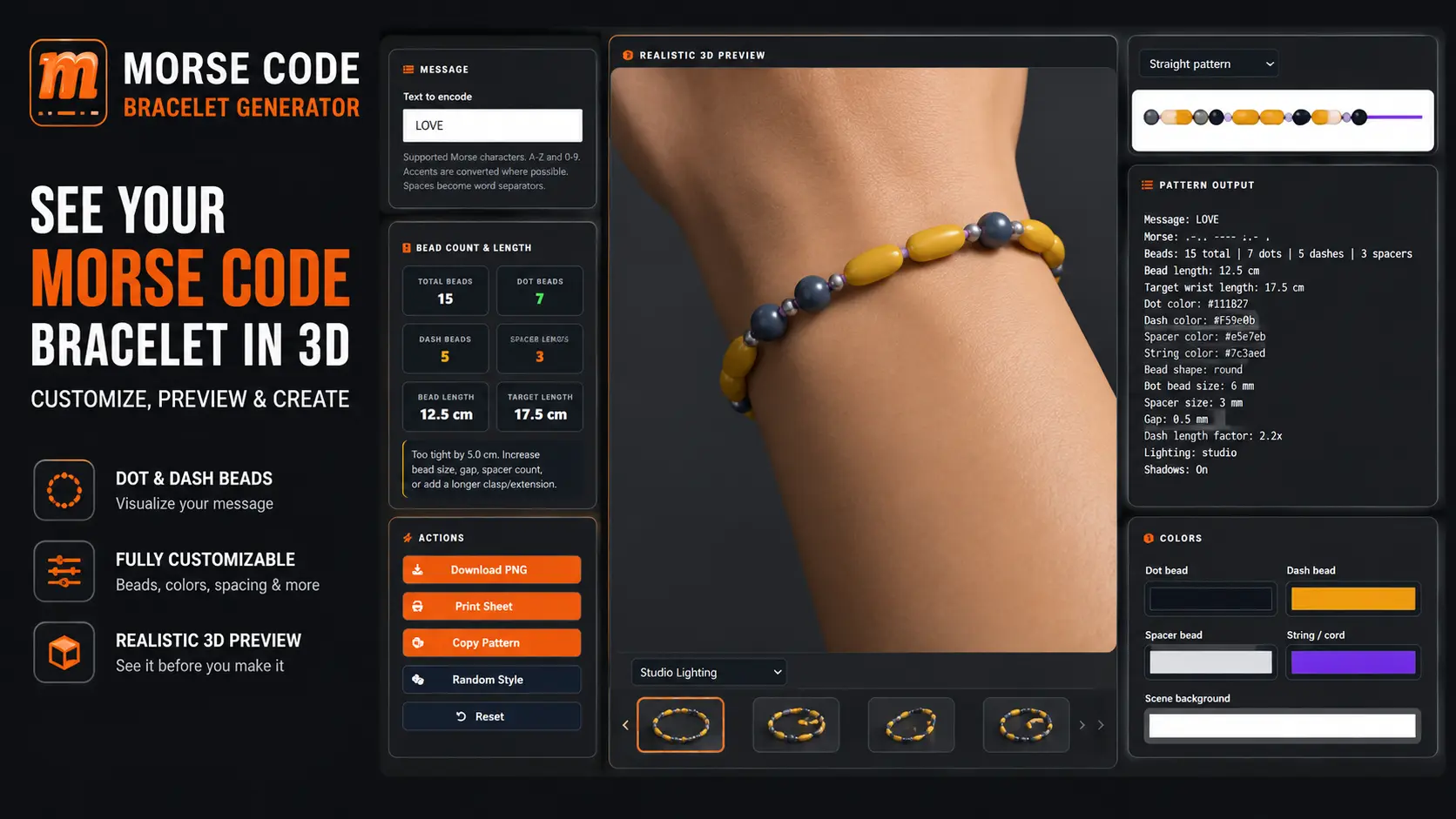
.-.. --- ...- ., which becomes 7 dot beads, 5 dash beads and 3 spacers: 15 beads in all. Type your word below to get the exact bead count, colors, wrist length and a printable pattern.
How to Make a Morse Code Bracelet
- Choose a short word. Names, initials, dates and single words work best. Every letter adds three to five beads, so MOM is a bracelet and UNCONDITIONALLY is a belt. The generator accepts up to 80 characters, letters A–Z and digits 0–9.
- Pick your bead styles. Round, square, tube, disk or diamond. The classic look uses small rounds for dots and tubes for dashes, but a disk-and-tube combination reads more clearly from a distance.
- Set your colors. Dot bead, dash bead, spacer bead and cord are all independent. Or open the pattern library — there are 700+ presets you can search, filter by category or shuffle at random.
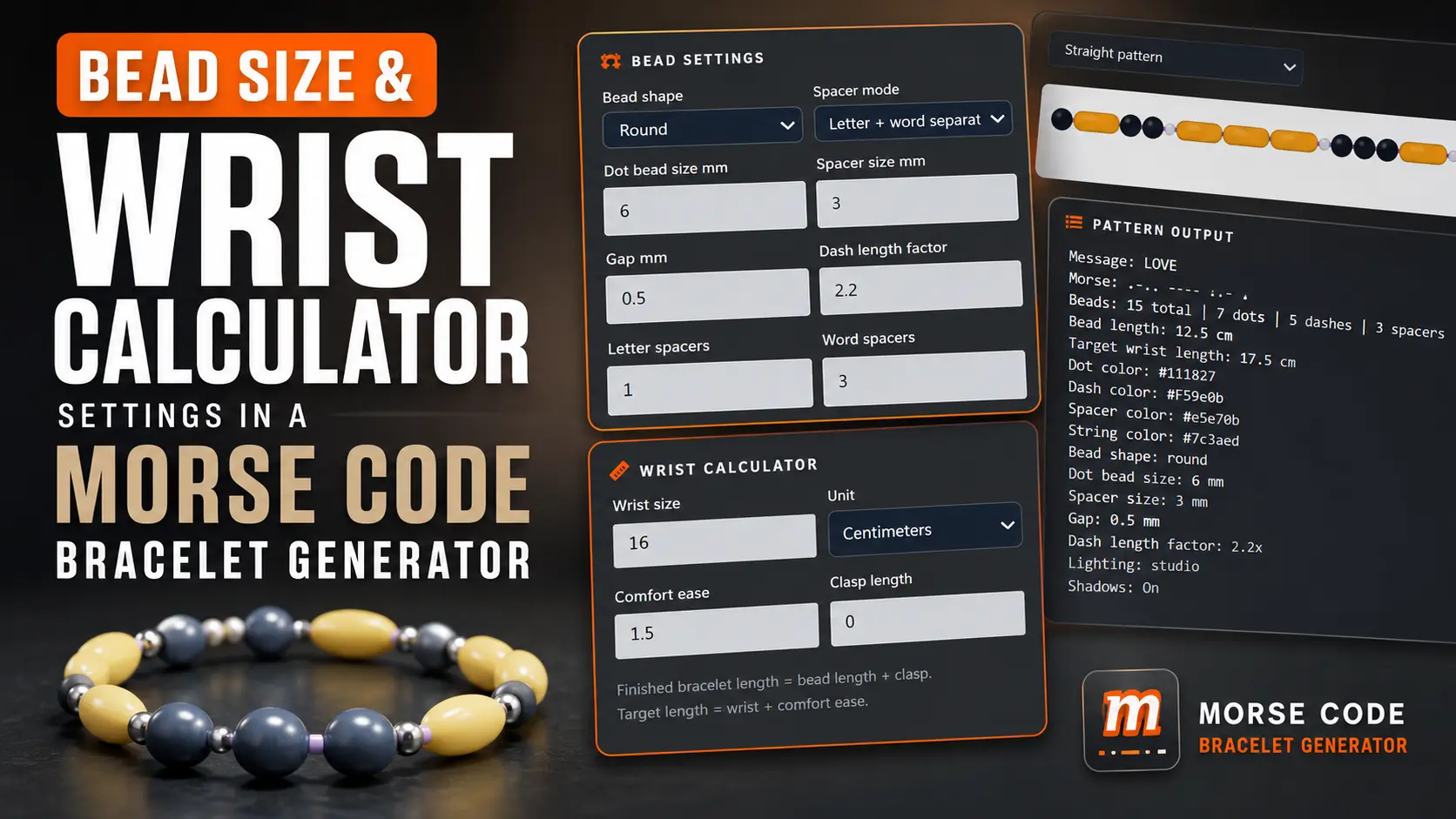
- Enter your wrist measurement. Add comfort ease (1.5 cm is standard) and clasp length if you’re using one. The calculator compares the bead length against your target and tells you whether the pattern fits.
- Check it in 3D. Drag to rotate, scroll to zoom, and switch on the wrist model to see how the pattern sits when it curves. Six lighting presets show how glossy versus matte beads will actually look.
- Print or download. The print sheet and PNG both include the circular layout, the straight layout and the 3D render, so you can bead directly from the page.
How Morse Code Translates Into Beads
Definition: A Morse code bracelet is a beaded bracelet where bead shape or length encodes dots and dashes, and a different bead marks the boundary between letters. It’s a wearable substitution cipher, not a decoration that happens to look coded.
| Morse element | Bead used | Default in this tool |
|---|---|---|
Dot (.) |
Small round bead | 6 mm |
Dash (-) |
Long tube or bugle bead | 6 mm × 2.2 = 13.2 mm |
| Gap between letters | Contrasting spacer bead | 1 spacer, 3 mm |
| Gap between words | Run of spacers | 3 spacers, 9 mm |
| Gap between beads | Knot or crimp | 0.5 mm |
Why the dash factor matters: in real Morse a dash lasts three times as long as a dot. Most jewelry uses a ratio closer to 2:1 because a true 3:1 tube looks disproportionate next to a 6 mm round. The tool defaults to 2.2 and lets you push it to 4 if you want the ratio to be technically faithful. Either way the reader distinguishes dots from dashes by length, exactly as an operator would by ear.
If you want to check a letter before committing 40 beads to it, the full character set is on our Morse code alphabet page, and there’s a printable version on the Morse code chart.
Bead Counts for Popular Words
These are calculated at the tool’s default settings — 6 mm dots, 2.2× dashes, 3 mm spacers, one spacer between letters:
| Word | Morse | Dots | Dashes | Total beads | Length |
|---|---|---|---|---|---|
| DAD | -.. .- -.. |
5 | 3 | 10 | ~8.0 cm |
| MOM | -- --- -- |
0 | 7 | 9 | ~10.2 cm |
| SISTER | ... .. ... - . .-. |
11 | 2 | 18 | ~11.6 cm |
| FAITH | ..-. .- .. - .... |
10 | 3 | 17 | ~12.0 cm |
| LOVE | .-.. --- ...- . |
7 | 5 | 15 | ~12.4 cm |
| HOPE | .... --- .--. . |
7 | 5 | 15 | ~12.4 cm |
| FRIEND | ..-. .-. .. . -. -.. |
11 | 4 | 20 | ~14.3 cm |
| STRONG | ... - .-. --- -. --. |
7 | 8 | 20 | ~17.2 cm |
| FAMILY | ..-. .- -- .. .-.. -.-- |
10 | 8 | 23 | ~19.2 cm |
The pattern most people miss: bead count and finished length don’t track each other. SISTER and STRONG are both 20-ish beads, but STRONG is nearly 6 cm longer because it’s dash-heavy. Words built from E, I, S, H and T stay short; words full of O, M, Q and Y stretch fast. If your word runs long, drop the dot bead to 4 mm before you start cutting letters.
Using the Wrist Calculator
The math the tool runs is simple enough to check by hand:
- Target length = wrist measurement + comfort ease
- Finished length = bead length + clasp length
A 16 cm wrist with 1.5 cm ease gives a 17.5 cm target. LOVE at default settings comes to about 12.4 cm of beads — roughly 5 cm short. That gap is normal and expected: you fill it with plain filler beads split evenly at both ends, which also centers the coded word on top of the wrist where it can be read.
Comfort ease guidance: 1–1.5 cm for a snug fit on elastic cord, 2–2.5 cm for a bracelet that slides, and 0.5 cm or less for a memory-wire cuff that doesn’t need to pass over the hand. If you’re using a lobster clasp, measure it and enter it separately — a 1.2 cm clasp is 1.2 cm of bracelet.
Choosing Beads and Colors
The color pickers control four separate elements, and the choice that decides whether your bracelet is readable is the spacer, not the dots and dashes.
- High contrast spacers — a white or metallic spacer against dark beads makes letter boundaries obvious. Best if you want people to be able to decode it.
- Matched spacers — spacers in the same tone as the beads hide the structure. The word becomes genuinely private, readable only by someone who already knows to count.
- Dot/dash contrast — two different colors for dots and dashes removes any ambiguity about bead length, which helps if you’re using round beads for both.
- Cord color — waxed cotton, leather and elastic all read differently in the preview. Set the scene background to white if you’re planning product photos.
The preset library is the fastest way to find combinations that work. Search by name, browse by category, or hit the dice button and keep shuffling until something lands.
Reading the 3D and 2D Views
3D preview shows the bracelet as a physical object with real lighting and shadows. This is where you catch problems a flat pattern hides — whether the word wraps out of sight when curved, and whether tube beads sit flush or gap on the inside of the curve. Turn on the wrist model for scale.
2D straight mode is your beading order: the exact sequence to thread, left to right.
2D circular mode shows where the word ends up once the bracelet is closed, so you can position the message on top rather than under the wrist.
Print sheet and PNG include all three, which means you can bead from paper without keeping a browser open on a workbench.
What People Put on Them
- Names and initials — children, partners, a person being remembered.
- Dates — anniversaries and birthdays in digits. Numbers are all five elements long, so a six-digit date is a full bracelet on its own; see Morse code numbers for the pattern logic.
- Single-word reminders — BREATHE, ENOUGH, STILL HERE. Common in recovery and grief jewelry.
- Inside jokes and private phrases — the point of the format is that only the wearer and the giver know.
- Team, unit or callsign identifiers — popular with scouts, cadets and amateur radio operators.
Stuck for a word? Our list of Morse code words shows which short words produce the cleanest, most balanced patterns.
Common Mistakes to Avoid
Forgetting the letter spacers. Without them the bracelet is unreadable. .- -. is AN; run it together as .--. and it becomes P. Spacing isn’t decoration, it’s part of the code.
Using beads that are too similar in length. If your dash is only 1.5× your dot, nobody can tell them apart on a curved surface. Keep the factor at 2 or above.
Measuring the bracelet instead of the wrist. Enter your actual wrist circumference and let the tool add ease. Copying a bracelet you already own carries over its fit errors.
Choosing a word before checking its length. Type it in first. Dash-heavy words can double your bead count with no warning.
Expecting punctuation to work. This generator handles letters and digits. Apostrophes, hearts and emoji have no bead equivalent — for messages with punctuation, use the Morse code translator and adapt.
Materials You’ll Need
- Round seed or glass beads for dots, 4–8 mm
- Tube or bugle beads for dashes, roughly twice your dot length
- Contrasting spacer beads, 2–4 mm
- Elastic cord (0.7–1 mm), waxed cotton, or beading wire with crimps
- A clasp, if you’re not using elastic
- Scissors, and jewelry glue for knot security
Buy about 20% more beads than the count says. Beads split, roll under furniture, and you’ll want spares if you make a second one.
Privacy and Requirements
Everything runs in your browser — the pattern, the calculations and the 3D render. Nothing you type is uploaded or stored, and no account is needed. The 3D preview uses WebGL and works in current versions of Chrome, Safari, Firefox and Edge on desktop and mobile; the 2D pattern and print sheet work even where WebGL is unavailable.
Frequently Asked Questions
It’s a beaded bracelet that spells a hidden word in Morse code. Small round beads represent dots, longer tube beads represent dashes, and a contrasting spacer bead marks the end of each letter. The word is only obvious to someone who knows how to read it.
Find a spacer bead and start there. Read each group of beads between spacers as one letter, treating short beads as dots and long beads as dashes, then look the pattern up on a Morse chart. A run of three spacers usually means a word break.
It depends entirely on the word. LOVE takes 15 beads and FAMILY takes 23 at standard settings. Type your word into the generator above and it will show the exact dot, dash and spacer counts along with the finished length.
A 6 mm round for dots and a tube roughly twice that length for dashes is the most common combination, with 3 mm spacers. Drop to 4 mm dots if your word is long and the bracelet runs past your wrist measurement.
Short, meaningful words work best — LOVE, HOPE, MOM, a name, or a set of initials. Words built from E, I, S, H and T stay compact, while words with O, M and Y use far more dash beads and run much longer.
Measure your wrist and add about 1.5 cm of comfort ease, then add the length of any clasp. A 16 cm wrist usually means a 17.5 cm bracelet. The wrist calculator in the tool does this and tells you whether your bead pattern fits.
Yes, digits 0 through 9 are supported. Be aware that every Morse digit is five elements long, so a six-digit date needs at least 30 element beads plus spacers — often a full bracelet on its own.
Yes. The Print Sheet button produces a page with the straight beading order, the circular layout and the 3D render, so you can bead from paper. You can also download the whole thing as a PNG or copy the pattern as text.
Yes, it’s free with no signup, no install and no limit on how many patterns you make. Everything is calculated in your browser, so nothing you enter is sent to a server.
