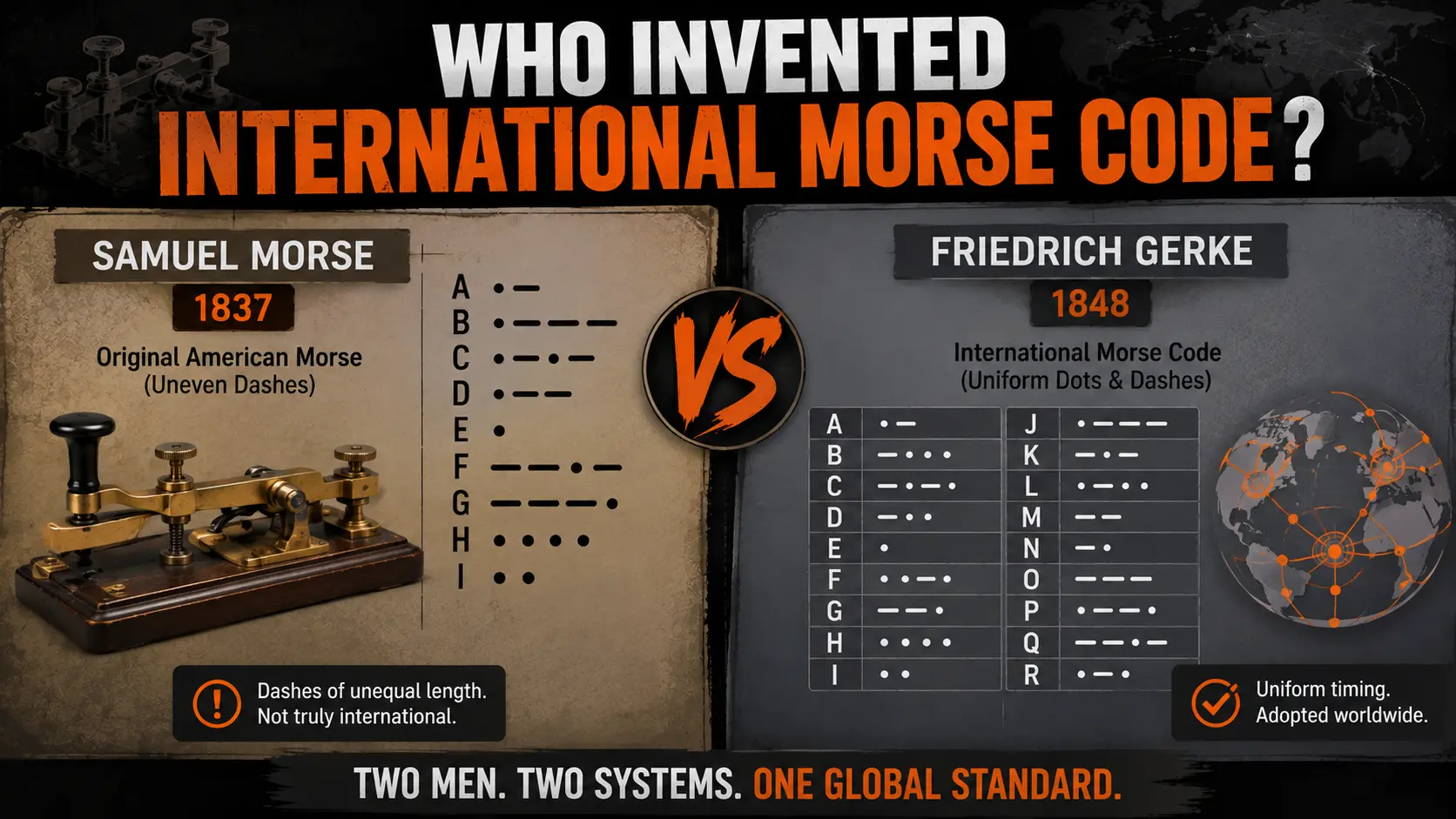
The code is named after Samuel Morse. The version you actually use today was mostly shaped by someone else, a German telegraph inspector named Friedrich Gerke. In 1848 he took the original American code apart and rebuilt it into the clean, two signal system that later became International Morse code. Here is who Gerke was, what he changed, and why the honest answer to who invented International Morse code includes his name as much as Morse’s.
Quick answer: International Morse code, the version used worldwide today, comes from Friedrich Clemens Gerke’s 1848 rewrite of the original American Morse code. Gerke removed the different dash lengths and the uneven gaps inside letters, leaving just the dot and the dash. His version was adopted by the German-Austrian Telegraph Union in 1851 and standardized internationally in 1865 in Paris. Samuel Morse and Alfred Vail built the first code. Gerke reshaped it into the global standard.
Who Was Friedrich Gerke?
Friedrich Clemens Gerke lived from 1801 to 1888. He was born in Osnabrück, Germany, and worked as a musician and journalist before he found his way into telegraphy. In 1838 he joined an optical telegraph line between Hamburg and Cuxhaven, and when electric telegraphs arrived he switched over, becoming inspector of the first Morse landline in Europe, the roughly 120 kilometre Hamburg to Cuxhaven route that began service in 1848.
That job matters, because Gerke was not a theorist. He ran a working telegraph line every day and saw exactly where the American code slowed operators down and caused mistakes. His fix came from the practical side of the desk.
The Problem With the Original Code
The first Morse code, the one Samuel Morse and Alfred Vail developed in the 1830s and 1840s, was clever but messy. It used dashes of more than one length. Some letters had short gaps in the middle of them, so a single character was really a small pattern of marks and spaces. On a paper tape or by ear, those uneven timings were easy to misread, and they were hard to teach to new operators.
This version is now called American Morse code, or railroad Morse. It worked well enough on United States telegraph lines, but it did not travel well. As telegraphy spread across Europe, the messiness became a real problem.
What Gerke Changed in 1848
Gerke rebuilt the code around a simple rule: two signals only. A dot, and a dash that lasts three times as long. Every gap inside a letter is the same short length. Nothing longer, nothing uneven.
To get there he changed nearly half of the letters and all of the numbers. He also added codes for the German umlauted vowels and for CH. The result was cleaner, faster, and far easier to send and read. It became known as the Hamburg alphabet.
A few letters survived untouched from the original, including E, H, K and N. That is why parts of the two codes still look the same. In both versions, E is simply . and H is ....
American Morse vs International Morse
Here is how the two versions compare.
American Morse code:
- Built by Morse and Vail in the 1830s and 1840s
- Used dashes of more than one length
- Had short gaps inside some letters
- Used mainly on United States railroad and landline telegraphs
- Almost extinct today, seen mostly in historical reenactments
International Morse code:
- Reworked by Gerke in 1848
- Uses only two signals, a dot and a dash, with the dash three times the length of the dot
- Uses even spacing, with no gaps inside letters
- Spread across Europe and then the rest of the world
- Is still the standard today, defined by the International Telecommunication Union
From a Hamburg Line to a Global Standard
Gerke’s code did not stay local for long. In 1851 the German-Austrian Telegraph Union adopted it for its member states, which covered much of central Europe. From there it kept spreading.
The big moment came in 1865, when representatives met in Paris at the International Telegraph Convention and adopted Gerke’s code, with a few small changes, as the standard for international telegraphy. That decision is the direct ancestor of today’s International Morse code, the version now defined by the International Telecommunication Union. Most of the letters in the modern standard come straight from Gerke’s revision.
So Who Invented International Morse Code?
The honest answer is that no single person did. Samuel Morse championed the electric telegraph and gave the code its name. Alfred Vail, the engineer working alongside him, did much of the original letter design. Friedrich Gerke then took that early code and reworked it into the version the world actually adopted.
So when you send a message in Morse today, you are mostly sending Gerke’s code, even though it carries Morse’s name. It is a shared invention, built up by several people over about thirty years. You can see the finished result on the Morse code alphabet page, and read the wider story on the history of Morse code page.
See Gerke’s Code for Yourself
Every letter pattern in use today traces back to Gerke’s 1848 rebuild. To see it in action, type any word into the Morse code translator and watch it turn into dots and dashes. What you are reading is the Hamburg alphabet, cleaned up and standardized, still doing its job more than 170 years later.
Frequently Asked Questions
Friedrich Clemens Gerke reworked the original American Morse code in 1848, and his version became International Morse code. It was based on the earlier code by Samuel Morse and Alfred Vail.
Not exactly. Morse and Alfred Vail built the original American Morse code. The version used around the world today comes from Gerke’s 1848 revision, which was standardized internationally in 1865.
American Morse used dashes of different lengths and had gaps inside some letters. International Morse, Gerke’s version, uses only a dot and a dash with even spacing, which makes it easier to send and read.
In 1865, at the International Telegraph Convention in Paris, where Gerke’s code was adopted with minor changes as the standard for international telegraphy.
Rarely. It has been almost entirely replaced by International Morse code and now shows up mainly in historical reenactments.
Sources
- Morse code (Wikipedia). Confirms that most of the alphabet in the ITU International Morse code comes from Gerke’s revision of the Vail and Morse code.
- Friedrich Clemens Gerke (Wikipedia). His life, dates, and the 1848 revision that removed the varying dash lengths and internal gaps.
- The invention of Morse code and the advent of German telegraphy (Museum for Communication Berlin). Gerke’s Hamburg line and the 1851 adoption by the German-Austrian Telegraph Association.
- What Is Morse Code? (HowStuffWorks). The split between American and International Morse and Gerke’s 1848 simplification.
