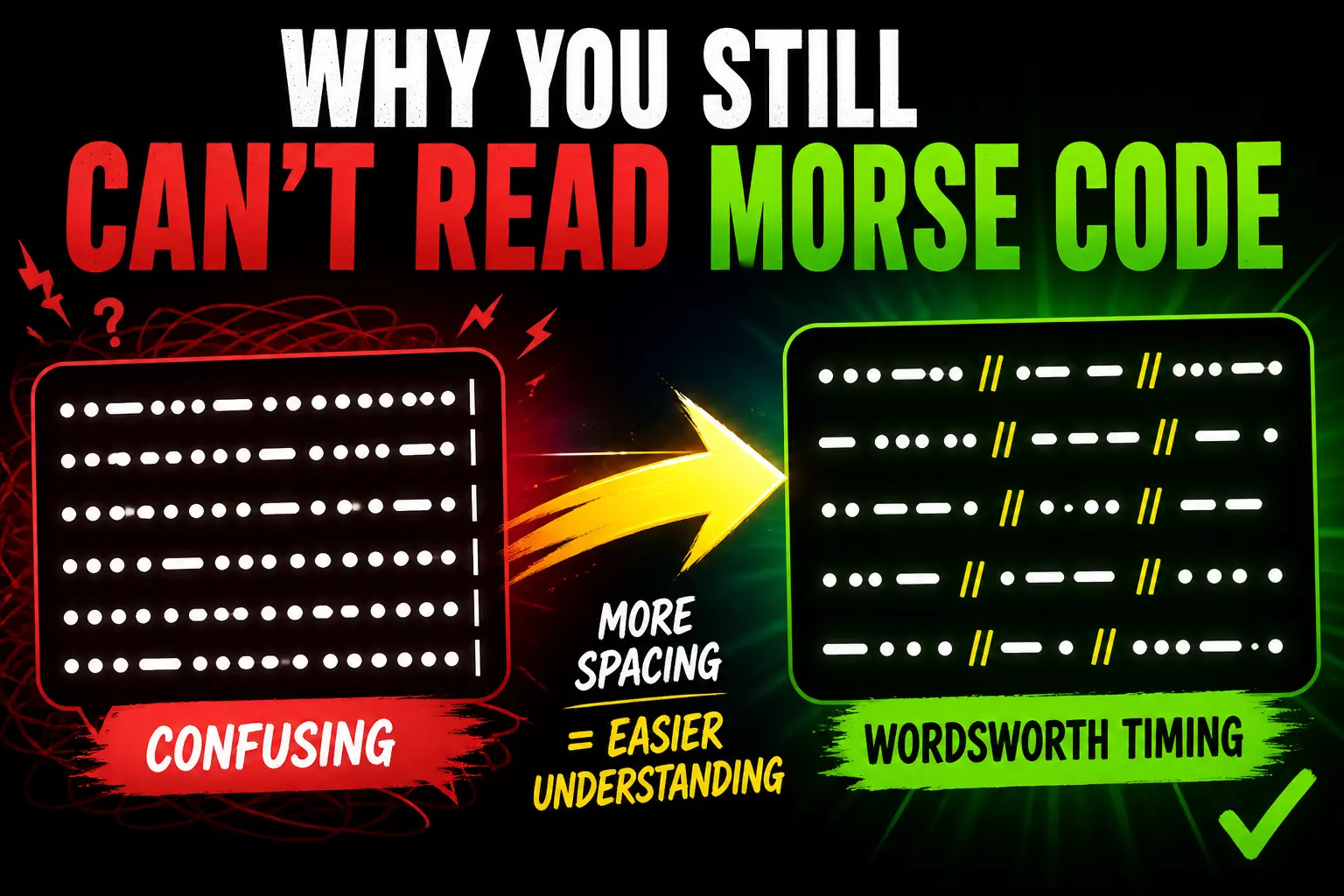
Wordsworth timing in Morse code is an advanced method that helps you recognize whole words faster without changing character speed. It focuses on increasing the spacing between words while keeping letters and signals at normal speed.
Timing is everything in Morse code. It defines how long dots and dashes last and how much space exists between them. Even the correct sequence can become confusing if timing is not accurate. That is why timing methods like Morse code timing rules and advanced techniques such as Farnsworth timing are important for real communication.
To understand Wordsworth timing, you must first understand the basics of Morse code. Letters are made from dots and dashes, and spacing separates parts of a letter, letters, and words. You can explore this using the Morse Code Alphabet or test signals with the Morse Code Translator.
What Wordsworth Timing Means
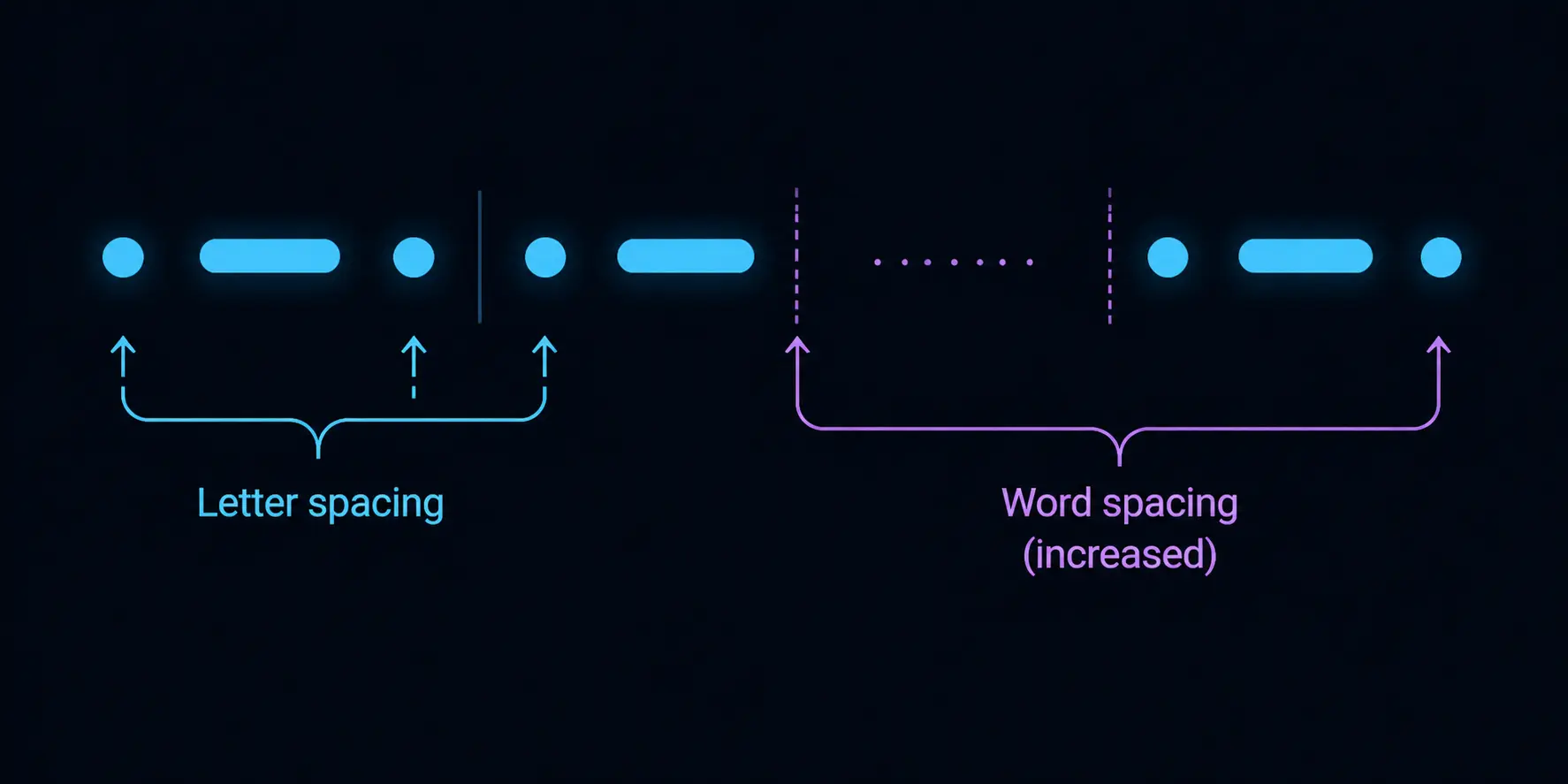
Wordsworth timing keeps the same character speed and letter spacing but increases the space between words.
- Characters sound fast
- Letters stay close together
- Longer pauses separate words
The signal itself does not slow down. Only the gap between words increases.
This allows the brain to group letters into words more easily. Instead of decoding letters one by one, you begin recognizing full words as sound patterns.
How Wordsworth Timing Works
In standard Morse code, timing follows fixed rules based on a unit system.
The basic timing formula is:
\text{Unit duration (ms)} = \frac{1200}{\text{WPM}}This defines how long each dot lasts at a given speed.
Wordsworth timing keeps this structure but changes word spacing.
- Character speed stays the same
- Letter spacing remains normal
- Word spacing becomes longer
This creates clear separation between words without affecting the rhythm of characters.
When to Use Wordsworth Timing
Wordsworth timing is used after you already understand characters and basic timing.
At this stage, many learners can recognize letters but struggle to understand full words in real time. This is where Wordsworth timing becomes useful.
It helps bridge the gap between character recognition and real communication. Instead of copying Morse code letter by letter, you begin copying by sound and meaning.
Learning Progression in Morse Code
Wordsworth timing is not for beginners. It comes after you understand basic timing.
There are three main learning stages:
- Learn letters using basic timing rules
- Use Farnsworth timing to improve character recognition
- Use Wordsworth timing to improve word recognition
This step-by-step progression helps you build skills without confusion.
Standard Timing vs Farnsworth vs Wordsworth
Each timing method serves a different purpose.
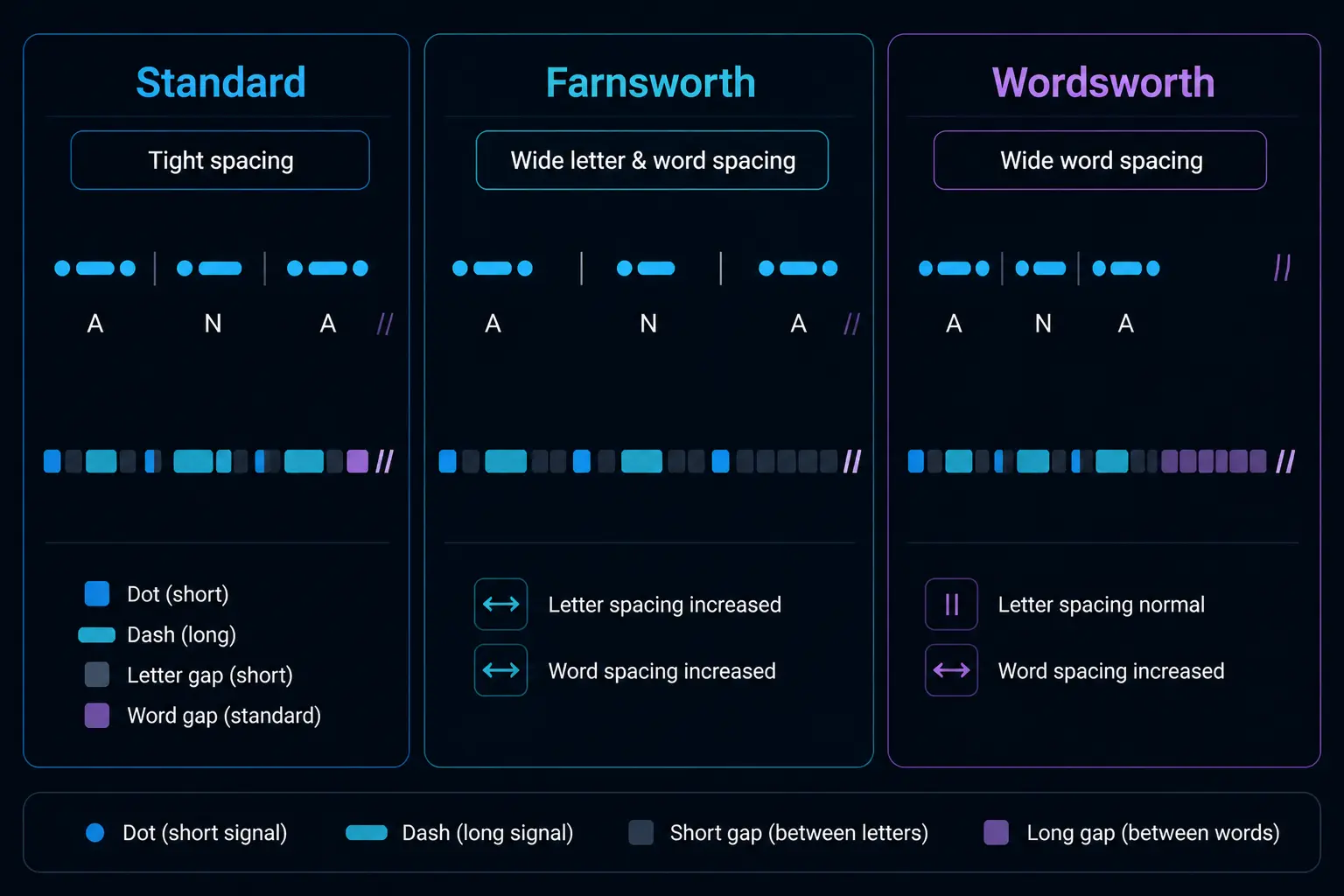
- Standard timing uses fixed spacing for real communication
- Farnsworth timing increases letter and word spacing
- Wordsworth timing increases only word spacing
The key idea is simple. Wordsworth timing helps you recognize words instead of individual letters.
Why Wordsworth Timing Improves Learning
Many learners can read letters but struggle with full words. This slows down communication and makes real-time decoding difficult.
Wordsworth timing solves this by increasing space between words.
It helps you:
- Recognize word patterns faster
- Improve listening flow
- Reduce mental effort
- Build natural rhythm
You stop thinking about each letter and start understanding the message as a whole. This is also known as word-level recognition in Morse code listening.
Morse Code Speed and Wordsworth Timing
Morse code speed is measured in words per minute (WPM). The standard reference word is “PARIS,” which equals 50 time units.
Another useful relation is:
T \propto \frac{1}{\text{WPM}}This shows that as speed increases, unit duration decreases.
Wordsworth timing does not change this unit duration. It only increases the time between words.
This creates a difference between actual signal speed and perceived message speed.
Example Calculation
\frac{1200}{20} = 60\,msAt 20 WPM:
- Dot duration = 60 ms
- Dash duration = 180 ms
Word Spacing Comparison
\text{Standard word gap} = 7 \times \text{unit} \text{Wordsworth word gap} > 7 \times \text{unit}In Wordsworth timing, the word gap is extended beyond the standard 7 units. This extra spacing gives your brain more time to process entire words instead of individual characters.
Simple Example of Wordsworth Timing
In standard timing, words are close together and may sound fast and compressed.
In Wordsworth timing:
- Each letter sounds normal
- Words are clearly separated
- Pauses between words are longer
This makes it easier to understand full sentences. Your brain begins to recognize patterns of sound instead of decoding each symbol.
You can practice this using real examples like Hello in Morse Code or SOS in Morse Code.
Where Wordsworth Timing Is Used
Wordsworth timing is mainly used in training environments.
- Amateur radio practice
- CW communication training
- Listening exercises
- Advanced Morse code learning systems
You can also explore common patterns in the Morse Code Words section.
Common Mistake in Learning Morse Code
A common mistake is slowing down the entire signal. This reduces learning efficiency and creates dependency on slow decoding.
Wordsworth timing avoids this by keeping character speed fast and only increasing spacing.
This builds real listening ability and helps you copy Morse code by ear instead of memorizing symbols.
How to Practice Wordsworth Timing
Start with simple words and focus on sound patterns instead of counting dots and dashes.
As your skill improves:
- Listen to longer words
- Practice full sentences
- Gradually reduce spacing
You can practice using the Morse Code Practice Tool.
Functional Importance of Wordsworth Timing
Wordsworth timing is important for advanced learning and real communication.
It helps learners:
- Understand full words quickly
- Improve message comprehension
- Develop natural listening rhythm
- Prepare for real communication
Without this step, many learners struggle to move beyond letter recognition.
Frequently Asked Questions
Wordsworth timing is a method where word spacing is increased while character speed and letter spacing remain unchanged.
It keeps dots and dashes at normal speed but increases spacing between words to improve recognition.
Farnsworth timing increases spacing between letters and words, while Wordsworth timing increases only word spacing.
It helps learners move from letter recognition to understanding full words and sentences.
No, it only changes spacing. The structure of Morse code remains the same.
Morse code timing is based on a unit system where one dot equals one unit of time, a dash equals three units, letter spacing is three units, and word spacing is seven units.
Yes, Morse code follows fixed timing and spacing rules based on a unit system to ensure clear communication.
Choose a speed in WPM, calculate unit duration using 1200 divided by WPM, then apply that unit to dots, dashes, and spacing while focusing on rhythm.
Conclusion
Wordsworth timing in Morse code is an advanced method that improves how you understand full messages.
It keeps character speed fast and increases spacing between words for clearer communication.
By using Wordsworth timing, you train your brain to recognize patterns instead of individual symbols.
This is the final step that helps you move from reading Morse code to truly understanding it in real-time communication.
