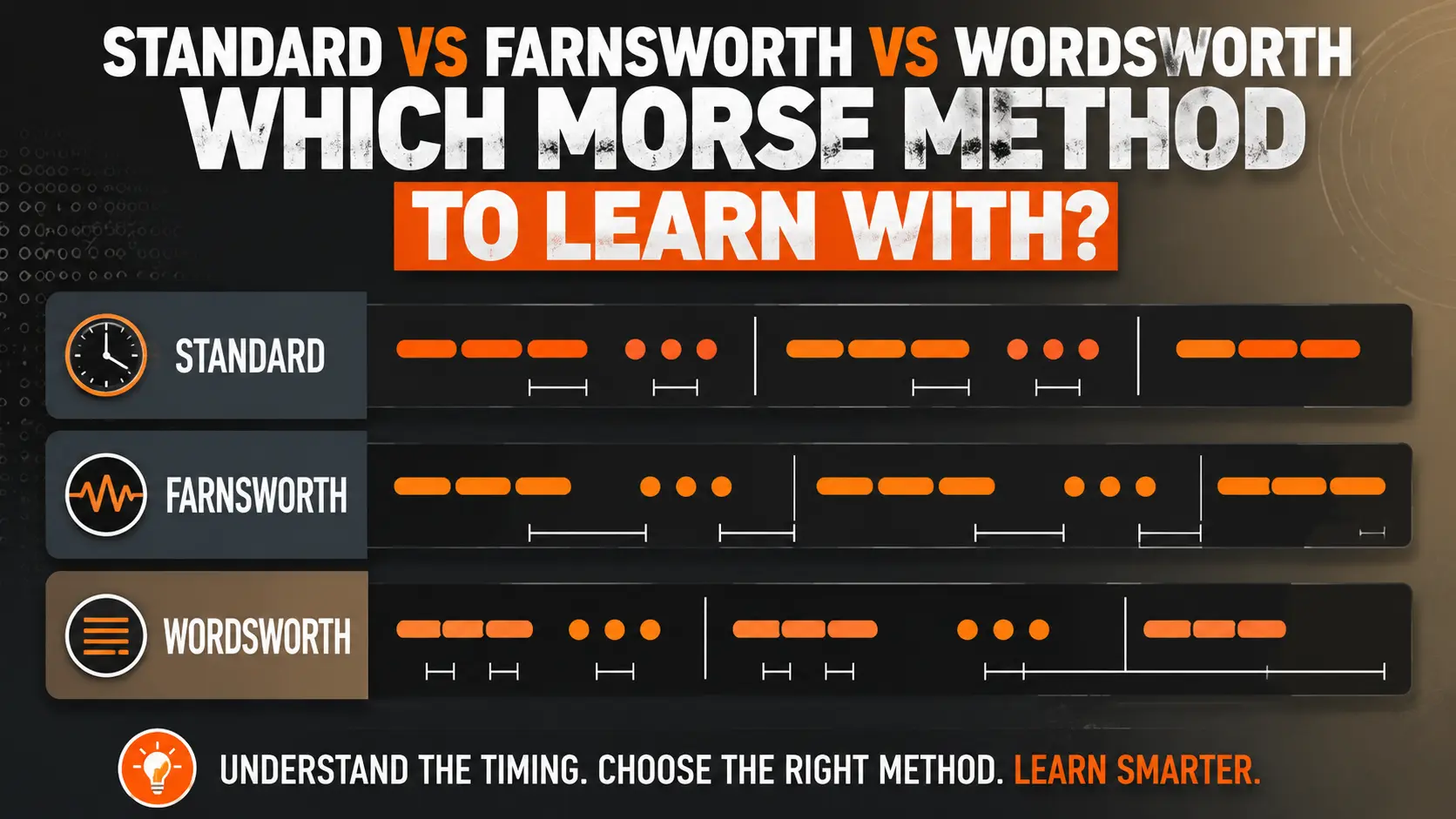
Morse code has three timing methods you will run into: standard, Farnsworth, and Wordsworth. Beginners waste a lot of time trying to figure out which one to learn with, or worse, mixing them up. The good news is that the choice is simple once you know what each one is actually for. This page sorts it out in about thirty seconds and points you to the right method for where you are right now.
Quick answer: Standard timing is the real system every operator ends up using, the fixed 1:3:7 unit structure that defines Morse itself. Farnsworth timing is for absolute beginners: it keeps each character at full speed but widens the gaps between letters and words so you learn each letter as a sound instead of counting dots. Wordsworth timing is for later: once you know your letters instantly, it stretches only the gaps between words to build word level fluency. Most people move through all three, starting with Farnsworth, then Wordsworth, then plain standard timing.
The 30-Second Decision
Pick the line that sounds like you:
- You are just starting and still learning the letters. Learn with Farnsworth timing.
- You already recognize letters instantly, but full sentences feel too fast. Move to Wordsworth timing.
- You want to understand how Morse actually works, or send and copy at true speed. Learn the standard timing rules.
Here is the same choice at a glance:
| Method | What it stretches | Best for |
|---|---|---|
| Standard timing | Nothing, pure 1:3:7 units | Sending and copying at real speed |
| Farnsworth timing | Gaps between letters and words | Beginners learning the letters |
| Wordsworth timing | Gaps between words only | Learners building word fluency |
That is the whole decision. The rest of this page explains why each one fits its stage, so the choice makes sense.
Standard Timing: The Foundation
Standard timing is the base system that Morse code is built on. Everything is measured in one unit, the length of a single dot:
| Element | Length |
|---|---|
| Dot | 1 unit |
| Dash | 3 units |
| Gap between parts of a letter | 1 unit |
| Gap between letters | 3 units |
| Gap between words | 7 units |
Speed just changes how long one unit lasts. At 20 words per minute a unit is 60 milliseconds, and every other value scales from there. This is not a learning trick. It is the real target, the timing used in aviation, maritime, and emergency signaling.
Here is the part that ties everything together: Farnsworth and Wordsworth are both just standard timing with certain gaps stretched out. When your speed catches up and you stop needing the extra space, they collapse straight back into standard timing. So you are never really leaving it, you are only adding training space and then removing it again. The full breakdown lives on the standard timing rules page.
Farnsworth Timing: For Learning Your First Characters
Farnsworth timing is the beginner method. Each character is sent at full speed, but extra silence is added between letters and between words to slow the overall pace down.
The reason this works is subtle but important. If you slow the characters themselves down, you start counting the individual dots and dashes, and that habit is very hard to unlearn later. Farnsworth keeps the character sounding exactly the way it will at real speed, so your ear learns the whole shape of the letter from day one. You just get generous thinking time between letters while you are still slow.
It is named after Donald R. “Russ” Farnsworth, and it has been used in official training programs for decades. A common beginner setting is characters at 20 words per minute with a much slower effective speed, which you then raise as you improve. If you do not yet know the alphabet by ear, this is where you start. See the full method on the Farnsworth timing page.
Wordsworth Timing: For Building Word Fluency
Wordsworth timing is the next step up. Instead of stretching the gaps between letters, it stretches only the gaps between words. The characters and the spaces inside and between them stay at full speed.
This suits a very specific moment in learning. You already recognize every letter the instant you hear it, but when letters come together into real words and sentences, your brain needs an extra beat to keep up. Widening just the word gaps gives you that beat while keeping everything else honest.
One thing worth being clear about: Wordsworth timing is a teaching convention, not an official standard. The name is a play on “Farnsworth” with a nod to the poet, and it was coined at Morse Code World rather than defined by the ITU. It is a genuinely useful training idea, it just does not carry the same official status as the standard rules. If instant character recognition is behind you and words are the wall, this is your method. It is explained in full on the Wordsworth timing page.
How the Three Fit Together
These are not three rival systems to choose between once and for all. They are three stages of the same road. The only thing that changes between them is where the extra silence goes, which is exactly what the comparison table above lays out.
A typical path looks like this. You learn your letters with Farnsworth. Once the letters are automatic, you switch to Wordsworth to get comfortable with whole words. As your effective speed climbs, the extra gaps shrink until they disappear, and what you are left with is plain standard timing at real speed. That is the finish line for everyone, no matter which method got them there.
Which One Should You Start With?
If you take nothing else from this page, take this. Beginners should start with Farnsworth timing. Learners who already know their characters should use Wordsworth timing. And everyone should understand the standard timing rules, because that is the code you are really working toward. When you are ready to hear the difference, put any of them into practice on the Morse code practice tool.
Frequently Asked Questions
Farnsworth timing stretches the gaps between letters and between words. Wordsworth timing stretches only the gaps between words. Both keep the characters themselves at full speed.
Farnsworth timing. It keeps each letter sounding correct while giving you extra time between letters, which stops the habit of counting dots and dashes.
No. Wordsworth timing is a teaching convention, not an ITU standard. The name is a play on Farnsworth, and it is used as a learning aid for word recognition.
Yes. Standard timing is the real system used in actual Morse communication. Farnsworth and Wordsworth are training stages that collapse back into standard timing once your speed catches up.
You can learn directly at standard timing, but most people find it much harder. The two methods exist because they make the early stages of learning far smoother.
Sources
- A Standard for Morse Timing Using the Farnsworth Technique (ARRL). The Farnsworth method of full speed characters with widened spacing between letters and words, named after Donald R. Farnsworth.
- Morse code (Wikipedia). The standard unit ratios and the ITU-R M.1677-1 definition of International Morse code timing.
