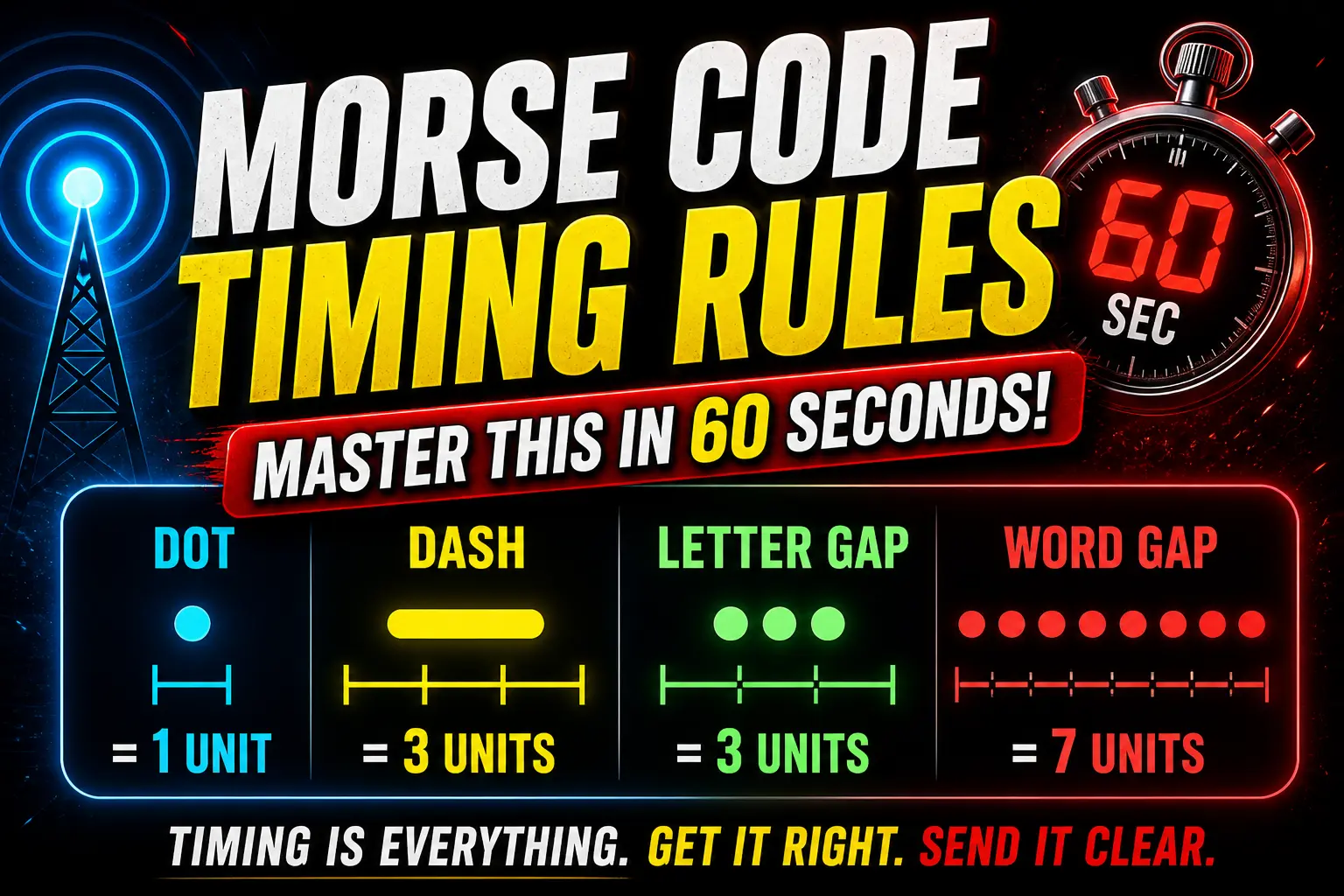
Morse code timing is the system that controls how long dots and dashes last and how spacing works between them. These Morse code timing rules define how signals are formed and interpreted in international communication systems.
If the timing is wrong, the same sequence can become unreadable or mean something else entirely. Because of this, International Morse code uses timing based on a unit system.
This structure defines all parts of transmission, including signal length, spacing, and speed measurement. These Morse code spacing rules are used in all standard communication systems to ensure clarity and consistency.
These rules follow international radio communication standards used in aviation, maritime communication, and emergency signaling systems.
To understand how symbols are formed, you can refer to the Morse Code Alphabet or try entering your own text in the Morse Code Translator to see how timing works in real signals.
Morse Code Timing Rules
- Dot = 1 unit
- Dash = 3 units
- Gap between parts of a letter = 1 unit
- Gap between letters = 3 units
- Gap between words = 7 units
These are the standard Morse code timing rules used in all international communication systems.
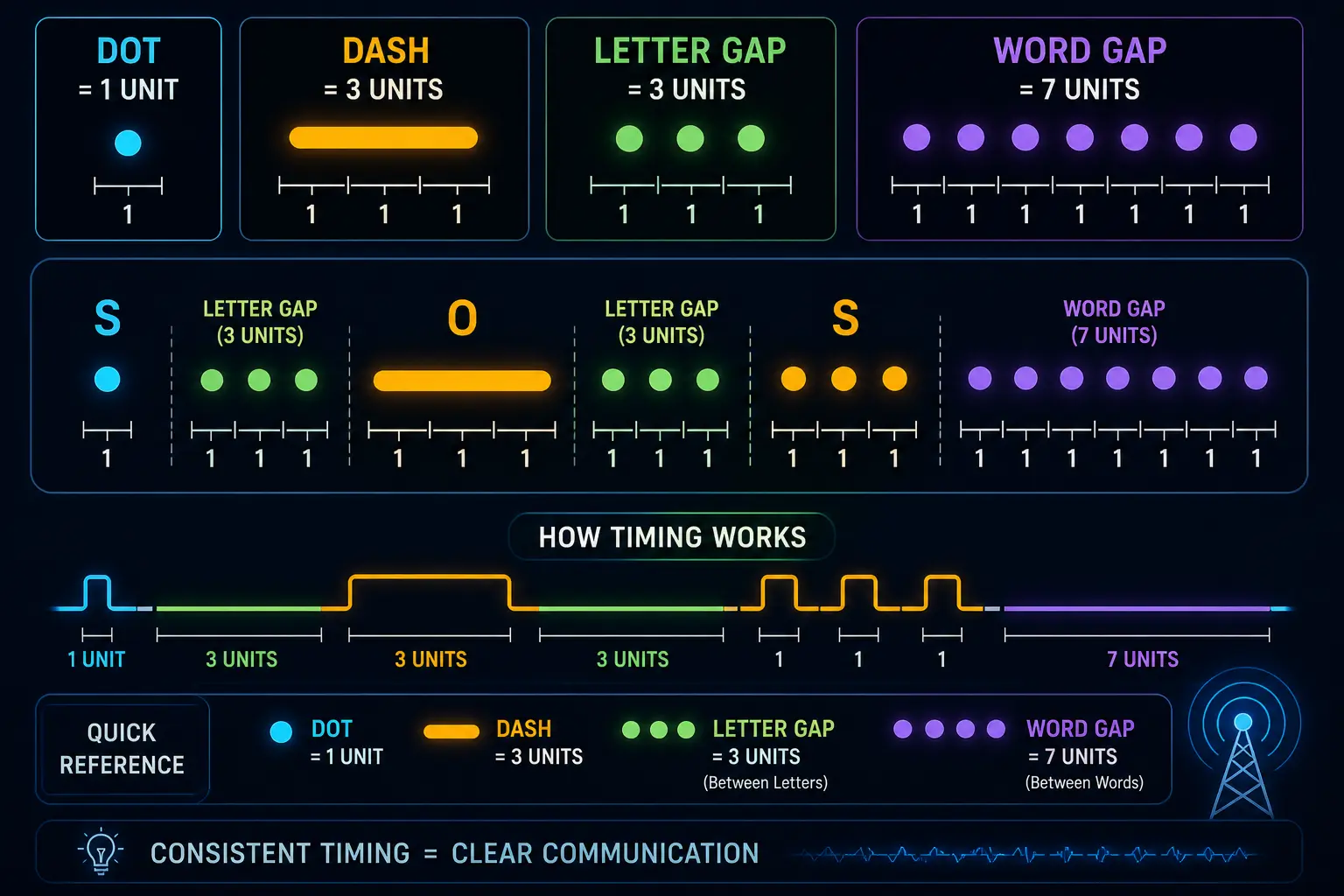
Unit System in Morse Code
Morse code timing is based on a single reference unit.
One unit represents the duration of a dot.
Everything else is defined relative to this reference.
Dot Duration
A dot is the base time unit in the system.
Dash Duration
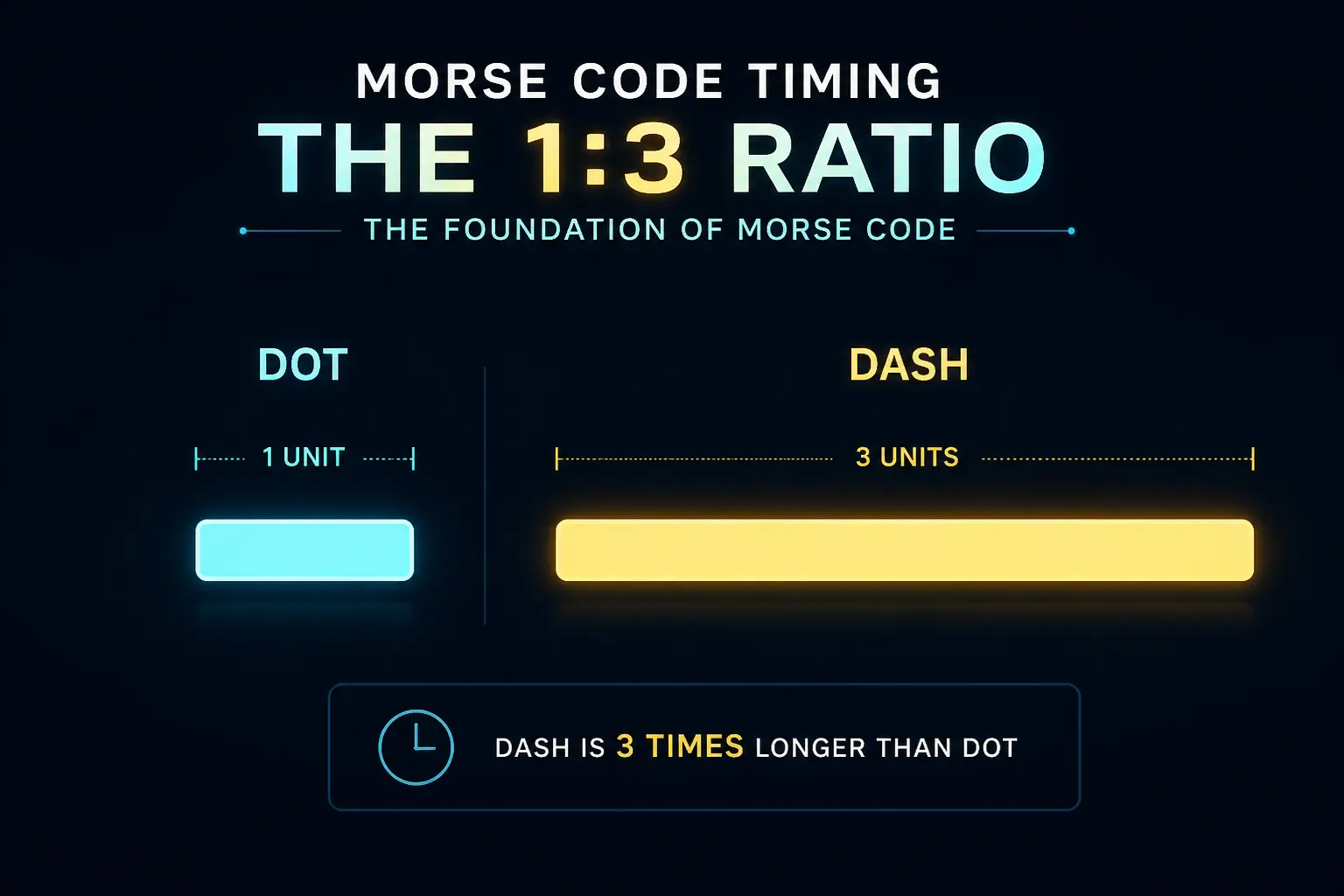
In Morse code, a dash lasts 3 units, while a dot lasts 1 unit.
This ratio is fixed and remains the same at all speeds. These Morse code timing rules remain consistent regardless of transmission speed.
The relationship between a dot and a dash forms the foundation of Morse code timing.
Timing Structure Inside a Character
A single character is not a continuous sound. It consists of a sequence of signals separated by short intervals.
Gap Between Elements of a Character
The gap between parts of a letter is 1 unit.
This gap separates dots and dashes within the same letter and ensures each element is clearly distinguishable without breaking the character.
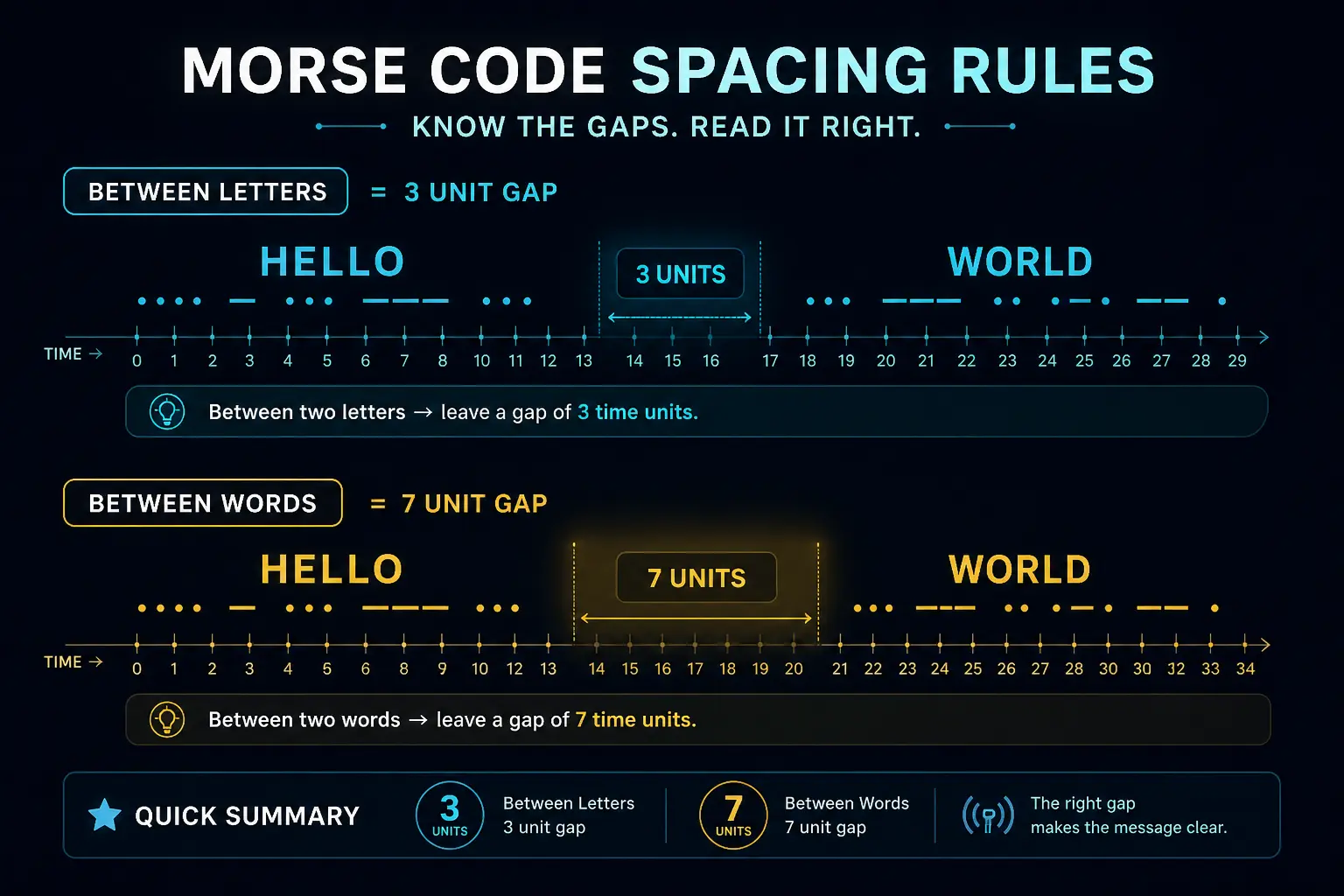
Spacing Between Characters
Each Morse code letter is separated by a longer pause.
Gap Between Letters
The gap between letters is 3 units.
This duration equals one dash and helps the receiver identify where one character ends and the next begins.
Without spacing, a sequence of letters becomes unreadable. You can see full structures in the Morse Code Chart.
The gap between letters is shorter than the gap between words, which helps separate individual characters from full words.
Spacing Between Words
Words require even longer spacing to maintain clarity.
Gap Between Words
The gap between words is 7 units.
This extended pause separates words clearly and prevents misinterpretation of continuous characters as one group.
Morse Code Timing Rules and Structure
| Element | Time Units |
|---|---|
| Dot | 1 unit |
| Dash | 3 units |
| Gap within letter | 1 unit |
| Gap between letters | 3 units |
| Gap between words | 7 units |
Morse Code Timing Example
For example, the letter A (· –) follows this timing structure:
- Dot = 1 unit
- Gap between signals = 1 unit
- Dash = 3 units
This example shows how Morse code timing rules work in real transmission patterns.
Speed Measurement and WPM System
Morse code speed is measured in words per minute (WPM). The standard reference word is “PARIS,” which represents 50 time units.
This method is used in Morse code speed calculation across international communication systems to maintain consistency.
Unit Duration Formula
\text{Unit duration (ms)} = \frac{1200}{\text{WPM}}This formula converts speed into time per unit in milliseconds.
Example at 20 WPM
\frac{1200}{20} = 60\,msAt this speed:
- One unit equals 60 milliseconds
- Dot duration equals 60 milliseconds
- Dash duration equals 180 milliseconds
Even when speed changes, the ratio between dot and dash remains the same.
Timing Behavior at Different Speeds
At lower speeds, the unit duration increases, so each signal lasts longer.
At higher speeds, the unit duration decreases, compressing all signals proportionally.
The structure does not change at any speed. Only the timing intervals adjust.
Farnsworth Timing Method
This method is used to improve readability and learning.
- Characters are sent at normal speed
- Gaps between characters are extended
This allows the brain to recognize patterns without slowing the signal itself.
You can practice this method on the Morse Code Practice Tool or try real phrases like Hello in Morse Code to understand timing better.
For a deeper understanding of this learning method, see Farnsworth timing in Morse code, where spacing and perception are explained in detail.
Common Timing Issues
Most interpretation errors come from incorrect timing rather than wrong symbols.
- Dash not equal to three units
- Missing or inconsistent spacing
- Incorrect word separation
- Irregular rhythm during transmission
These issues can change meaning even when the correct sequence is used. For example, emergency signals like SOS in Morse Code depend heavily on correct timing. You can also explore common phrases on the Morse Code Words page.
Functional Importance of Timing
Timing defines the structure of Morse code. Without it, signals become unclear and meaningless.
It allows:
- Separation of characters
- Separation of words
- Consistent decoding at any speed
- Universal interpretation across systems
This makes Morse code reliable for communication systems that require clarity and simplicity.
You can test these Morse code timing rules instantly using the Morse Code Translator.
Frequently Asked Questions
Morse code timing is the system that defines how long dots and dashes last and how much space exists between signals, letters, and words. It follows a fixed unit structure so messages remain clear and readable.
Morse code timing works using a unit system where one dot equals one unit of time. A dash is three units long. Spaces between parts of a letter are one unit, between letters are three units, and between words are seven units.
The basic unit in Morse code timing is the dot. All other signals and spaces are measured relative to the duration of one dot.
A dash is three times longer than a dot. This 1 to 3 ratio remains the same at all speeds.
Morse code spacing rules include a 1 unit gap between parts of the same letter, a 3 unit gap between letters, and a 7 unit gap between words.
The gap between letters in Morse code is 3 time units. This pause is equal to the length of one dash and helps separate one letter from another.
Timing is important because it separates signals into clear letters and words. Without correct timing, Morse code can become confusing or change meaning.
Morse code speed is measured in words per minute, or WPM. It uses the standard word “PARIS,” which equals 50 time units, to calculate timing.
The unit duration in milliseconds is calculated using the formula 1200 divided by WPM. This determines how long each dot lasts at a specific speed.
When speed increases, each unit becomes shorter. However, the ratio between dots, dashes, and spacing remains the same.
A common approach is to focus on rhythm instead of counting dots and dashes. Listening to patterns and practicing regularly helps build recognition faster.
The Farnsworth technique is a learning method where characters are sent at normal speed, but the spaces between them are longer. This helps learners understand patterns without reducing character speed.
Common mistakes include incorrect dash length, missing spacing, wrong word gaps, and inconsistent rhythm. These errors can make messages unclear even if the symbols are correct.
Conclusion
In Morse code timing, dot equals 1 unit, dash equals 3 units, letter gap equals 3 units, and word gap equals 7 units.
Morse code timing is based on a fixed unit system that defines signal length and spacing. Regardless of speed, the structure remains consistent and supports clear communication.
To read or transmit Morse code accurately in any situation, understanding these Morse code timing rules is essential.
Advanced learners can take this further with Wordsworth Timing, which modifies only word spacing while keeping the core timing rules unchanged.
