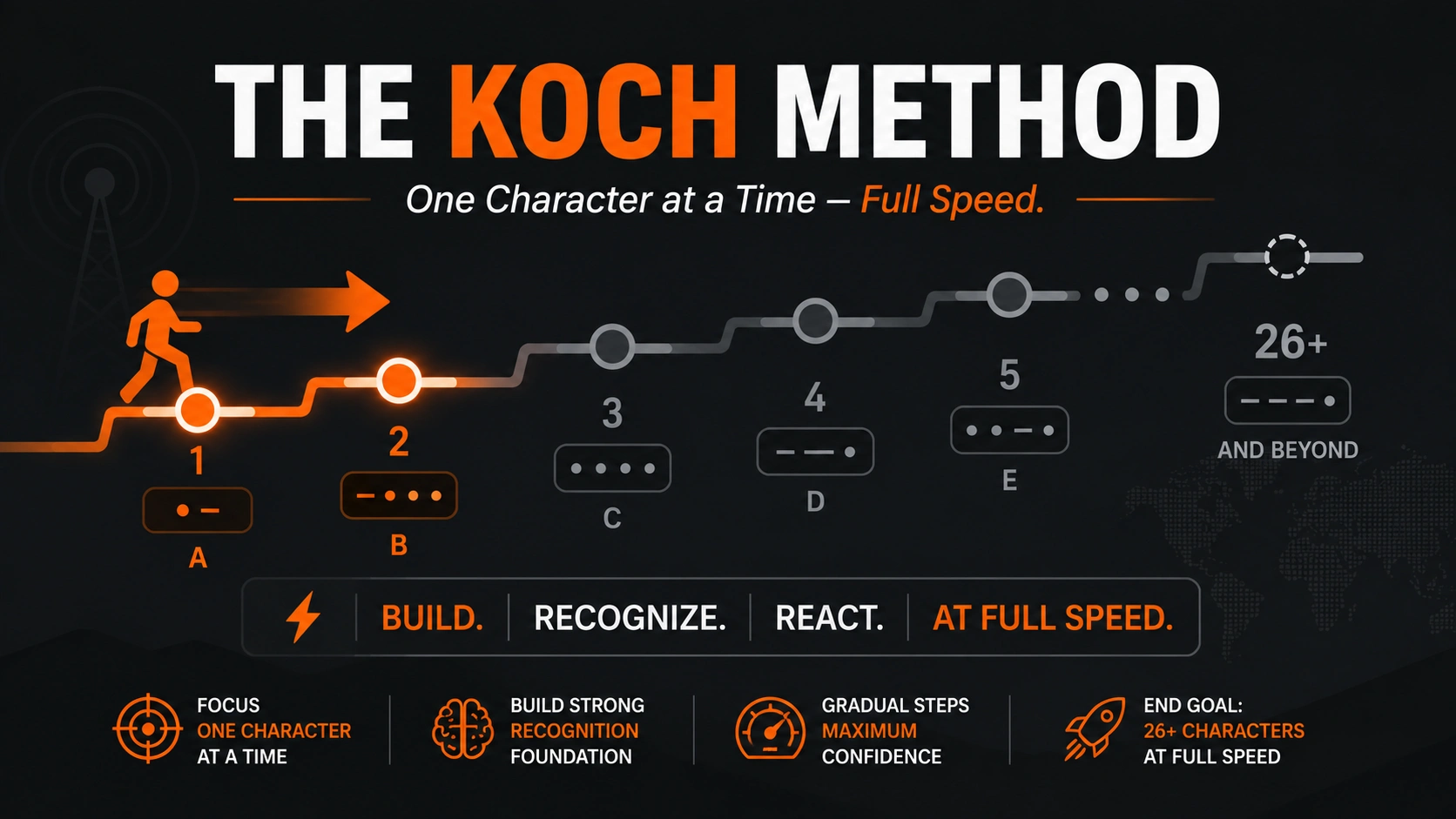
If you’ve read guides on how to learn Morse code fast, you’ve probably run into the term “Koch Method” without a clear explanation of what it actually is, why it works, or how to use it correctly. Most articles mention it in a single sentence and move on. This one doesn’t. Here’s exactly what the Koch Method is, the research behind it, the math behind “full speed,” and how to apply it step by step.
Quick answer: The Koch Method is a Morse code training technique developed by German engineer Ludwig Koch in the 1930s. Instead of learning slowly and speeding up later, you learn just two characters at full target speed (18-20 wpm), add one new character only once you can copy the current set with 90% accuracy, and repeat until the full character set is mastered. It’s built on the idea that Morse code is a reflex, not a translation task.
What Is the Koch Method?
The Koch Method is a character-acquisition system for learning Morse code by ear. It was published in 1936 by Ludwig Koch, based on training research he conducted in Germany. Rather than teaching all 26 letters at once, or teaching them slowly and increasing speed over time, the Koch Method restricts training to a tiny character set — starting with just two letters — but sends them at the full speed a proficient operator would actually use.
Once a learner can correctly copy that small set with roughly 90% accuracy, exactly one new character is added. The process repeats, one character at a time, until the learner has worked through the entire alphabet, numerals, and punctuation. The speed never changes. Only the number of characters increases.
Where the Koch Method Came From
Ludwig Koch published his method in 1936 as part of research into how people acquire Morse code characters. His central claim, later summarized by other researchers, was that Morse code recognition at low speed and Morse code recognition at high speed are two different mental skills — not the same skill performed slower. Training slowly, in Koch’s view, builds a habit that has to be unlearned later, rather than a foundation that transfers upward.
Independent reviews of Koch’s original data have since pointed out some limitations in his research — small sample sizes and comparisons drawn from separate training institutions rather than controlled experiments. That doesn’t overturn the method’s core insight, but it’s worth knowing the method is based on a strong theoretical argument and decades of practical use by radio operators, more than it is on airtight modern experimental proof.
Separately, U.S. Army-funded research into Morse code character acquisition — including a study archived by the Defense Technical Information Center — has examined related “full speed” and code-voice training approaches for military radio operators, reinforcing the same general principle: characters learned at operational speed transfer better than characters learned slowly and sped up afterward.
Why “Full Speed From Day One” Actually Works
The reasoning behind the Koch Method comes down to how the brain processes sound. At low speeds, individual dots and dashes are distinguishable enough that your brain can consciously count them — three short beeps, a gap, one long beep — and mentally look up which letter that is. This is a thinking task, and thinking tasks have a hard speed limit.
At full operational speed, individual dots and dashes blur into a single rhythmic “sound-shape” for each character — closer to how you recognize a spoken word than how you’d decode a cipher. The Koch Method trains this sound-shape recognition directly, from the very first lesson, so there’s no slow habit to unlearn later.
The Math Behind “Full Speed” (WPM and Timing)
Morse code speed is measured in words per minute (wpm), based on a standardized reference word — “PARIS” — which is defined as exactly 50 “dot units” long, including its internal spacing. This gives Morse code timing a precise mathematical basis rather than a vague “fast or slow” feel, and the character timings and proportions themselves are formally defined by the International Telecommunication Union’s Recommendation ITU-R M.1677. The duration of a single dot unit, in milliseconds, at a given speed is:
\text{Unit duration (ms)} = \frac{1200}{\text{WPM}}At 20 wpm — a typical Koch Method training speed — a single dot unit lasts 60 milliseconds. A dash is three units long (180 ms), and the gap between elements within a character is one unit (60 ms). This is why “full speed” isn’t arbitrary: it’s the actual timing ratio a real operator will encounter, which is exactly what the Koch Method wants your ear to learn from the start, rather than a stretched-out version that has different proportions.
How to Practice the Koch Method, Step by Step
- Pick a full training speed. 18-20 wpm character speed is standard. Don’t go slower — the whole method depends on training the real rhythm.
- Start with two characters. A common starting pair is
-.-(K) and--(M), though any two clearly distinct characters work. - Listen and copy. Write down or type each character as you hear it, in short 3-5 minute blocks. Don’t look at a chart while listening.
- Check your accuracy. If you’re copying the current character set with at least 90% accuracy, move on. If not, keep practicing the same set.
- Add exactly one new character. Repeat the listen-and-copy process with the expanded set.
- Continue until the full set is complete. Most Koch trainers use a 40-character sequence covering the alphabet, numerals, and essential punctuation.
This is the same progressive-unlock structure used in our own interactive Morse code practice tools, which let you drill a character set at full speed and track your accuracy before unlocking the next character.
Koch Method vs. Farnsworth Method
These two methods are often confused, but they solve the same problem in opposite ways:
| Aspect | Koch Method | Farnsworth Method |
| Character speed | Full target speed from lesson one | Full target speed from lesson one |
| Number of characters | Starts with 2, adds one at a time | Full alphabet taught together |
| Spacing between characters | Normal, full-speed spacing | Extra “thinking time” spacing, reduced over time |
| Best for | Building instant, reflex-level recognition | Beginners who need more processing time early on |
They aren’t mutually exclusive. A common hybrid approach — recommended in our full Morse code speed guide — uses Farnsworth-style extra spacing only in the first few days as a crutch, while still following the Koch structure of adding one character at a time, then removing the extra spacing as accuracy improves.
Does the Koch Method Actually Work? A Balanced Look
The short answer is yes, with a caveat worth knowing. Decades of use by radio operators, along with military-adjacent research into code-voice and full-speed training methods, support the core idea that characters learned at operational speed transfer more directly than characters learned slowly. At the same time, Koch’s original 1930s data has known limitations — it wasn’t a large, tightly controlled modern study, and some of the comparison data came from a separate military training institution rather than Koch’s own experiments.
What this means practically: treat the Koch Method as a well-supported, widely practiced framework rather than a scientifically “proven” formula. It’s the approach most current Morse code trainers and CW instructors default to, precisely because it consistently outperforms slow-and-speed-up learning in real-world use, even if the original research behind it isn’t airtight by modern standards.
Common Mistakes When Using the Koch Method
- Starting too slow “to be safe.” Training below 15-18 wpm character speed defeats the entire purpose of the method.
- Adding characters too soon. Moving on before hitting roughly 90% accuracy just stacks confusion on top of confusion.
- Looking at a written chart while listening. This reinforces visual translation instead of the auditory reflex the method is designed to build.
- Skipping numerals and punctuation. These are part of the standard character sequence and appear constantly in real messages.
- Practicing for too long per session. Fatigue causes guessing. Short, frequent sessions consistently outperform long, tired ones.
Frequently Asked Questions
The Koch Method is a training technique, published in 1936 by German engineer Ludwig Koch, that teaches Morse code characters at full target speed from the first lesson, starting with just two characters and adding one new character at a time as accuracy improves.
The Koch Method was developed and published in 1936 by Ludwig Koch, a German engineer whose research focused on how people acquire Morse code characters.
Neither method is universally “better” — the Koch Method builds instant character recognition through full-speed training with a growing character set, while the Farnsworth Method uses extra spacing for thinking time. Many learners combine both, using Farnsworth-style spacing briefly while following the Koch Method’s one-character-at-a-time structure.
Most Koch Method training uses 18-20 words per minute character speed, since the method depends on learning the real, full-speed rhythm of each character rather than a slowed-down version.
Most modern Koch Method trainers use a 40-character sequence that covers the full alphabet, numerals 0-9, and essential punctuation and procedural signs.
Yes, based on decades of practical use by radio operators and supporting research into full-speed character training, though Koch’s original 1930s study had some methodological limitations by modern research standards.
References
- International Telecommunication Union — Recommendation ITU-R M.1677-1, International Morse Code
- U.S. Army Research Institute for the Behavioral and Social Sciences, via Defense Technical Information Center — Learning Morse Code Characters: A Replication of the Keller Method
The Koch Method isn’t a trick or a shortcut — it’s a specific, well-tested training structure built on a simple idea: learn the real sound of Morse code from day one, and let the character set grow instead of the speed. If you’re ready to put it into practice, our step-by-step Morse code speed guide walks through a full 4-week plan built on this exact method.
