Quick answer
Morse code did reach prisoners of war, but not in the way films suggest. The most famous confirmed case is US Navy Commander Jeremiah Denton, who blinked the word
TORTUREin Morse during a televised propaganda interview in Hanoi in 1966, giving American intelligence its first clear confirmation that POWs were being tortured. What prisoners did not generally do was tap Morse on walls and pipes, because a tap cannot express the difference between a dit and a dah. That limitation is exactly why American POWs in Vietnam used a completely different system, the tap code, which is often mistaken for Morse.
Why Morse suits captivity in principle
Morse has one property that makes it unusually well suited to imprisonment: it does not depend on any particular medium.
The code is a pattern of short and long signals. Whether those signals are sound, light, movement or pressure is irrelevant, as long as the receiver can tell short from long. That means it can be sent with a torch, a mirror, a hand squeeze, a cough, or the blink of an eye.
It also requires no equipment and cannot be confiscated. A prisoner who knows Morse carries the capability in their head.
For military personnel of the period, that knowledge was widespread. Aviators and naval officers had been trained in it, so a shared code already existed between people who had never met.
But there is a hard limit hiding in that first paragraph, and it shaped everything that follows.
The case that genuinely was Morse: Jeremiah Denton, 1966
On 18 July 1965, US Navy Commander Jeremiah Denton was shot down over North Vietnam and captured. He would remain a prisoner for seven and a half years.
On 2 May 1966, his captors arranged for him to be interviewed by a Japanese television reporter as part of a propaganda effort. Denton answered questions about his treatment in the way he was expected to, describing adequate food and medical care, while stating on camera that he continued to support his own government.
What his captors did not notice was what he was doing with his eyes. Throughout the interview he blinked, repeatedly and deliberately, in Morse code: T-O-R-T-U-R-E.
The tape circulated widely and was reviewed by US Naval Intelligence, who picked up the message. It was the first clear confirmation American intelligence had received that prisoners in North Vietnam were being tortured. Denton later believed his captors did not work out what he had done until 1974, well after the fact. The recording is held in the US National Archives.
Denton was released in February 1973. He was later awarded the Navy Cross, and went on to serve as a United States Senator.
This case works because of the medium. A blink can be short or long. The distinction that Morse depends on survives.
The myth: tapping Morse on a wall
This is where most accounts, and most films, go wrong.
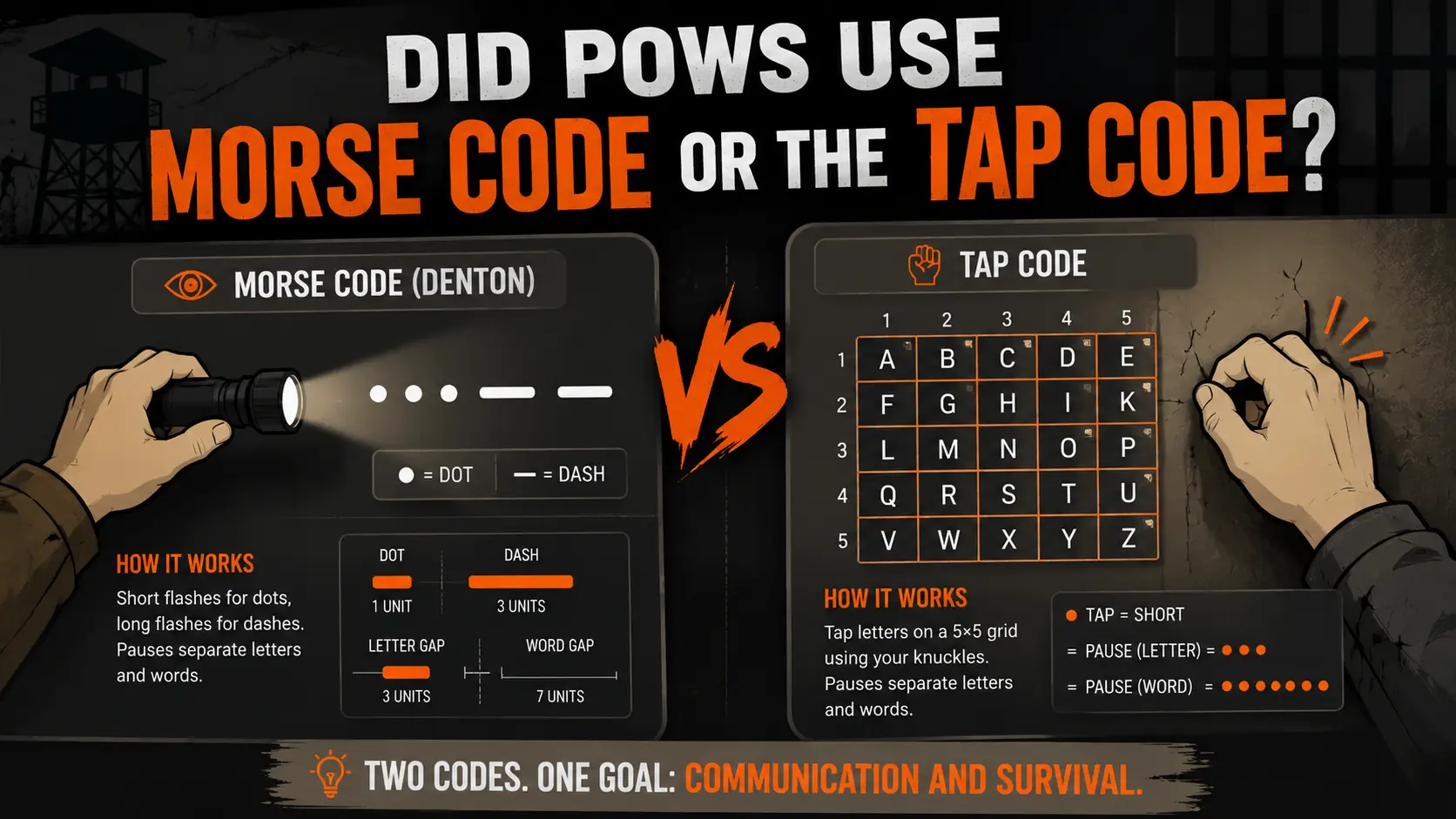
Morse requires the receiver to distinguish a dit from a dah, and the difference is duration. A dah is three times the length of a dit.
A knock on a concrete wall or a metal pipe is a single percussive event. It has no length. Tap softly or firmly, quickly or slowly, and the sound the receiver hears is essentially the same brief noise. There is no practical way to make a tap last three times as long as another tap.
So a message tapped in Morse arrives as an undifferentiated string of identical knocks. The receiver has the timing between them, but not the element lengths, and Morse without element lengths is unreadable.
The scene in which prisoners tap Morse through pipes is dramatically satisfying and technically wrong. Faced with that limitation, the prisoners at Hoa Lo turned to a different system rather than persisting with Morse.
What POWs in Vietnam actually used: the tap code
In June 1965, at Hoa Lo Prison in Hanoi, known to its prisoners as the Hanoi Hilton, four American officers worked out a system that would spread through the camp and become one of the most remarkable communication stories of the war.
Air Force Captain Carlyle “Smitty” Harris, along with Navy officers Phillip Butler, Robert Peel and Robert Shumaker, needed a way to talk between cells. Morse was the obvious candidate and it did not work, for exactly the reason above. There was no way to knock a dash.
Harris remembered a different system entirely. An Air Force instructor had once shown him a grid based code, describing how prisoners in the Second World War had used it on shared water pipes.
How the tap code works
The tap code arranges the alphabet in a five by five grid. That gives 25 cells for 26 letters, so one letter is dropped, usually K, with C used in its place.
Each letter is sent as two groups of taps. The first group gives the row, the second gives the column, with a short pause between them.
Reading across the standard grid, A B C D E occupy the first row, F G H I J the second, L M N O P the third, Q R S T U the fourth, and V W X Y Z the fifth.
So:
- A is row 1, column 1:
. . - B is row 1, column 2:
. . . - H is row 2, column 3:
.. ... - W is row 5, column 2:
..... ..
Every tap is identical. Nothing depends on duration. That is the entire reason it works where Morse does not.
The trade off is speed. Morse sends E as a single dit, while the tap code needs a minimum of two taps and up to ten for a letter in the far corner of the grid. It is slower and clumsier, and it was the right choice anyway, because a slow readable system beats a fast unreadable one.
Prisoners also developed the conventions that make any code usable in practice. A prisoner wanting to start a conversation would tap the opening rhythm of “shave and a haircut” and wait for the two answering knocks.
Morse code and tap code compared
| Feature | Morse code | Tap code |
|---|---|---|
| Signal type | Short and long signals | Identical taps |
| Depends on signal duration? | Yes | No |
| Basic principle | Signal duration and spacing | Row and column |
| Designed for identical knocks? | No | Yes |
| Works by tapping a wall? | Not reliably | Yes |
| Main POW example | Denton blinking, 1966 | Hoa Lo Prison, 1965 |
| Relative speed | Generally faster | Generally slower |
Why the tap code mattered so much
The prisoners were held in isolation, and communication between them was forbidden and punished. The tap code broke that isolation.
It allowed them to pass names, so that the identity of every prisoner could be recorded and eventually carried home. It let them maintain a chain of command, agree resistance policy, and warn each other about interrogation methods. Men returning from interrogation would report what had happened as soon as the guard had gone.
It also did something harder to quantify. A returning prisoner would sometimes hear three letters tapped through the wall, G B U, for “God bless you”. In solitary confinement, that mattered.
The four originators were separated after one was caught passing a note, which had the opposite effect to the one intended. Each man taught the code in his new location. By August 1965, most of the prisoners in the camp knew it.
Where Morse genuinely appeared in the Second World War
Morse also reached POW camps in the Second World War, but through radio rather than through walls.
Prisoners in German camps frequently had access to radio receivers, either smuggled in or built from components inside the camp. British intelligence, through the organization MI9, exploited that by hiding coded messages inside ordinary BBC broadcasts. A particular programme was used, and the presenter’s choice of opening words signaled to listening prisoners that a coded message was coming. Prisoners took the broadcast down in shorthand and decoded it afterwards.
The American equivalent, MIS-X, operated from a secret site at Fort Hunt in Virginia, known by its mailing address as P.O. Box 1142. It sent prisoners parcels that appeared to come from charitable foundations, containing objects that were not what they seemed. Cribbage boards concealed radio receivers. Baseballs held hidden cavities. Pipes contained maps and miniature compasses.
Coded letters ran in both directions, using systems agreed before capture, so that a prisoner’s ordinary looking letter home could carry intelligence past a censor.
At the end of the war, staff were ordered to destroy the MIS-X records, which is why the programme is less well documented than others of its kind.
Note what all of this has in common. Where Morse was involved, it arrived by radio, a medium where a tone can be short or long. The moment the medium could not express duration, prisoners used something else.
Why the distinction matters
Conflating the tap code with Morse flattens the more interesting story.
What the Hanoi prisoners did was not simply use a code they had been taught. They identified that the obvious tool did not fit the constraint, recalled a different system from a second hand account of an earlier war, adapted it, taught it covertly under threat of punishment, and built a functioning communication network across a prison designed to prevent exactly that.
Calling it Morse turns an act of problem solving into a piece of routine training. The truth is more impressive.
Frequently asked questions
In some situations, yes. The clearest confirmed case is Jeremiah Denton blinking TORTURE in Morse during a televised interview in Hanoi in 1966. Morse also reached POW camps in the Second World War via radio broadcasts, but it was not generally used for tapping between cells.
No. They are entirely different systems. Morse uses short and long signals of differing duration, while the tap code uses identical taps counted in two groups, giving a row and a column on a five by five grid.
Because a tap has no duration. You cannot make a knock three times longer to represent a dah, so a Morse message tapped on a wall arrives as a string of identical sounds that cannot be decoded.
It was introduced at Hoa Lo Prison in June 1965 by Captain Carlyle Harris with Phillip Butler, Robert Peel and Robert Shumaker. Harris had learned the grid system from an Air Force instructor, who described its use by prisoners in the Second World War.
The single word TORTURE, during a propaganda interview on 2 May 1966. It gave US intelligence its first clear confirmation that American prisoners in North Vietnam were being mistreated.
Mainly by radio. Prisoners had smuggled or homemade receivers, and intelligence services concealed coded material inside ordinary broadcasts, which prisoners transcribed and decoded afterward.
Not reliably. Without a way to vary the length of each signal, the essential distinction in Morse is lost. Systems designed for tapping, like the tap code, count taps instead of measuring them.
References and further reading
- US National Archives. Holds the recording of the Denton interview within records of the Central Intelligence Agency, and states that his message was the first clear confirmation received by US intelligence that American POWs were being tortured.
- PBS American Experience. Documents the tap code grid, its introduction at Hoa Lo, and how it spread through the camp.
- Air and Space Forces Magazine. Records that the prisoners turned to the tap code specifically because there was no way to produce a dash sound on the concrete walls of their cells.
- National Veterans Memorial Museum. Covers the tap code’s origins in the Polybius square and the conventions prisoners used with it.
- NPR reporting on MIS-X and Fort Hunt. Details the concealed radio receivers and other items sent to American prisoners in Europe.
- Accounts by former prisoners. Carlyle Harris and Jeremiah Denton both published memoirs of their captivity.
Final word
Morse code did reach prisoners of war, and in Denton’s case it carried one of the most consequential single words of the war, sent with nothing but his eyelids.
But the popular image of prisoners tapping Morse through pipes is wrong, and the real story is better. Faced with a code that could not survive the only medium available to them, prisoners in Hanoi found a different one, taught it in secret at considerable personal risk, and used it to hold themselves together for years.
The lesson is one any signaler would recognize. The code has to fit the channel. When it does not, you change the code.
