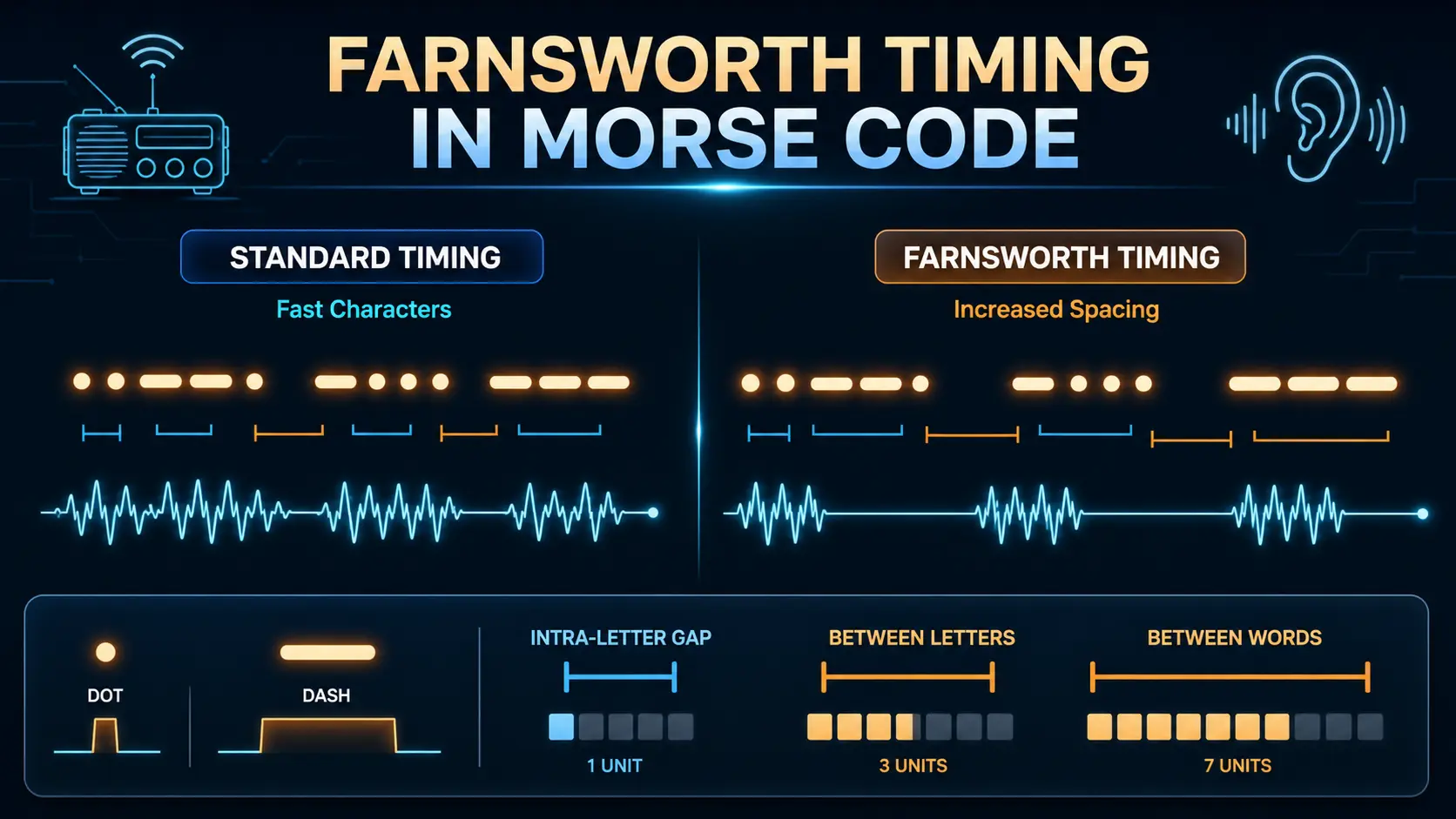
Farnsworth timing in Morse code is a training approach that teaches novices to absorb Morse code faster without actually slowing down the character speed. It does this by keeping the speed of dots and dashes normal while increasing the spacing between letters and words.
This method or style is often used in Morse code practice, as it trains the brain to recognize patterns rather than count dots and dashes.
If you are a Morse code novice, it is best to start by understanding the basic structure of the language using the Morse Code Alphabet or practicing timing with a Morse Code Translator.
What Farnsworth Timing Means
Farnsworth timing in Morse code is a learning method that focuses on rhythm recognition instead of symbol counting.
It works by sending Morse code characters at normal speed, while increasing spacing between letters and words.
The signal speed does not change. Only spacing changes.
This makes it easier to learn Morse code timing without slowing real communication systems.
How Farnsworth Timing Works
In standard Morse code, timing is strictly controlled using fixed rules for dots, dashes, and spacing. These rules are explained in detail in Morse code timing rules, which form the foundation of Farnsworth timing.
In Farnsworth timing:
- Characters are sent at full speed
- Spaces between letters are longer
- Word spaces are longer as well
This helps the brain process sound patterns instead of decoding each symbol separately.
Standard Timing vs Farnsworth Timing
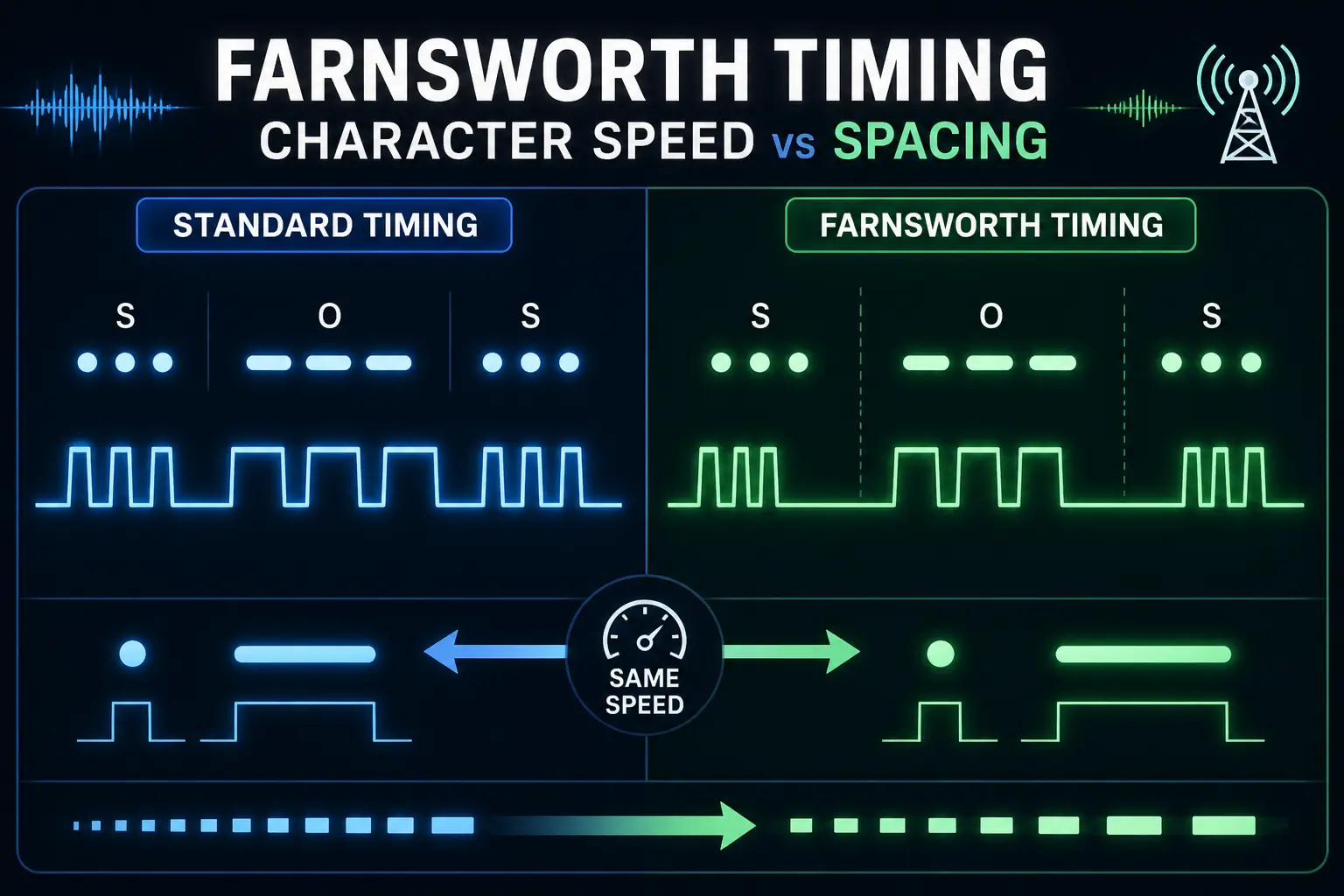
Standard Morse code and Farnsworth timing share the same signal structure.
The difference is only in spacing.
- Standard timing = normal speed + normal spacing
- Farnsworth timing = normal speed + extended spacing
The dot and dash structure never changes.
Why Farnsworth Timing Helps Learning
Beginners often try to count dots and dashes, which slows learning and reduces comprehension.
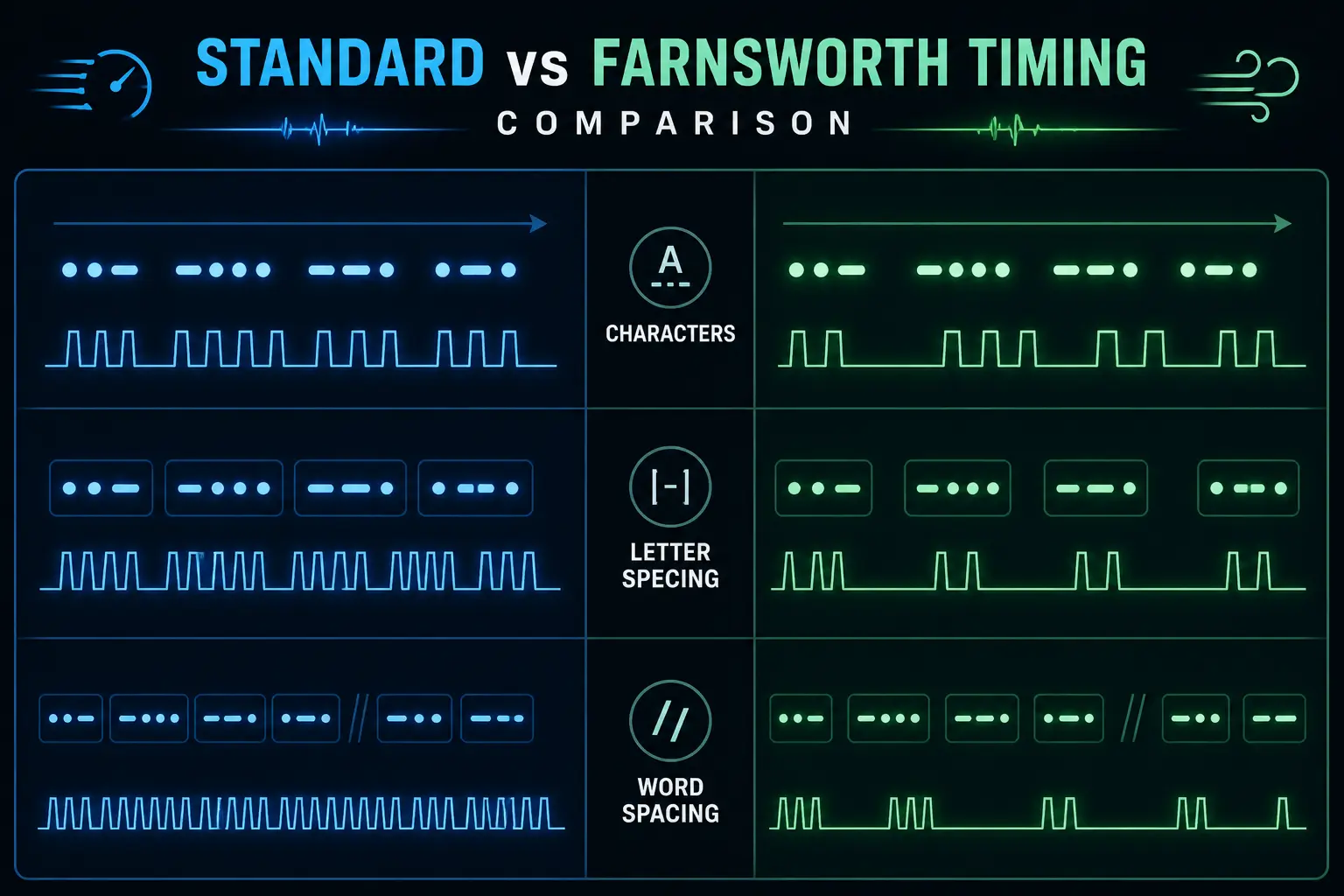
Farnsworth timing removes this issue by increasing spacing between characters.
This helps learners:
- Recognize Morse code sound patterns
- Improve listening speed in CW communication
- Stop symbol-based decoding
- Build natural rhythm understanding
This trains the brain to listen instead of calculate.
Morse Code Speed and Farnsworth Timing
Morse code speed is measured in words per minute (WPM). Farnsworth timing separates two important ideas:
- Character speed: how fast each letter is sent
- Perceived speed: how fast the message feels to the learner
This allows training at higher speeds while still improving comprehension.
Unit Timing Formula
\text{Unit duration (ms)} = \frac{1200}{\text{WPM}}This formula defines how long one unit of Morse code lasts.
Speed Relationship
T \propto \frac{1}{\text{WPM}}This shows that as speed increases, unit time decreases proportionally, while structure remains unchanged.
Perceived Speed Model
V_{effective} = V_{character} \neq V_{perceived}This explains how Farnsworth timing separates actual signal speed from human perception of message speed.
Real Calculation Examples
Example 1: 15 WPM
\frac{1200}{15} = 80\,msAt 15 WPM:
- One unit = 80 ms
- Dot duration = 80 ms
- Dash duration = 240 ms
Example 2: 25 WPM
\frac{1200}{25} = 48\,msAt 25 WPM:
- One unit = 48 ms
- Dot duration = 48 ms
- Dash duration = 144 ms
These examples show how Morse code timing scales with speed.
Spacing in Farnsworth Timing
In standard Morse code:
- Gap between parts of a letter = 1 unit
- Gap between letters = 3 units
- Gap between words = 7 units
In Farnsworth timing:
- Letter spacing is increased
- Word spacing is increased
- Dot and dash timing remains constant
This improves learning without changing signal structure.
Farnsworth Spacing Model
S_{F} = S_{standard} + \Delta SThis shows that Farnsworth timing increases spacing while preserving Morse code structure.
Example of Farnsworth Timing
A standard Morse code message sounds fast and tightly packed.
In Farnsworth timing:
- Each letter still sounds fast
- Pauses between letters are longer
- Words are easier to separate
This helps beginners understand full sentences instead of isolated signals.
Where Farnsworth Timing Is Used
Farnsworth timing is widely used in real learning environments such as:
- Amateur radio CW training
- Morse code practice systems
- Beginner communication training
- Signal recognition drills
It is not a different code. It is a training method for standard Morse code.
Common Mistake in Learning Morse Code
A common mistake is slowing down the entire Morse code signal.
This reduces long-term learning efficiency.
Farnsworth timing fixes this by keeping character speed unchanged and only increasing spacing.
This improves real-world listening skills instead of memorization.
How to Practice Farnsworth Timing
The best way to learn Farnsworth timing is through consistent listening practice.
Start with simple words and focus on rhythm instead of individual symbols.
As recognition improves, gradually increase speed.
You can practice using Morse code practice tools or explore real words from the Morse code words section.
Functional Importance of Farnsworth Timing
Farnsworth timing improves Morse code learning efficiency and real-world usability.
It helps learners:
- Understand rhythm patterns
- Improve CW listening accuracy
- Build real communication skills
- Reduce cognitive overload
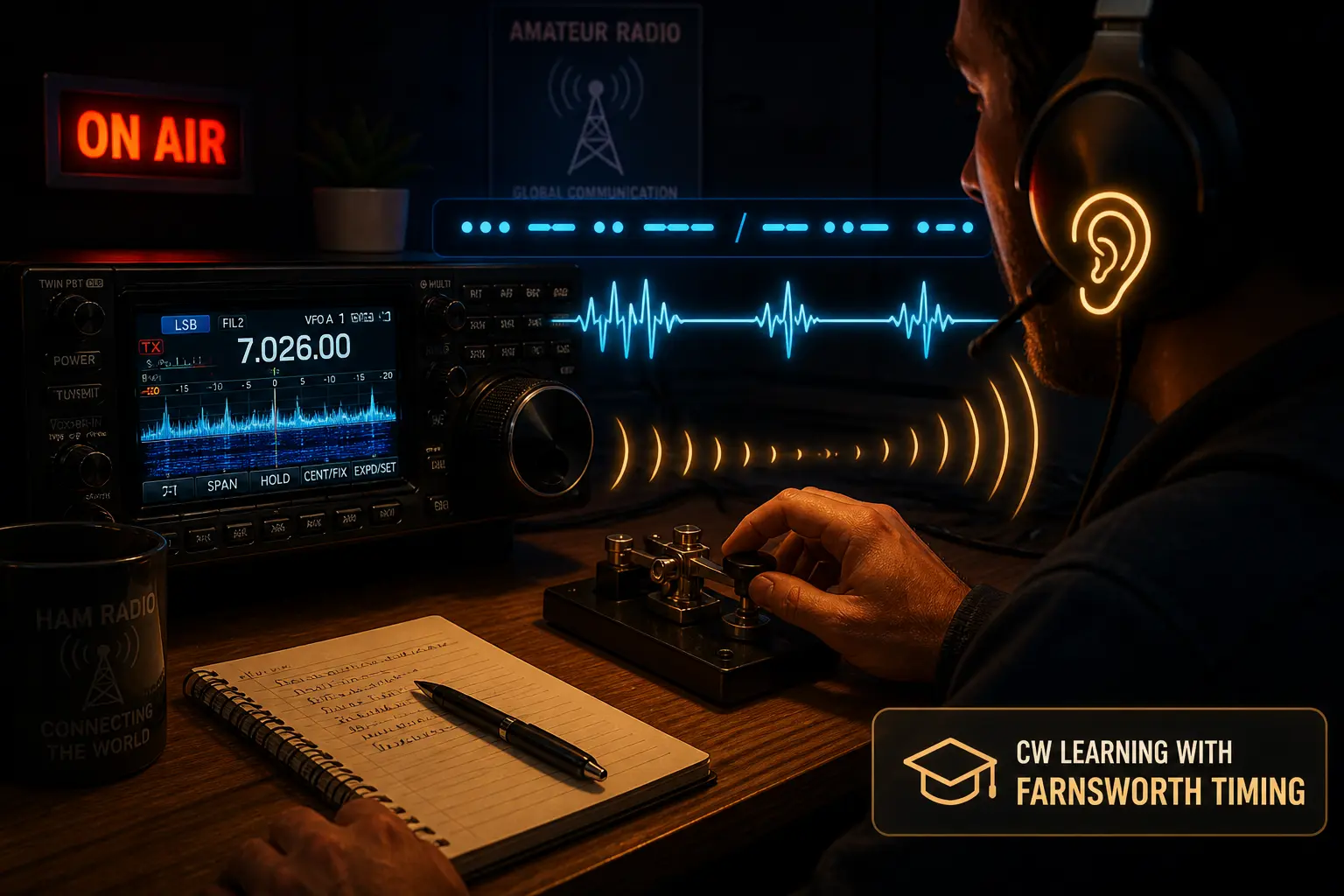
It is widely used in amateur radio training because it reflects real communication conditions.
Frequently Asked Questions
Farnsworth timing is a learning method where Morse code characters are sent at normal speed, but spacing between letters and words is increased to help beginners learn faster.
It keeps dot and dash speed unchanged but increases spacing between letters and words, allowing more time to recognize patterns.
Morse code timing is based on a unit system where one dot equals one unit. A dash equals three units, letter spacing is three units, and word spacing is seven units. Timing is calculated using WPM.
Morse code timing is calculated using the formula [katex]\text{Unit duration (ms)} = \frac{1200}{\text{WPM}}[/katex]. This defines how long each unit lasts, which is then applied to dots, dashes, and spacing.
It is used to help beginners learn Morse code faster by focusing on rhythm instead of counting dots and dashes.
No, it only changes spacing. The structure of Morse code remains the same.
Yes, it improves listening skills and helps learners understand patterns more easily.
It is used in amateur radio training, CW practice, and Morse code learning systems.
Conclusion
Farnsworth timing in Morse code is a structured learning method that increases spacing while keeping character speed unchanged.
It helps learners focus on rhythm and pattern recognition instead of counting symbols.
Understanding Farnsworth timing is an important step in mastering Morse code and improving real communication skills.
If you are already familiar with Farnsworth timing, the next advanced step is understanding Wordsworth Timing, which focuses only on improving word-level recognition by increasing word spacing.
