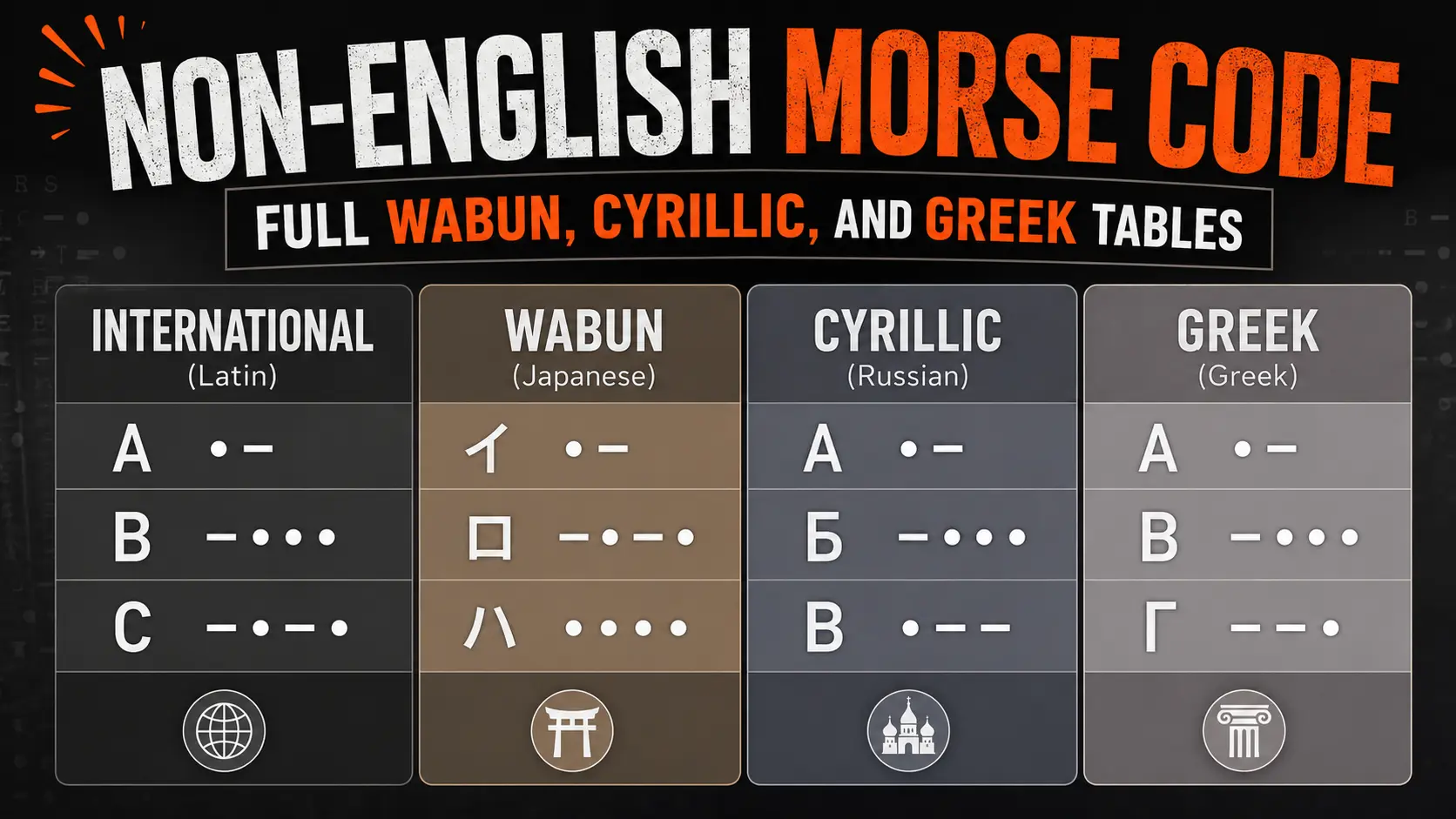
Morse code was built for the 26 letters of the Latin alphabet. That worked for English, but not for the many languages written in other scripts. So as the telegraph spread, separate Morse systems grew up for them. This page gives the full, clean code tables for three of the most important: Wabun for Japanese kana, Russian Cyrillic, and Greek. Each table is sourced, and each section explains how that system relates to the International Morse code you may already know.
Quick Answer: There is no single worldwide Morse code for every language. Japanese uses Wabun code, where each signal stands for a whole kana syllable rather than a letter, so
.-is the kana い, not the letter A. Russian and Greek take a different route: they mostly reuse the International Morse patterns, giving each Cyrillic or Greek letter the code of the Latin letter it sounds or looks like, and adding a few unique codes where there is no match. Because the same dots and dashes mean different things in each system, you always have to know which alphabet is being sent.
Why Morse Needed Non-English Versions
International Morse code, the standard defined today by the ITU, covers the Latin letters A to Z, the digits, and some punctuation. It has no way to write a Japanese kana, a Russian Cyrillic letter, or a Greek one. As telegraphy reached countries that did not use the Latin alphabet, each had to solve the same problem in its own way.
Two broad approaches appeared. Greece and Russia kept the existing International patterns and simply mapped their own letters onto the nearest Latin letter by sound or shape, which made it easy for operators who already knew Morse. Japan went the other way and built a whole new mapping, because kana are syllables, not letters, and there was no useful letter-by-letter match to borrow. You can see the base system these all grew from on the Morse code alphabet page, and the wider story of how the code spread on the history of Morse code page.
Japanese Morse Code (Wabun)
Wabun code (和文モールス符号) is the Japanese Morse system. Its key difference from every other version here is that each signal represents a whole kana, a single Japanese syllable, rather than one letter. So the pattern .- is the kana い (i) in Wabun, even though the very same pattern is the letter A in International Morse. The two systems are completely separate, and a Wabun message decoded with a Latin chart comes out as nonsense.
The table below lists the basic kana in the traditional Iroha order, which is how Japanese charts arrange them rather than by the Latin A, B, C. The digits 0 to 9 are the same as in International Morse.
| Kana | Rōmaji | Morse code |
|---|---|---|
| い | i | .- |
| ろ | ro | .-.- |
| は | ha | -... |
| に | ni | -.-. |
| ほ | ho | -.. |
| へ | he | . |
| と | to | ..-.. |
| ち | chi | ..-. |
| り | ri | --. |
| ぬ | nu | .... |
| る | ru | -.--. |
| を | wo | .--- |
| わ | wa | -.- |
| か | ka | .-.. |
| よ | yo | -- |
| た | ta | -. |
| れ | re | --- |
| そ | so | ---. |
| つ | tsu | .--. |
| ね | ne | --.- |
| な | na | .-. |
| ら | ra | ... |
| む | mu | - |
| う | u | ..- |
| ゐ | wi | .-..- |
| の | no | ..-- |
| お | o | .-... |
| く | ku | ...- |
| や | ya | .-- |
| ま | ma | -..- |
| け | ke | -.-- |
| ふ | fu | --.. |
| こ | ko | ---- |
| え | e | -.--- |
| て | te | .-.-- |
| あ | a | --.-- |
| さ | sa | -.-.- |
| き | ki | -.-.. |
| ゆ | yu | -..-- |
| め | me | -...- |
| み | mi | ..-.- |
| し | shi | --.-. |
| ゑ | we | .--.. |
| ひ | hi | --..- |
| も | mo | -..-. |
| せ | se | .---. |
| す | su | ---.- |
| ん | n | .-.-. |
Voiced and semi-voiced sounds are not separate codes. They are written as the base kana followed by a small mark. A voiced kana such as が (ga) is sent as か (ka), .-.., followed by the dakuten mark ... The marks below also cover Japanese punctuation, plus the two prosigns that switch a transmission in and out of Wabun when it is mixed with International Morse.
| Mark | Meaning | Morse code |
|---|---|---|
| ゛ | Dakuten (voiced mark) | .. |
| ゜ | Handakuten (semi-voiced mark) | ..--. |
| ー | Chōonpu (long vowel) | .--.- |
| 、 | Comma | .-.-.- |
| 。 | Full stop | .-.-.. |
| DO | Start of Wabun (prosign) | -..--- |
| SN | Return to International (prosign) | ...-. |
Russian Morse Code (Cyrillic)
Russian Morse code was enacted in 1856 and approximates the International code. Most Cyrillic letters simply take the pattern of the Latin letter they sound like: Б uses the code for B, В uses the code for W, Г uses G, Д uses D. Letters that have no natural Latin match were given spare Latin codes instead, which is why Щ borrows the code for Q. Operators memorise the patterns using sung mnemonics called napevy, or melodies, where long syllables stand for dashes and short ones for dots.
The table below shows the Russian national standard, with the Latin letter each Cyrillic character shares its code with.
| Letter | Morse code | Shares code with Latin |
|---|---|---|
| А | .- |
A |
| Б | -... |
B |
| В | .-- |
W |
| Г | --. |
G |
| Д | -.. |
D |
| Е | . |
E |
| Ё | . |
same as Е |
| Ж | ...- |
V |
| З | --.. |
Z |
| И | .. |
I |
| Й | .--- |
J |
| К | -.- |
K |
| Л | .-.. |
L |
| М | -- |
M |
| Н | -. |
N |
| О | --- |
O |
| П | .--. |
P |
| Р | .-. |
R |
| С | ... |
S |
| Т | - |
T |
| У | ..- |
U |
| Ф | ..-. |
F |
| Х | .... |
H |
| Ц | -.-. |
C |
| Ч | ---. |
Ö |
| Ш | ---- |
CH |
| Щ | --.- |
Q |
| Ъ | none | no code in the classic standard |
| Ы | -.-- |
Y |
| Ь | -..- |
X |
| Э | ..-.. |
É |
| Ю | ..-- |
Ü |
| Я | .-.- |
Ä |
Two notes on the edges of the alphabet. The letter Ё is not given its own code and is sent as plain Е. The hard sign Ъ has no code in the classic Russian standard, though some modern tables assign it one. The order and codes above follow the Russian standard, which later shaped the KOI-7 and KOI-8 computer character sets.
Greek Morse Code
Greek Morse code is the closest of the three to the Latin version. Almost every Greek capital takes the code of the Latin letter it most resembles by shape or sound. Alpha uses the code for A, Beta uses B, Delta uses D, and so on. There is one extra code, four dashes ----, for the letter Χ (chi), and the Greek system drops the Latin codes for J, U, and V, which it does not need.
The accent mark (tonos) is not sent in Morse. A reader simply works out which vowels need one from context. Old Greek charts also list codes for vowel combinations, but these were never really used in practice, and the two vowels are just sent one after the other.
| Letter | Name | Morse code |
|---|---|---|
| Α | Alpha | .- |
| Β | Beta | -... |
| Γ | Gamma | --. |
| Δ | Delta | -.. |
| Ε | Epsilon | . |
| Ζ | Zeta | --.. |
| Η | Eta | .... |
| Θ | Theta | -.-. |
| Ι | Iota | .. |
| Κ | Kappa | -.- |
| Λ | Lambda | .-.. |
| Μ | Mu | -- |
| Ν | Nu | -. |
| Ξ | Xi | -..- |
| Ο | Omicron | --- |
| Π | Pi | .--. |
| Ρ | Rho | .-. |
| Σ | Sigma | ... |
| Τ | Tau | - |
| Υ | Upsilon | -.-- |
| Φ | Phi | ..-. |
| Χ | Chi | ---- |
| Ψ | Psi | --.- |
| Ω | Omega | .-- |
How These Differ From International Morse
The one thing to keep straight across all of these is that a given row of dots and dashes does not carry a fixed meaning. It depends entirely on which alphabet is in use. The pattern .- is the letter A in International Morse, the kana い in Wabun, and the letter А in Russian. Here is how the four systems compare at a glance.
| System | Each signal maps to | Relationship to International Morse | Still in use |
|---|---|---|---|
| International | A Latin letter, digit, or symbol | The base standard | Yes |
| Wabun (Japanese) | A whole kana syllable | Fully independent, same signals mean different things | Yes, in Japanese amateur radio |
| Russian (Cyrillic) | A Cyrillic letter | Reuses Latin codes by sound, plus a few extras | Yes |
| Greek | A Greek letter | Reuses Latin codes by shape or sound, plus one extra | Historically, though hams often spell Greek in Latin now |
To hear how the base International patterns sound before you compare them with the tables above, type any word into the Morse code translator, or browse the full reference on the Morse code chart.
Frequently Asked Questions
It is called Wabun code, also known as kana code. Unlike International Morse, which encodes Latin letters, each Wabun signal stands for a whole Japanese kana syllable, so the same pattern means something different in the two systems.
Mostly, yes. Russian Morse code, enacted in 1856, gives each Cyrillic letter the International code of the Latin letter it sounds like, and borrows spare Latin codes for letters with no match, such as Щ using the code for Q. A handful of letters have their own patterns.
Only slightly. Each Greek letter uses the code of the Latin letter it resembles in shape or sound. Greek adds one extra code, four dashes, for Χ (chi), and drops the codes for J, U, and V, which it does not use.
Yes. The pattern for dot dash is A in International Morse, the kana い in Wabun, and the letter А in Russian Cyrillic. Because the systems overlap, you have to know which alphabet is being sent before you can decode it.
Wabun is still used by Japanese amateur radio operators for domestic contacts. Russian Cyrillic Morse remains in use as well. Greek Morse is mostly historical now, and many operators spell Greek words using the Latin alphabet instead. You can read more about where Morse survives on the is Morse code still used today page.
Sources
- Wabun code (Wikipedia). The full Iroha-order kana table, the dakuten and handakuten marks, and the DO and SN prosigns.
- Morse code for non-Latin alphabets (Wikipedia). The Greek and Russian Cyrillic code tables and their mapping to Latin letters.
- Russian Morse code (Wikipedia). The 1856 Russian standard and the napevy mnemonic melodies.
- The Japanese Morse Telegraph Code (QST, September 1942). An early published description of the Wabun kana code.
- Recommendation ITU-R M.1677-1 (International Telecommunication Union). The International Morse code standard that these systems adapt or sit alongside.
