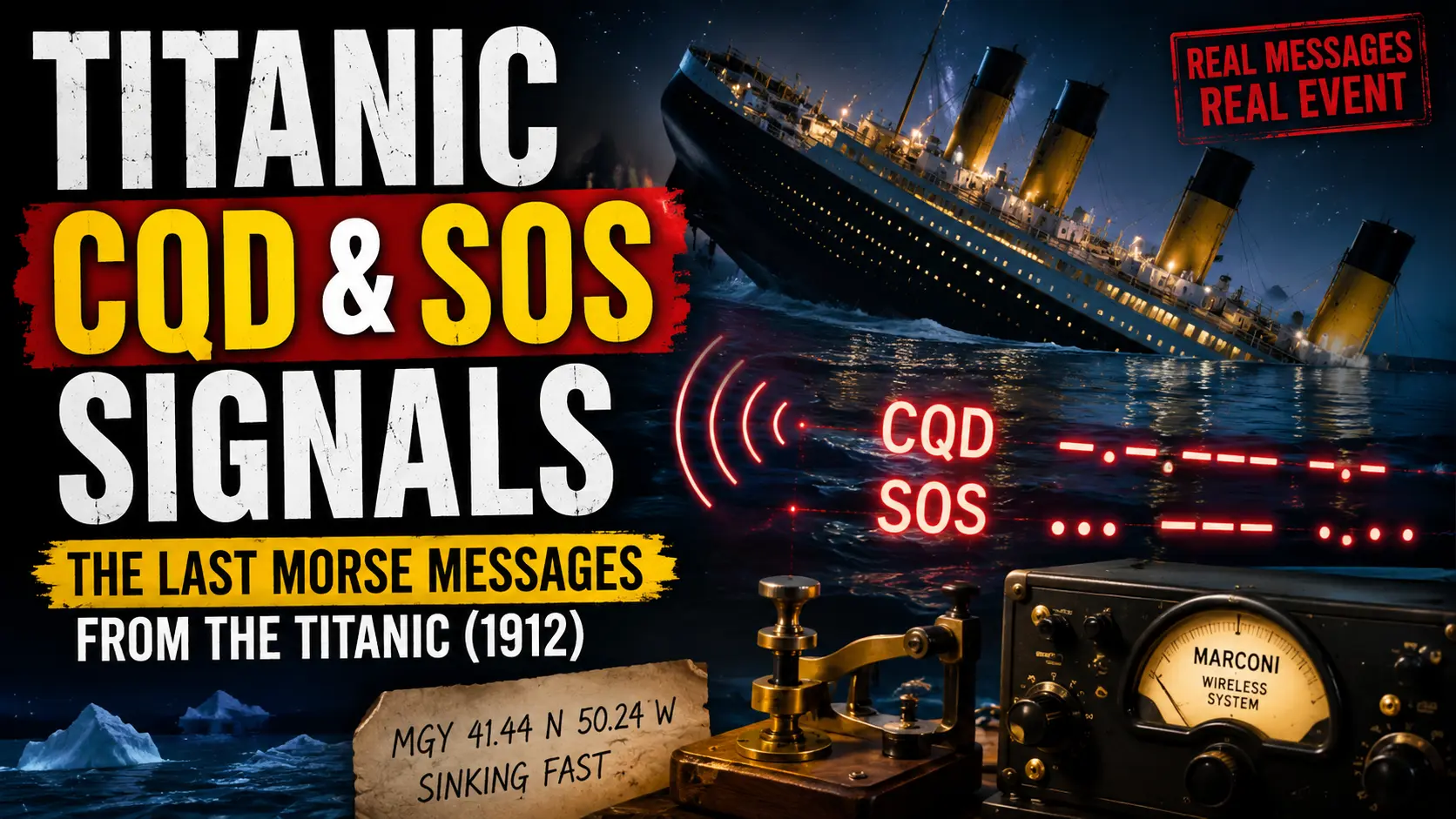
The sinking of the Titanic remains one of the most studied maritime disasters in history. What makes this event even more significant is how Morse code became the only working communication system during the final hours of the ship.
This was not a stable communication environment. It was a collapsing system under extreme pressure, where operators had to send emergency signals while the ship was physically breaking apart.
In this article, we break down the full Titanic Morse code timeline, the communication system behind it, and why some messages were received while others failed.
To understand the basics of Morse communication, you can also explore the Morse Code Alphabet and the full Morse Code Chart.
The Crisis Timeline: How Titanic Morse Communication Unfolded
The Titanic’s wireless communication did not fail instantly. It degraded step by step as the disaster escalated.
The situation can be understood in five phases:
- Initial collision and early distress signals
- Transition from CQD to SOS communication
- Rapid escalation of emergency messages
- Evacuation coordination under pressure
- Final transmissions before system silence
This progression is important because it shows that Morse code was not just used, it was continuously adapted under crisis conditions.
What Was Morse Code Used for on the Titanic?
The Titanic relied entirely on Morse code for wireless communication. There were no voice systems or modern navigation communication tools available in 1912.
Morse code was used for four critical functions:
- Emergency distress signaling to nearby ships
- Position reporting using latitude and longitude
- Rescue coordination with responding vessels
- Continuous status updates during sinking conditions
Wireless operators worked continuously under extreme pressure, often repeating the same signals to ensure reception.
You can learn more about emergency messaging patterns in Morse code here: How to Say Help Me in Morse Code and How Do You Say Help in Morse Code.
System Model: How Titanic Morse Communication Actually Worked
To understand why some messages worked and others failed, it is important to break the system into three layers:
- Transmitter Layer: Titanic wireless operators sending CQD and SOS signals
- Transmission Medium: Atmospheric radio waves affected by distance, weather, and interference
- Receiver Layer: Nearby ships like RMS Carpathia interpreting incoming signals
This system was not stable. Any weakness in one layer could cause partial or total communication failure.
Critical Distress Signals: CQD and SOS Transition
At the time of the Titanic disaster, two distress signals were in use: CQD and SOS.
CQD was the older Marconi distress call, while SOS was the newer international standard still being adopted globally in 1912.
In Morse code, SOS is transmitted as ... --- ...
On the Titanic, both signals were used together. CQD was transmitted first, followed by SOS as the situation escalated. This overlap reflects real-world uncertainty during early wireless communication standardization.
For deeper reference: SOS in Morse Code and SOS Meaning Page.
Complete Titanic Morse Code Timeline (Verified + Reconstructed Messages)
The following timeline combines documented wireless operator logs with historically reconstructed transmissions. Some messages are confirmed, while others are standardized reconstructions used for educational clarity.
| Time | Message (English) | Morse Code |
|---|---|---|
| 12:15 a.m. | CQD CQD CQD CQD CQD CQD MGY 41.44 N 50.24 W SINKING FAST | -.-. --.- -.. / -.-. --.- -.. / -.-. --.- -.. / -.-. --.- -.. / -.-. --.- -.. / -.-. --.- -.. / -- --. -.-- / ....- .---- .-.-.- ....- ....- / -. / ..... ----- .-.-.- ..--- ....- / ... .. -. -.- .. -. --. |
| Shortly after 12:15 a.m. | SOS SOS SOS added alongside CQD | ... --- ... / ... --- ... / ... --- ... |
| 12:20–12:30 a.m. | Come at once. We have struck a berg. Position confirmed. CQD in use. | -.-. --- -- . / .- - / --- -. -.-. . .-.-.- / .-- . / .... .- ...- . / ... - .-. ..- -.-. -.- / .- / -... . .-. --. .-.-.- |
| 12:30–1:00 a.m. | Tell your captain to come to our help. We are on the ice. | - . .-.. .-.. / -.-- --- ..- .-. / -.-. .- .--. - .- .. -. / - --- / .... . .-.. .--. / --- -. / - .... . / .. -.-. . |
| 12:40–1:30 a.m. | We are in collision with a berg. Sinking continues. Position repeatedly transmitted. | .-- . / .- .-. . / .. -. / -.-. --- .-.. .-.. .. ... .. --- -. / .-- .. - .... / .- / -... . .-. --. .-.-.- |
| 1:00–1:30 a.m. | We are putting the women off in the boats. | .-- . / .- .-. . / .--. ..- - - .. -. --. / - .... . / .-- --- -- . -. / --- ..-. ..-. / .. -. / - .... . / -... --- .- - ... |
| 1:10–1:40 a.m. | Engine room getting flooded. | . -. --. .. -. . / .-. --- --- -- / --. . - - .. -. --. / ..-. .-.. --- --- -.. . -.. |
| 1:40–2:00 a.m. | Engine-room full up to boilers. | . -. --. .. -. . -.-. .-. --- --- -- / ..-. ..- .-.. .-.. / ..- .--. / - --- / -... --- .. .-.. . .-. ... |
| 2:10 a.m. | Final transmission: CQD DE MGY CQ | -.-. --.- -.. / -.. . / -- --. -.-- / -.-. --.- |
| 2:17 a.m. | Final general call: CQ (silence follows) | -.-. --.- |
Why Some Titanic Messages Were Received and Others Failed
Morse code transmission was heavily dependent on early radio physics limitations. Some messages were received clearly, while others were partially or completely lost.
Key failure factors included:
- Limited transmission power of spark-gap radios
- Atmospheric interference affecting signal clarity
- Receiver tuning mismatches on nearby ships
- Distance-related signal decay over the Atlantic Ocean
This explains why communication during the disaster was inconsistent rather than fully reliable.
Myth vs Reality of Titanic Morse Communication
| Myth | Reality |
|---|---|
| SOS was fully standardized worldwide in 1912 | SOS was still being adopted and not universally enforced |
| All messages were received instantly | Reception depended on distance, tuning, and interference conditions |
| Only SOS was used during the sinking | Both CQD and SOS were used in real operational conditions |
Final Insight: Morse Code Under Real Crisis Conditions
The Titanic disaster shows that Morse code was not just a communication tool, but a survival system operating under collapse conditions.
Its success depended not only on technology, but on human decision-making, timing, and fragile early radio infrastructure.
Frequently Asked Questions
Yes, both SOS and CQD signals were transmitted using Morse code during the sinking.
CQD was used first, followed by SOS as the situation escalated.
The Titanic sent iceberg warnings, position updates, and distress calls using Morse code.
Due to signal interference, limited radio range, and early wireless technology limitations.
