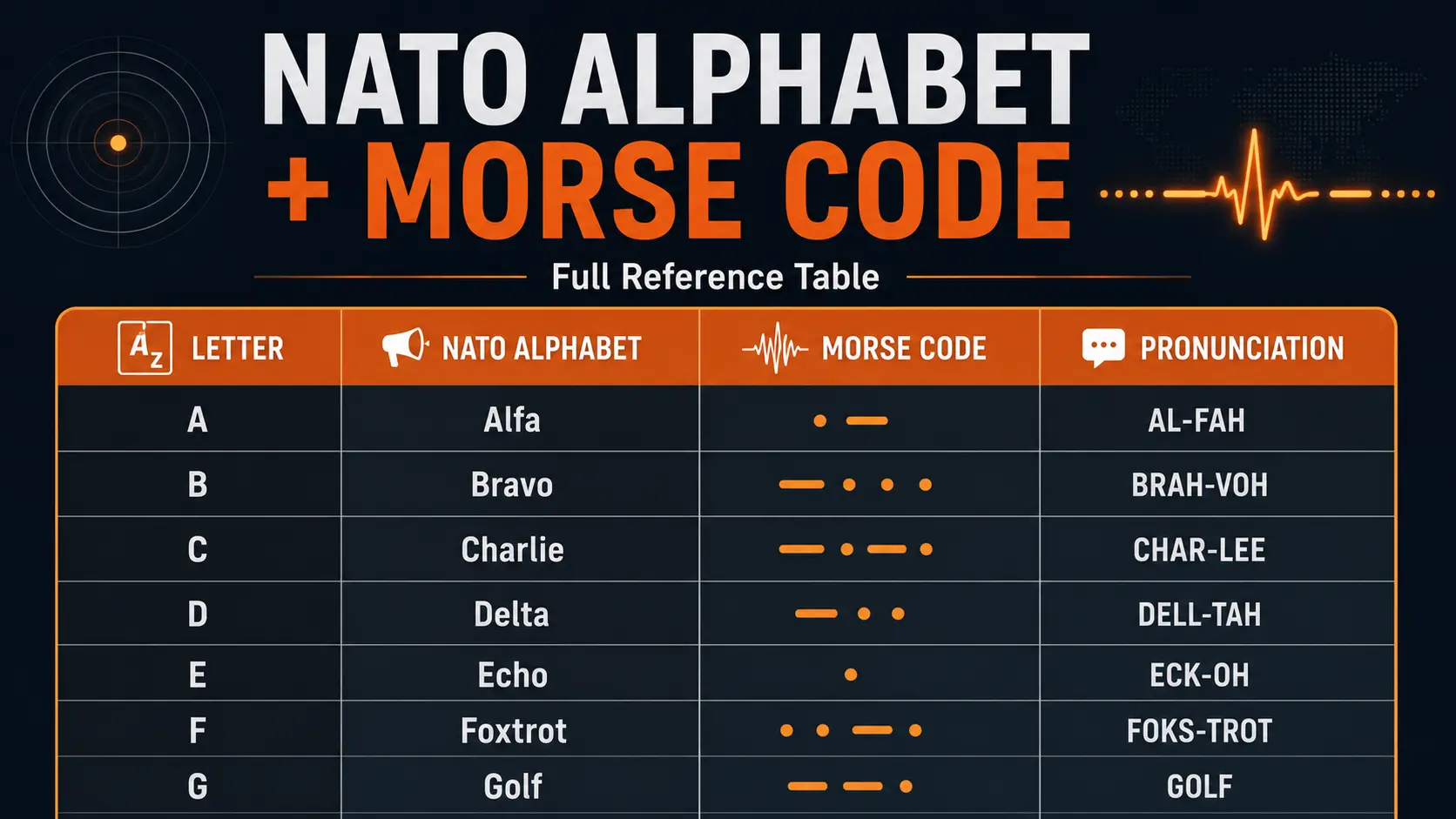
The NATO phonetic alphabet and Morse code are two completely different systems, but they’re often needed side by side — especially in radio, aviation, and military contexts where a letter might need to be spoken clearly and sent as a signal in the same session. Below is the complete, official NATO phonetic alphabet with the correct Morse code for every letter and number.
Quick answer: Each letter of the NATO phonetic alphabet (Alfa, Bravo, Charlie…) corresponds to a standard English letter, which has its own separate Morse code pattern. For example, A is “Alfa” in the NATO alphabet and .- in Morse code — the NATO word and the Morse pattern aren’t derived from each other, they’re two independent systems that happen to map to the same 26 letters.
NATO Phonetic Alphabet With Morse Code (Full Table)
| Letter | NATO Word | Morse Code |
| A | Alfa | .- |
| B | Bravo | -... |
| C | Charlie | -.-. |
| D | Delta | -.. |
| E | Echo | . |
| F | Foxtrot | ..-. |
| G | Golf | --. |
| H | Hotel | .... |
| I | India | .. |
| J | Juliett | .--- |
| K | Kilo | -.- |
| L | Lima | .-.. |
| M | Mike | -- |
| N | November | -. |
| O | Oscar | --- |
| P | Papa | .--. |
| Q | Quebec | --.- |
| R | Romeo | .-. |
| S | Sierra | ... |
| T | Tango | - |
| U | Uniform | ..- |
| V | Victor | ...- |
| W | Whiskey | .-- |
| X | X-ray | -..- |
| Y | Yankee | -.-- |
| Z | Zulu | --.. |
Note the spellings: it’s officially “Alfa” (not “Alpha”) and “Juliett” (with two Ts), not typos — both spellings were chosen deliberately by the International Civil Aviation Organization so speakers of any language pronounce them consistently.
NATO Numbers With Morse Code
The NATO system also standardizes how numbers are spoken aloud over radio, since digits like “nine” and “five” can be misheard just as easily as letters. Here’s the full set with their Morse code:
| Digit | Radiotelephony Pronunciation | Morse Code |
| 0 | Zero | ----- |
| 1 | One | .---- |
| 2 | Two | ..--- |
| 3 | Tree | ...-- |
| 4 | Fower | ....- |
| 5 | Fife | ..... |
| 6 | Six | -.... |
| 7 | Seven | --... |
| 8 | Eight | ---.. |
| 9 | Niner | ----. |
The unusual spellings — “Tree” for three, “Fife” for five, “Niner” for nine — aren’t errors either. They’re intentional: “Three” is hard to distinguish from other words over noisy radio, “Five” can sound like “Fire,” and “Nine” can be confused with the German “nein” (no) in international radio traffic, so “Niner” removes the ambiguity.
Why Learn Both Together
The NATO phonetic alphabet and Morse code solve different problems, but they show up in the same real-world situations — amateur radio, aviation communication, and military signaling. Knowing both means you can spell a callsign clearly over voice (“Kilo Alfa Tango”) and also recognize or send that same callsign in Morse (-.- .- -) without switching mental systems. If you’re focused specifically on learning Morse code itself rather than just this reference table, our step-by-step guide to learning Morse code fast covers the actual training method, built on the Koch Method. For how the NATO alphabet fits alongside other signaling systems like flag semaphore, see our full comparison of Morse code, semaphore, and the NATO alphabet.
Frequently Asked Questions
Each letter of the NATO phonetic alphabet uses the same Morse code as the standard English letter it represents. For example, “Alfa” (A) is .- in Morse code, and “Bravo” (B) is -.... The NATO word and the Morse pattern are separate systems that both map to the same 26 letters.
“Alfa” is the official ICAO spelling, chosen so that speakers of languages where “ph” isn’t pronounced like an English “f” still pronounce the word correctly and consistently over radio.
“Niner” is used instead of “Nine” to avoid confusion with the German word “nein,” meaning “no,” which sounds similar and could cause serious miscommunication in international radio traffic.
No. The NATO phonetic alphabet assigns a clear spoken word to each letter to prevent it from being misheard over voice radio, while Morse code encodes each letter as a completely different pattern of short and long signals, unrelated to how the letter sounds when spoken.
SOS in Morse code is ... --- ... (Sierra Oscar Sierra in the NATO alphabet), though SOS itself is a standalone distress signal rather than three individually spelled letters in practice.
References
- International Telecommunication Union — Recommendation ITU-R M.1677-1, International Morse Code
- NATO — The NATO Phonetic Alphabet (Official History)
- NATO — Phonetic Alphabet, Codes & Signals (Official Reference Poster, PDF)
- Wikipedia — NATO Phonetic Alphabet
Keep this table bookmarked as a quick lookup — whether you’re spelling a callsign clearly over voice or sending the same letters in Morse code, both systems are designed to remove ambiguity from communication, just through completely different means.
