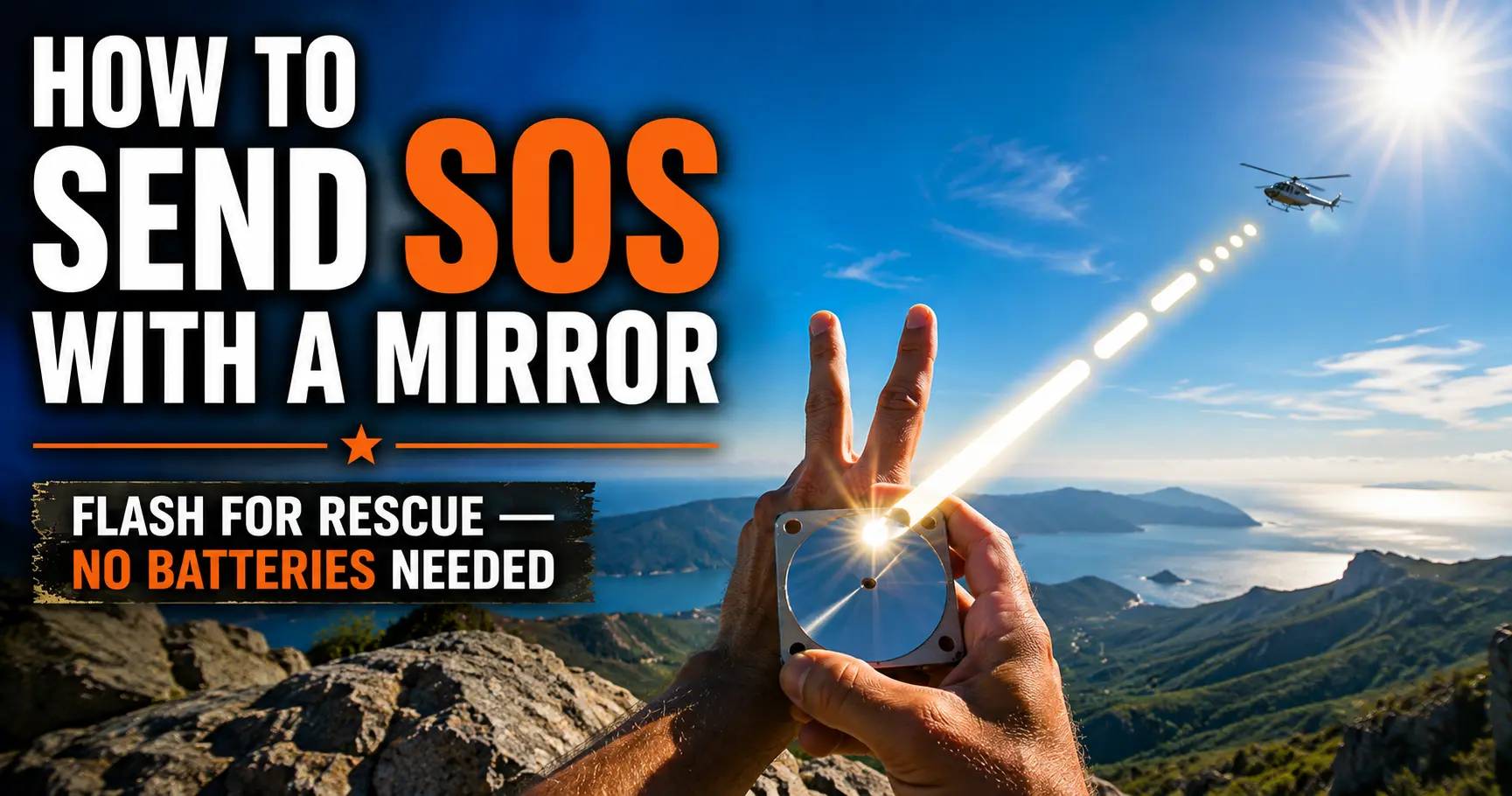
To send an SOS with a mirror, reflect sunlight onto your target and flash it in the Morse code SOS pattern: three short flashes, three long flashes, and three short flashes — written as ... --- .... Aim the reflected light by catching the bright spot on your outstretched hand, guide it toward a rescuer or aircraft using a “V” made with your fingers, then break the beam into the SOS rhythm and repeat it. A signal mirror needs no batteries, works only in sunlight, and can be seen for miles, making it one of the most powerful survival signaling tools you can carry.
This guide walks you through exactly how to do it: how a signal mirror works, the correct aiming techniques rescuers teach, the precise SOS flash pattern and timing, critical safety warnings, and what to do if you do not have a real mirror. Read it now, and practice before you ever need it — because aiming a mirror is a skill, not a guess.
How a Signal Mirror Works
A signal mirror works on one simple principle: the angle of incidence equals the angle of reflection. When sunlight hits the mirror, it bounces off at a predictable angle. By tilting the mirror, you steer that bright beam of reflected light exactly where you want it — toward a plane, a boat, a vehicle, or a search party.
What makes it so effective for rescue is the intensity. A well-aimed mirror flash is far brighter than the surrounding landscape, so it stands out sharply to anyone scanning the area. In clear conditions, that flash can be seen for many miles, and aircraft can spot it from even farther away. Because it runs on nothing but sunlight, a mirror keeps working long after batteries die and where no phone signal exists. This is also why signal mirrors are official-issue survival gear — techniques like the ones below are drawn from military training documents such as the U.S. Air Force’s own Survival manual (AFM 64-5).
What You Need Before You Start
- Sunlight. A signal mirror only works when the sun is out. It performs best when the sun is reasonably high, roughly above 20 degrees over the horizon, and behind or to the side of you.
- A reflective surface. A purpose-built signal mirror with a sighting hole is ideal, but any smooth, shiny surface can work in an emergency.
- A target. A rescue aircraft, boat, vehicle, or search party. You can also sweep the horizon even when you see no one, in case a searcher is just out of your view.
- A clear, elevated position if possible. Height and an open line of sight dramatically improve how far your flash travels.
How to Aim a Signal Mirror: The V-Hand Technique
Aiming is the part people get wrong, so take it step by step. The most reliable method without a sighting hole is the “V-hand” or “peace sign” technique used in military survival training.
- Face the sun to your side. Position yourself so the sun is behind or beside you and your target is in front of you.
- Catch the light on your hand. Hold the mirror near your face and reflect the sunlight onto your outstretched palm. You will see a bright bead of light on your hand. This confirms the mirror is catching the sun.
- Make a “V” with your fingers. Stretch your other arm out and spread two fingers into a V, or a peace sign. Line up your target so it sits inside the V.
- Walk the light to the target. Slowly move the reflected bead of light up your hand and out through the V toward your target. Keep a little of the reflection visible on your fingers so you always know where the beam is.
- Flash the target. Once the light is passing through the V onto your target, tilt the mirror gently up and down or side to side to send flashes.
How to Aim a Signal Mirror With a Sighting Hole
Many purpose-built signal mirrors have a small hole or retro-reflective aimer in the center, which makes aiming far easier.
- Hold the mirror close to your eye and look through the sighting hole at your target.
- Tilt the mirror toward the sun until you see a bright spot of light — often appearing as a glowing dot — in the aimer.
- Move the mirror so that bright spot lines up with your target seen through the hole.
- When the spot sits on your target, the reflected beam is hitting it. Hold that aim and begin flashing.
How to Send the SOS Signal With a Mirror
SOS is the internationally recognized distress signal, understood worldwide. The exact timing of short and long signals is formally defined by the International Telecommunication Union’s Recommendation ITU-R M.1677-1, the same standard that defines Morse code timing worldwide. In Morse code it is three short signals, three long signals, and three short signals, written as ... --- .... The letters stand for S (...), O (---), and S (...) again.
To send SOS with your mirror once it is aimed at the target:
- Three short flashes. Give three quick, distinct flashes, each roughly half a second to one second long. This is the letter S.
- Three long flashes. Follow with three longer, sustained flashes, each held a couple of seconds. This is the letter O.
- Three short flashes. Finish with three more quick flashes — the second S.
- Pause, then repeat. Wait a moment, then send the whole pattern again. Repeat it steadily as long as your target is in view.
You create each flash by breaking the beam — tilting the mirror off the target and back on, or passing your hand across it. Even if you cannot manage perfect Morse timing, three-of-a-kind flashes in groups signal deliberate distress, because rescuers recognize any repeated set of three as a call for help. Want to get the rhythm right before you need it in the field? Our Morse code practice tools let you drill the short-long timing until it’s automatic.
Signaling When You Cannot See Anyone
You do not have to wait until you spot a rescuer. If you hear an aircraft you cannot see, or simply want to maximize your chances, slowly sweep the reflected light back and forth across the horizon and the sky. A searcher who is just out of your sight may still catch the flash. Keep sweeping and repeating your SOS pattern in the direction of any engine noise.
Critical Safety Warnings
- Do not flash directly into a pilot’s eyes. When signaling a low aircraft, aim slightly below or to the side of the cockpit. A direct flash into the eyes can temporarily blind the pilot at a dangerous moment.
- Never aim the beam into anyone’s eyes at close range. A concentrated flash can cause real eye damage even in a brief burst.
- A signal mirror is for signaling, not fire-starting. Do not try to use it to start a fire; you risk scratching or damaging the surface you need for rescue.
- Protect your mirror. Keep it clean and unscratched, and if it hangs around your neck, keep the reflective side against your body when not in use so it does not flash accidentally.
How to Send SOS Without a Signal Mirror
If you do not have a purpose-built mirror, many everyday reflective surfaces can work in a pinch:
- A polished metal cup, canteen, or belt buckle
- A stainless-steel plate or knife blade
- Aluminum foil smoothed flat over a card or your hand
- The screen of a phone or GPS device (less effective, but usable)
- A CD or DVD
- Still water in a container, which can reflect the sun
The same rules apply: catch the sun, aim with the V-hand method, and flash the SOS pattern. A dedicated signal mirror reflects far more light and is worth carrying, but in a true emergency, any bright surface is better than none. If flashes aren’t an option, a whistle or a flashlight can carry the same SOS pattern in other signaling formats — the rhythm matters more than the medium.
Tips to Maximize Your Chances of Rescue
- Get high and clear. Move to the highest open ground you safely can. Gaining elevation greatly increases how far your flash can be seen.
- Keep repeating. A single flash is easy to miss or mistake for a natural glint. Repeated, rhythmic flashing tells searchers it is intentional.
- Signal aircraft even after they pass. Pilots and spotters may be looking backward or to the side. Keep flashing until the aircraft is well out of range.
- Combine signals. Pair your mirror with other methods — a whistle, bright clothing, a ground signal, or a fire — so you are visible by more than one means.
- Practice first. Aiming a mirror takes coordination. Practice in your backyard on a sunny day so the technique is automatic when it counts.
Key Takeaways
- Send SOS with a mirror by flashing three short, three long, three short:
... --- ... - Aim by catching the light on your hand and guiding it through a “V” in your fingers, or through the mirror’s sighting hole.
- A signal mirror needs sunlight, works with no batteries, and can be seen for miles.
- Aim slightly off a pilot’s eyes, and never flash the beam into anyone’s eyes up close.
- In an emergency, any bright reflective surface can substitute for a real signal mirror.
- Get to high, open ground and repeat the signal steadily for the best chance of rescue.
Want to memorize the SOS rhythm cold before you’re ever in a survival situation? Use our free Morse code translator to see and hear the pattern, or drill it hands-on with our practice tools.
Reflect sunlight onto your target, then flash the Morse code SOS pattern — three short flashes, three long flashes, three short flashes (… — …). Aim by catching the bright spot of light on your hand and guiding it toward the target through a “V” made with two fingers, or through the mirror’s sighting hole. Repeat the pattern steadily while the target is in view.
SOS is three short signals, three long signals, and three short signals, written as … — … . The short signals are the letter S and the long signals are the letter O. It is the internationally recognized distress signal and is understood worldwide.
In clear conditions, a signal mirror flash can be seen for several miles, and aircraft can often spot it from even farther — reports range up to tens of miles depending on sunlight, altitude, angle, and visibility. It is one of the longest-range signaling methods available without electronics.
No. A signal mirror relies on reflecting the sun, so it only works in direct sunlight. It performs best when the sun is fairly high in the sky, roughly above 20 degrees, and positioned behind or to the side of you. On overcast days or at night, use other methods such as a flashlight, whistle, or fire.
Catch the reflected light on your hand, then use the V-hand technique to guide the beam onto the aircraft, keeping part of the reflection visible on your fingers so you know where the beam is pointing. For a moving aircraft, gently track it and aim slightly ahead of its path, but keep the flash off the cockpit so you do not blind the pilot.
Yes. Any smooth, reflective surface can work in an emergency — a polished cup, belt buckle, knife blade, smoothed aluminum foil, a phone screen, a CD, or even still water. A purpose-built signal mirror reflects much more light and is worth carrying, but in a survival situation any bright surface is better than none.
During the day, a signal mirror is far more visible over long distances because it reflects intense sunlight. At night, a flashlight or strobe is better. Ideally, carry both so you can signal in any lighting conditions.
