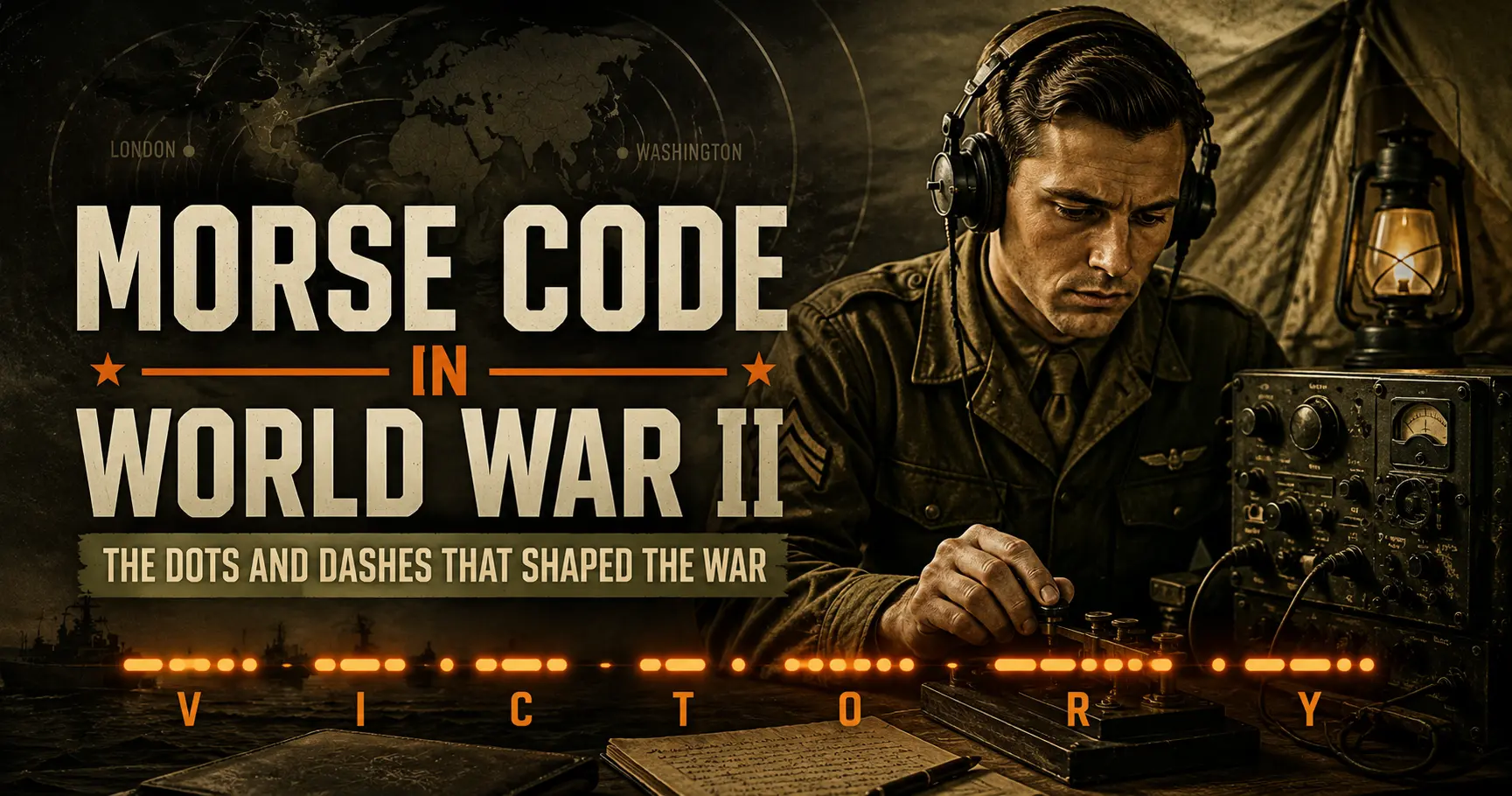
Morse code was one of the most important communication tools of World War II. Between 1939 and 1945, armies, navies, air forces, spies, and codebreakers all relied on its simple pattern of dots and dashes to send fast, reliable messages across battlefields, oceans, and skies. When telephone lines were cut, radios were jammed, and voice signals were too weak or too risky, Morse code still got through. It carried battle orders, guided ships and aircraft, powered secret espionage networks, and sat at the very center of the intelligence war that helped decide the outcome of the conflict.
This guide explains exactly how Morse code was used in World War II, why it mattered so much, who used it, and the surprising human details — like how an operator’s personal “fist” could give away their identity — that most accounts leave out.
Why Morse Code Was So Important in World War II
In a global war fought across continents and oceans, communication was everything. Commanders needed to coordinate troops, ships, and aircraft that were often thousands of miles apart. The side that could communicate faster, more reliably, and more secretly held a real advantage.
Morse code met that need better than any other method available at the time, for a few key reasons:
- It worked in poor conditions. A Morse signal is just a tone switched on and off. Unlike voice radio, it could still be read clearly through static, interference, and weak, long-distance transmissions where a spoken message would be lost.
- It travelled far on little power. A simple transmitter sending on-off pulses could reach much farther than voice radio using the same equipment — vital for ships and aircraft far from base.
- It was flexible. The same code could be sent by radio, by cable, by a signal lamp flashing light, or even by tapping. If one method failed, another could carry the message.
- It was easy to encrypt. Because Morse turns letters into signals, those letters could first be scrambled by cipher machines, making intercepted messages meaningless to the enemy.
The letters SOS — ... --- ... — remained the universal distress call throughout the war, instantly recognisable to any trained operator on either side. The character timing and structure behind signals like this are still formally defined today by the International Telecommunication Union’s Recommendation ITU-R M.1677-1, the same underlying standard that WWII-era operators worked from.
How Morse Code Was Used Across the Military
Morse code was not confined to one branch of the armed forces. It ran through nearly every part of the war effort.
Naval and U-boat communication
The sea was where Morse code proved most indispensable. Ships operated across vast distances where early voice radio simply could not reach reliably, and where security was critical. Morse code allowed long-range ship-to-ship and ship-to-shore communication that voice systems of the era could not match.
The German Navy, the Kriegsmarine, depended heavily on Morse code to direct its U-boat fleet during the Battle of the Atlantic. Submarines surfaced to transmit and receive Morse messages coordinating their attacks on Allied convoys. This dependence later became a fatal weakness, because every message the U-boats sent could be intercepted.
Aircraft and air navigation
Aviation communication in the 1940s was far more primitive than today. Pilots and navigators often used Morse-based radio signals for navigation, homing in on transmitting stations to find their position and stay on course. Ground stations broadcast Morse identification letters so aircrew could confirm exactly which beacon they were receiving. If you want to get a feel for how demanding that real-time listening skill was, our Morse code practice tools let you train the same kind of ear.
Army and battlefield communication
On land, Morse code carried battlefield reports, orders, and intelligence between units. It could be sent over field radios or telegraph cables, and when radio silence was needed, the same code could be flashed with signal lamps between positions or ships that were within sight of one another.
Morse Code and the Secret War: Espionage and Codebreaking
The most dramatic role Morse code played in World War II was not on the battlefield but in the shadow war of spies and codebreakers.
Spies and the Special Operations Executive
Britain’s Special Operations Executive (SOE) sent secret agents into occupied Europe, where they used compact, concealable radio sets to transmit intelligence back home in Morse code. These transmissions were extraordinarily dangerous. Enemy detector vans roamed occupied cities hunting for the source of clandestine signals, and an agent who stayed on the air too long risked being located and captured. Speed and brevity were, quite literally, a matter of life and death. Want to see how quickly a short message translates? Try encoding one yourself with our Morse code translator.
Bletchley Park, Enigma, and the Y-stations
Here lies the greatest irony of the war. The Germans believed their Enigma cipher machine made their Morse messages unbreakable, so they transmitted freely over the airwaves. They were wrong.
Britain operated a chain of wireless interception sites known as Y-stations scattered across the country and beyond. Operators at these stations listened to enemy frequencies and wrote down the enciphered Morse traffic they heard, letter by letter. At the busiest points, thousands of intercepted messages a day were recorded and rushed — at first by motorcycle dispatch rider — to the codebreakers at Bletchley Park. The Bletchley Park Trust’s own archive, drawn from official Y-station records held by the UK National Archives, documents this network in detail — as does the U.S. National Security Agency’s declassified WWII signals intelligence history collection.
There, the team including Alan Turing built on earlier work by Polish mathematicians to break the Enigma cipher. The decrypted intelligence, codenamed Ultra, gave Allied commanders an extraordinary window into enemy plans. None of it would have been possible without the Morse operators at the Y-stations who first plucked those signals out of the air. The message itself was scrambled, but it still travelled as ordinary Morse code — and that was the thread the codebreakers pulled. If you’re curious how Morse compares with other wartime signaling systems the Allies also relied on, see our Morse vs. semaphore vs. NATO alphabet comparison.
The “Morse Fist”: How Operators Were Identified by Their Style
One of the most fascinating and least-known facts about wartime Morse code is that a skilled operator could be personally identified by the way they tapped.
Every operator developed a slightly different rhythm and timing when sending — the tiny, unconscious variations in the length of their dots, dashes, and pauses. This personal signature was known as a “fist.” To a trained listener, one operator’s fist was as recognizable as a person’s handwriting or voice. Developing your own sending rhythm is still part of learning Morse today — our practice tools are a good place to start noticing your own.
Allied intelligence turned this into a weapon. As part of traffic analysis, interception operators learned to recognize individual enemy senders by their fist. This allowed them to track a particular German unit even when it changed its call sign, or to notice when a captured operator’s set was suddenly being worked by someone else. The human quirk in how a person tapped out dots and dashes became a genuine source of intelligence.
Code Talkers: A Different Kind of Code
It is worth clearing up a common point of confusion. Alongside Morse operators, the United States famously used Native American “code talkers” — most notably Navajo speakers — to transmit messages in their own languages, which the enemy could not understand.
This was a separate system from Morse code, not the same thing, though the two are often mentioned together. Code talkers protected messages through an unbreakable spoken language, while Morse code protected messages through cipher machines and sheer transmission skill. Both were vital, and both show how the war drove endless innovation in secure communication.
Why Morse Code Sometimes Beat Voice Radio
It may seem strange that a system of dots and dashes remained dominant when voice radio already existed. But Morse code offered concrete advantages that voice could not match in wartime conditions:
- Clarity through noise. A single tone switched on and off is far easier to pick out of heavy static than a human voice, so Morse got through when speech became unintelligible.
- Greater range. The same transmitter could send Morse much farther than voice, extending the reach of ships and aircraft.
- Security. Morse messages could be enciphered before sending, and their brevity gave enemy direction-finders less time to lock on.
- Simplicity and reliability. The equipment needed to send Morse was simple, rugged, and easy to repair or improvise in the field.
The Legacy of Morse Code After World War II
Morse code did not vanish when the war ended. International Morse code continued to serve shipping, aviation, and the military for decades, and it remained a maritime safety standard until the 1990s. For much of the twentieth century, knowing Morse was a core skill for radio operators around the world.
Its formal military role has since faded. In 2004 the United States Department of Defense changed its position so that operators no longer needed to be trained solely in Morse code, reflecting the rise of digital communication. Yet the code endures — in amateur radio, in aviation station identifiers, in emergency signalling when modern systems fail, and in the cultural memory of a war it helped to win. If this history has you curious about learning it yourself, our guide to learning Morse code fast with the Koch Method is a good next stop.
Key Takeaways
- Morse code was a central communication tool for all sides in World War II, used by armies, navies, air forces, spies, and codebreakers.
- It excelled where voice radio failed — cutting through static, reaching farther, and allowing encryption.
- German U-boats relied on Morse code, and those very transmissions were intercepted and exploited by the Allies.
- Y-station operators intercepting enemy Morse made the Enigma codebreaking at Bletchley Park possible.
- Operators could be personally identified by their unique tapping style, or “fist,” which became an intelligence tool.
- Navajo code talkers used a spoken language and were a separate system from Morse code.
Want to try sending a message the way a WWII operator would have? Use our free Morse code translator to encode and decode text instantly.
Yes. Morse code was one of the most widely used communication methods of World War II. Every major military branch on both the Allied and Axis sides used it to transmit orders, intelligence, and alerts over long distances by radio, cable, and signal light.
It was used for naval and U-boat communication, aircraft navigation, army battlefield messaging, espionage by secret agents, and the interception of enemy signals for codebreaking. Messages were often first encrypted by cipher machines such as Enigma, then transmitted as Morse code.
Yes. Most important military Morse transmissions were enciphered before sending, using machines such as the German Enigma, the British Typex, and the American SIGABA. The scrambled text was then sent as ordinary Morse code, so intercepting a message did not automatically mean the enemy could read it.
Bletchley Park did not intercept signals itself. A network of British wireless interception sites called Y-stations listened to enemy frequencies and wrote down the enciphered Morse traffic. Those intercepts were sent to Bletchley Park, where codebreakers including Alan Turing broke the Enigma cipher to reveal the messages.
A “fist” was an operator’s unique sending style — the personal rhythm and timing of their dots and dashes. It was as distinctive as handwriting, and Allied intelligence used it to identify and track individual enemy operators even when they changed call signs.
No. Navajo code talkers transmitted messages in the Navajo language, which the enemy could not understand. This was a separate method from Morse code, which relied on cipher machines and transmission skill for security. Both were used by the United States during the war.
Rarely. In 2004 the U.S. Department of Defense ended the requirement that operators be trained solely in Morse code. It has largely been replaced by digital communication, though it still appears in aviation identifiers, amateur radio, and emergency signaling.
