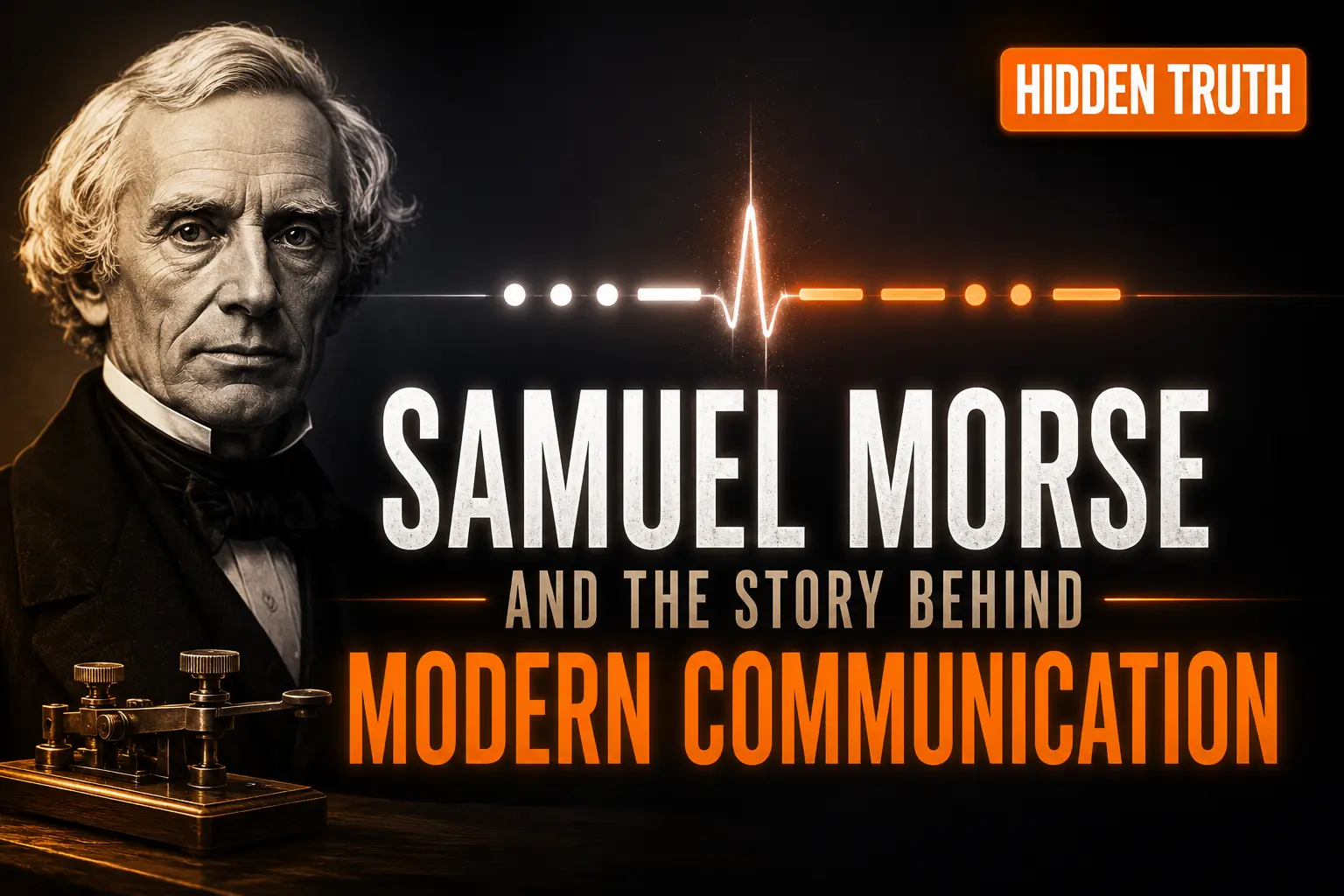
Samuel Morse is one of the most important inventors in communication history. His work transformed the way humans transmit information over great distances and directly contributed to the creation of modern communication systems.
Before his invention, sending messages could take days, weeks, or even months. After his work, communication became dramatically faster using electrical signals.
This is not just about Morse code. It is about the first practical system that made long-distance electrical communication possible.
Quick Facts About Samuel Morse
- Full Name: Samuel Finley Breese Morse
- Date of Birth: April 27, 1791
- Place of Birth: Charlestown, Massachusetts, United States
- Profession: Inventor, Painter
- Known For: Electric Telegraph and Morse Code
- Died: April 2, 1872
Who Was Samuel Morse?
Born in Massachusetts, United States, in 1791, Samuel Morse was an American inventor and artist.
He began his career as a painter and achieved success in portrait painting. However, his life changed when he developed a strong interest in electricity and communication systems.
He later shifted from art to science and communication technology.
He is best known for:
- Inventing the electric telegraph
- Helping develop Morse code
- Transforming global communication systems
The Importance of Samuel Morse in History
Samuel Morse is famous because he solved one of the biggest problems of his time:
How to send messages instantly across long distances.
Before his invention:
- Communication depended on horses, ships, and messengers
- News traveled extremely slowly
- Governments and military faced delayed responses
After his invention:
- Messages could travel through electrical wires
- Communication became almost real-time
- Global connectivity began to develop
His system became the foundation of modern communication networks.
What Did Samuel Morse Actually Invent?
Samuel Morse is mainly associated with two major contributions:
Electric Telegraph
The electric telegraph was a system that transmitted electrical signals through wires over long distances.
Instead of physical transport, messages were sent using electrical pulses.
It became the first practical system for long-distance electrical communication.
Morse Code Communication System
Morse code is a system that converts letters, numbers, and symbols into:
- Short signals (dots)
- Long signals (dashes)
Each character has a unique pattern.
Example:
- A =
.- - B =
-... - S =
... - O =
--- - SOS =
... --- ...
You can explore the full system here: Morse code alphabet chart
Understanding Morse Code (Simple Technical Overview)
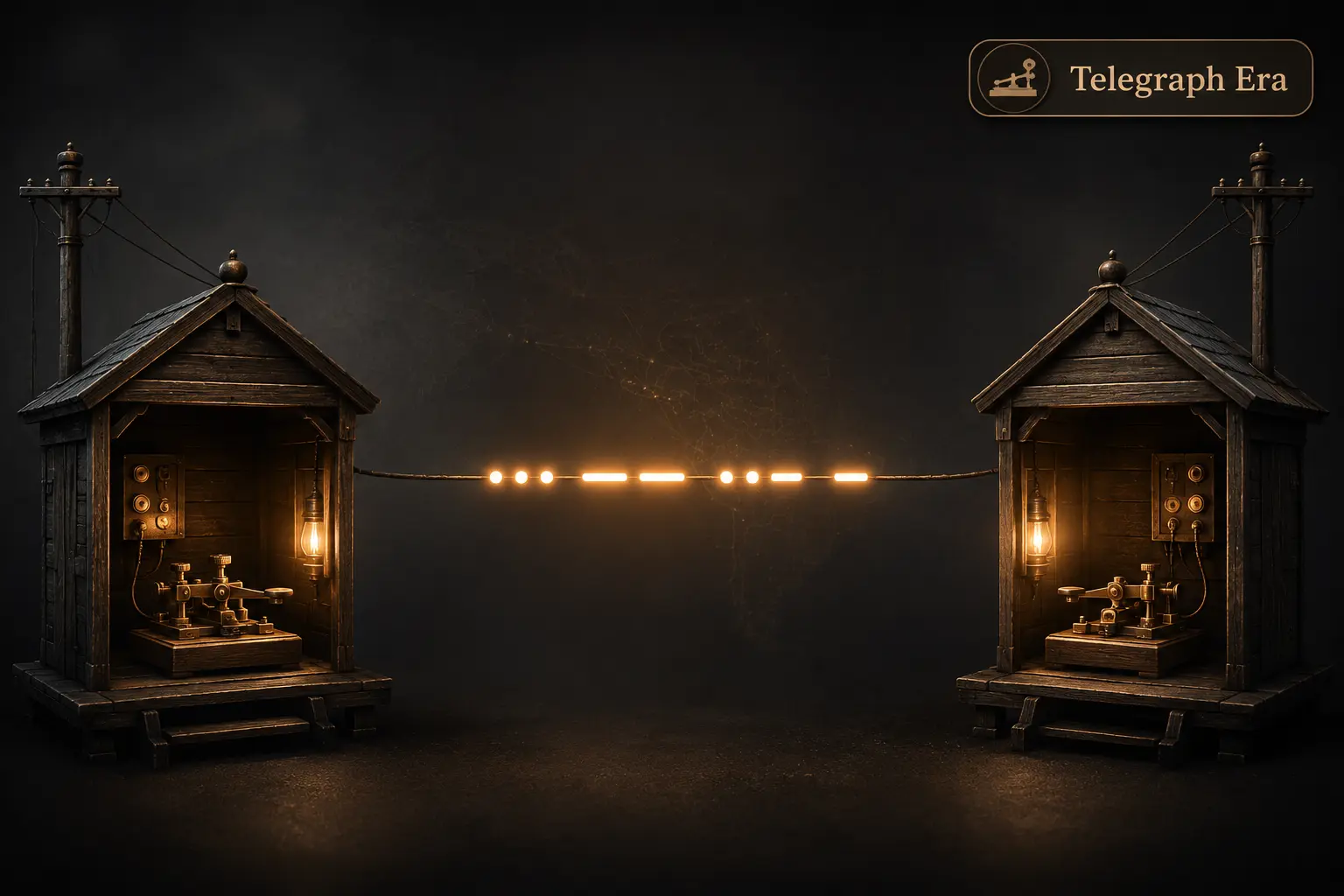
Morse code represents information using time-based signals.
There are three basic elements:
- Dot (short signal)
- Dash (long signal)
- Space (gap between signals)
Each letter is formed using a unique sequence of these signals.
Example breakdown:
- A = dot dash (.-)
- E = dot (.)
- T = dash (-)
This structure makes Morse code:
- Easy to transmit
- Reliable over long distances
- Resistant to signal noise
The First Successful Telegraph Message
The first successful telegraph message was sent in 1844.
The message was:
“What hath God wrought”
It was transmitted from Washington D.C. to Baltimore.
This moment marked:
- The beginning of electronic communication
- Proof that Morse’s system worked
- A major shift in human communication history
How Morse Code Became a Global Standard
After successful testing, Morse code quickly spread worldwide.
It was adopted in:
- Railways (train signaling systems)
- Military communication
- Maritime communication (ships at sea)
- Early aviation communication
Learn more here: History of Morse code
Morse code became one of the earliest global communication standards.
Samuel Morse and Alfred Vail
Although named after Samuel Morse, the system was developed with major contributions from Alfred Vail.
Samuel Morse:
- Designed the communication concept
- Built the telegraph system
- Promoted and patented the invention
Alfred Vail:
- Improved code efficiency
- Refined signal patterns
Together, they created a complete communication system.
Practical Impact of Samuel Morse’s Invention
Samuel Morse’s invention created long-term global changes:
Communication Systems
- Faster message delivery
- Reduced distance barriers
Economy and Trade
- Faster business decisions
- Global trade expansion
Military and Government
- Real-time battlefield communication
- Faster strategic coordination
Transportation Systems
- Railway signal systems
- Maritime safety communication
His work laid the foundation for modern digital communication systems.
Is Morse Code Still Used Today?
Yes, Morse code is still used, but in limited areas.
Modern usage includes:
- Aviation emergency communication
- Military training
- Amateur radio (ham radio)
- Educational learning tools
- Accessibility communication systems
Learn more here: Is Morse code still used today
Why Morse Code Still Matters Today
Even in the digital age, Morse code remains relevant because:
- It works without internet
- It can use sound, light, or radio waves
- It is highly reliable in emergencies
- Basic signals are easy to learn
It is still used as a backup communication system in critical situations.
Related Concepts to Samuel Morse
To fully understand Morse code, these concepts are important:
- Telegraph systems
- Electrical signal transmission
- Time-based encoding
- Signal decoding systems
- Communication protocols
These ideas later influenced modern computing and digital communication systems.
Frequently Asked Questions
Samuel Morse was an American inventor who created the electric telegraph and helped develop Morse code.
He invented the electric telegraph and contributed to Morse code communication.
It was created to transmit fast, electrical long-distance communication.
“What hath God wrought” sent in 1844.
Yes, it is still used in aviation, military, and radio communication.
It was the first system that enabled fast global communication.
Final Summary
Samuel Morse was not just the inventor of a code. He created the foundation of modern communication.
His telegraph system and Morse code made it possible to transmit human thoughts instantly over long distances.
This invention shaped the modern communication world, including telephones, internet messaging, and wireless systems.
Understanding Samuel Morse is understanding the beginning of modern communication itself.
