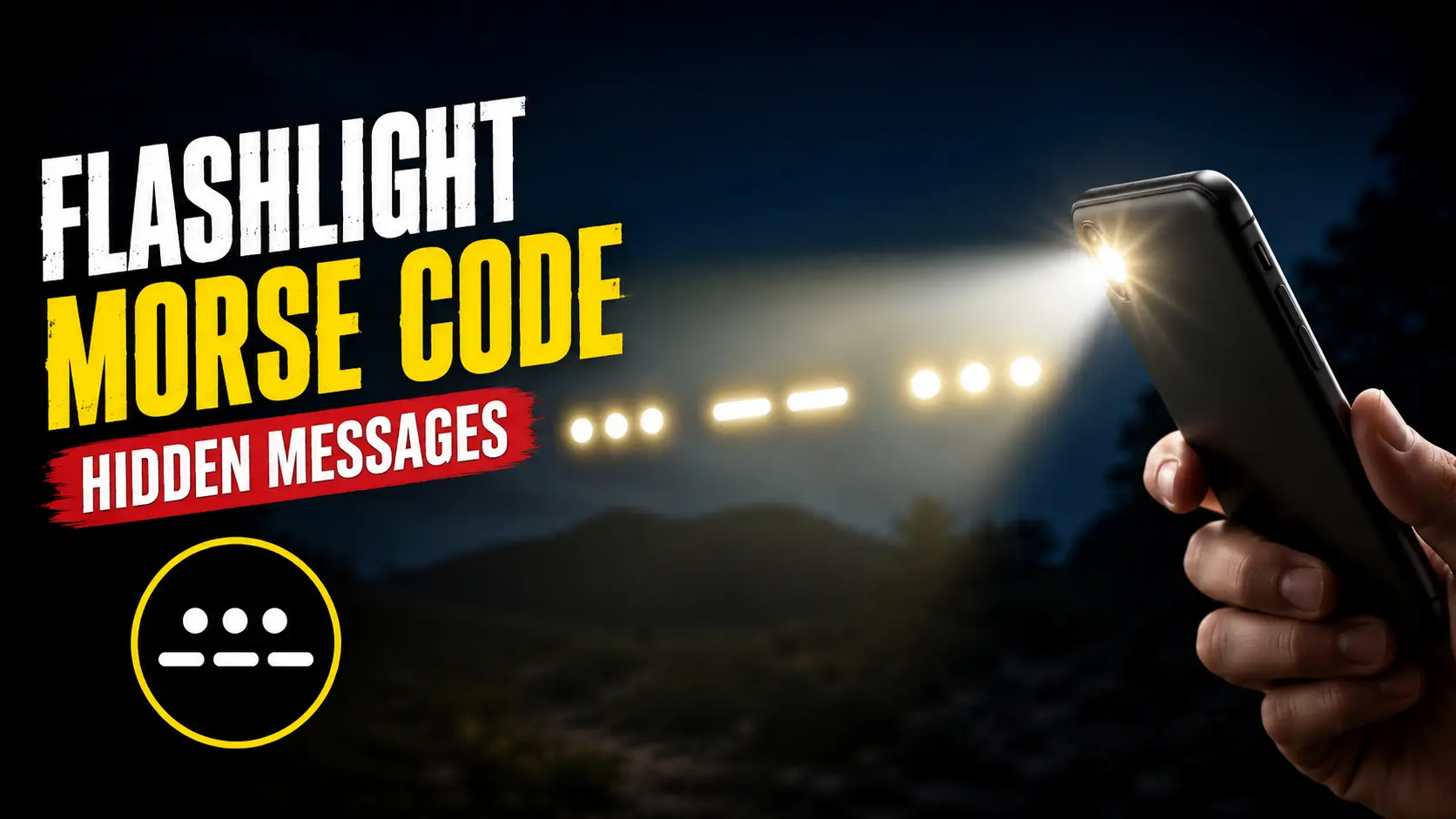
The flashlight Morse code trick enables you to use short and long flashes of light from your phone to communicate hidden messages instantly. In theory, this seems simple. In real-world use, it becomes far more complex due to timing inconsistency, visibility limitations, and human reaction delays.
This page explains not only how it works, but also where it fails, how experienced users actually apply it in practice, and what most beginner tutorials do not explain.
What Is the Flashlight Morse Code Trick?
Morse code represents letters using dots and dashes:
- Dot (•) = short flash
- Dash (—) = long flash
Examples:
- A =
• — - S =
• • • - O =
— — —
A phone flashlight acts as a visual signaling device to transmit these patterns.
Learn the full alphabet here: Morse Code Alphabet
How to Use Flashlight Morse Code on Your Phone
Step-by-step execution:
- Turn on your phone flashlight
- Use timing rules:
- Dot = ~1 second flash
- Dash = ~3 seconds flash
- Pause ~3 seconds between letters
- Pause ~7 seconds between words
Timing reference: Morse Code Timing Rules
Basic Morse Code Reference (Most Used Letters)
| Letter | Code |
|---|---|
| E | • |
| T | — |
| A | • — |
| S | • • • |
| O | — — — |
In real-world usage, communication relies heavily on a small subset of high-frequency letters rather than the full alphabet.
Why Flashlight Morse Code Often Fails in Real Use
In practical environments, perfect Morse transmission rarely works due to real-world constraints:
- Flashlight hardware delay between activation and emission
- Human reaction time inconsistency during manual signaling
- Uneven dash length under stress or urgency
- Bright daylight reducing signal visibility
- Distance causing light dispersion and signal weakening
- Device variation in LED brightness and response behavior
Key technical reality: Morse code is not a precise timing system. It behaves more like a rhythm-based communication pattern that adapts to human execution and environmental conditions.
Myth vs Reality: Flashlight Morse Code Misconceptions
| Myth | Reality |
|---|---|
| You must memorize the entire Morse alphabet first | Only a small subset of characters is commonly used in real communication |
| Timing must be exact | Timing is flexible and context-dependent |
| Apps replace learning Morse code | Apps fail in offline, emergency, or low-power situations |
| Morse code is widely used today | It is mainly used in survival situations, aviation, maritime distress signaling, and hobby communication |
Related examples:
Situations Where Flashlight Morse Code Completely Fails
- Direct sunlight where signals are not visible
- Fog, rain, or dust that scatter light signals
- Long-distance communication where beam dispersion occurs
- Battery-saving mode reducing LED intensity unpredictably
- Device variation causing inconsistent flash strength
Key insight: This method is highly environment-dependent and cannot be treated as a universal communication system.
Adaptive Morse Coding (Advanced Real-World Technique)
Experienced users do not rely on strict timing rules.
Instead, they use adaptive communication strategies:
- Grouping letters into rhythm-based chunks instead of strict timing
- Using only high-frequency letters for faster communication
- Pre-agreed shorthand signals to reduce message length
- Adjusting speed dynamically based on receiver response
- Repeating keywords instead of full message retransmission
Expert insight: Real Morse communication functions as a shared rhythm system between sender and receiver, not a fixed encoding chart.
Decision Tree: When to Use Flashlight Morse Code
Use it when:
- Silent communication is required
- Short-range signaling is needed
- Emergency situations occur without network access
Do NOT use it when:
- Internet messaging is available
- Visibility conditions are poor
- Long or complex messages are required
Better alternatives:
- Messaging apps for normal communication
- Sound-based signals in low visibility environments
- Vibration-based communication for silent alerts
How to Send SOS Using Flashlight Morse Code
The SOS signal is universal:
- S =
• • • - O =
— — — - S =
• • •
This is globally recognized and does not require advanced learning.
Common Mistakes Beginners Make
- Over-focusing on perfect timing accuracy
- Attempting full sentences too early
- Ignoring spacing between letters and words
- Using flashlight in overly bright environments
- Not confirming whether the receiver understood the message
Example Secret Message: HELLO
| Letter | Code |
|---|---|
| H | • • • • |
| E | • |
| L | • — • • |
| L | • — • • |
| O | — — — |
In real-world use, this becomes a rhythmic light pattern rather than strict encoding.
Final Thoughts
The flashlight Morse code trick is more than a novelty communication method. It combines historical signaling systems, survival communication principles, and human rhythm-based encoding behavior.
To use it effectively, you must understand:
- It is not mechanically precise
- It is highly environment-dependent
- It works best for simple structured messages
When applied correctly, it becomes a surprisingly effective low-tech secret communication system.
Frequently Asked Questions
Yes, but success depends on timing, environment, and receiver understanding.
Yes, mainly in aviation, maritime distress signals, survival training, and hobby communication.
It fails due to timing inconsistency, brightness issues, and environmental interference.
No, it can be done manually, but apps can help with learning and practice.
